
Vandaag of morgen in huis

Kwaliteit gegarandeerd

Welkomstaanbiedingen ontgrendelen: GRATIS bezorging | Tot 80% korting | Gratis 30 dagen JoyPlus-proefperiode
Download de app
Good outdoor lighting needs to suit the location, the weather and how you plan to use it. A light for a covered balcony has different requirements from a ground spotlight alongside a driveway. Yet many people choose mainly based on appearance or light colour. As a result, they may later find that the light is too fragile, difficult to install or less practical than expected.
IP44 outdoor lighting is protected against splashes, but not automatically against heavy rain, water jets or immersion. An IP44 wall light is therefore best suited to a sheltered wall, veranda or covered patio. Always check whether the manufacturer advises against direct exposure to rain or high-pressure water.
Some models come with the fitting only. For example, the Brilliant Jelani, Keola and Newport wall lights have a GU10 or E27 fitting, but the product information states that they are supplied without a light source. So remember to include a suitable LED bulb in your budget. Check the maximum wattage too: this helps prevent overloading and unnecessary heat build-up.
An outdoor light with a sensor is useful by an entrance or shed, but its position determines how reliably it detects movement. A sensor aimed at a busy path or public road may switch on more often than you’d like.
With solar garden lighting, how long it stays on depends on receiving enough daylight. Shade from a fence, tree or wall limits charging. The light may also stay on for less time in winter. So look beyond the advertised run time and check the battery type, charging time and position of the solar panel.
IP44 may be suitable for a sheltered outdoor location. Don’t install an IP44 outdoor light somewhere water can collect on the fitting or where it will regularly be sprayed with a garden hose. For an exposed wall or a location with heavy rainfall, it’s worth considering a higher level of protection.
For atmospheric garden lighting, a warmer colour temperature is often more pleasant. For a driveway, back door or dark passage, a more functional level of brightness may be more useful.
A fixed 230 V wall light must be connected by a qualified electrician, according to the product information. Check where the power cable runs and whether the wall can support the weight before you start. A battery-powered or USB model is more flexible, but needs to be recharged regularly.
An outdoor string light powered by batteries is handy for temporary decorations. For example, the Aigostar String Lights are 5 metres long and have 200 LED bulbs, eight lighting modes, a timer and a memory function. The IP44 rating makes them suitable for outdoor use, but the battery box must still be protected from direct exposure to water.
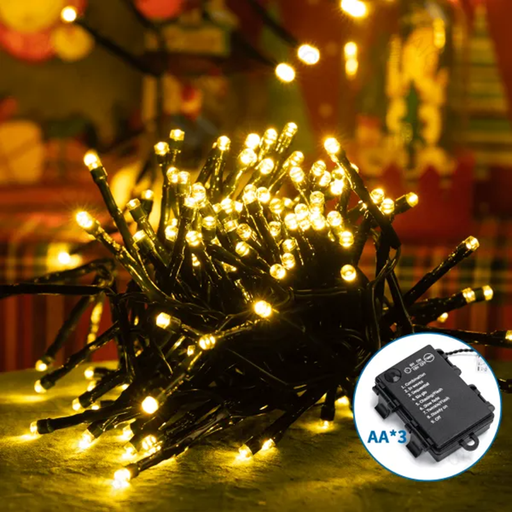
Why it suits this need: This battery-powered string light is ideal for a balcony, table, pergola or temporarily decorated patio without a fixed power connection.
The length, number of LEDs, timer and eight lighting modes are all clearly stated. However, the IP44 rating doesn’t mean the battery box can be exposed to direct water jets.
5-metre length, 200 LED bulbs, timer, memory function and powered by 3 AA batteries.
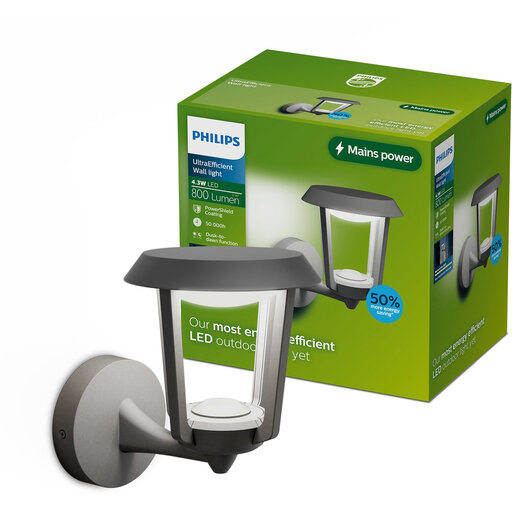
Why it suits this need: This fixed wall light is ideal for a wall, balcony or entrance where you want automatic switching and a fixed power connection.
The integrated LED means there’s no need to buy a separate bulb. However, IP44 means protection against splashes, not direct water jets.
800 lumens, warm white light at 2700 K, an integrated LED and a dusk sensor, according to the product information.
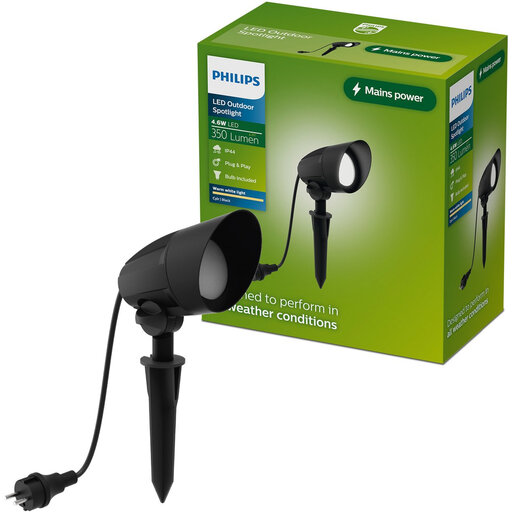
Why it suits this need: This ground spotlight is designed to illuminate a shrub, tree, gate or driveway without needing to be mounted on a wall.
The GU10 light source is included, so you won’t accidentally buy a fitting without a bulb. However, installation requires a suitable outdoor power point and a stable surface.
350 lumens, 2700 K, 4,6 W, a 1.5-metre cable and a swivelling design, according to the product information.
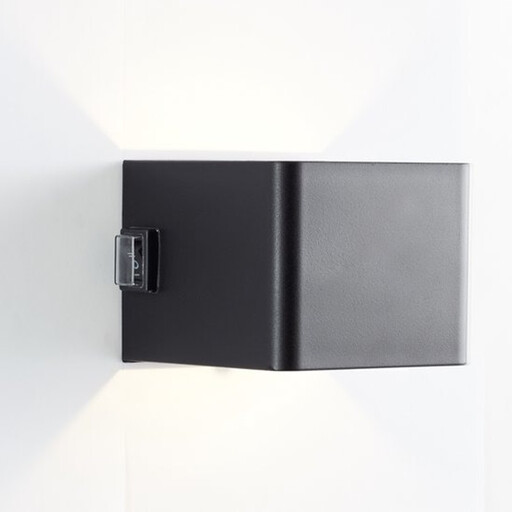
Why it suits this need: The magnetic mounting and rechargeable battery are handy for renters or places without fixed wiring.
There’s no need for a fixed connection. Do check that the mounting plate is secure: the light attaches magnetically, and IP44 doesn’t mean waterproof.
Rechargeable battery, USB-C, motion sensor, 300 lumens according to the specifications table, and warm white light at 3000 K.
We’ve put together a complete, up-to-date list of products that meet these strict selection criteria and the applicable European safety regulations.
Yes, IP44 outdoor lighting is designed for locations where the light needs to withstand splashes. This rating is best suited to sheltered locations. Avoid direct water jets, immersion and prolonged exposure to heavy rain.
Energy use depends on the wattage and how many hours the light is on. A 5-watt light that runs for five hours a day uses less electricity than a 20-watt model under the same conditions. A sensor or timer can reduce the number of hours it’s on. For a fair comparison, check the wattage, light output in lumens and expected usage time.
Lifespan varies depending on the light source and the conditions it’s used in. Product information may state an LED lifespan of 15,000 or 50,000 hours, for example, but this doesn’t guarantee the total lifespan of the fitting. Regularly removing dust, installing the light correctly and protecting it from water can help keep it working for longer.
