
Vandaag of morgen in huis

Kwaliteit gegarandeerd

Welkomstaanbiedingen ontgrendelen: GRATIS bezorging | Tot 80% korting | Gratis 30 dagen JoyPlus-proefperiode
Download de app
Good outdoor lighting makes an entrance, patio, balcony or garden more usable after dark. Yet many people choose an outdoor light based on its appearance or a bold product claim. Later, they find it’s too dim, the bulb isn’t included or its protection isn’t suitable for where it’s being installed.
So, look out for these three common pitfalls:
For many sheltered walls, balconies and gardens, an IP44 outdoor light is a practical choice. The first 4 means protection against solid particles larger than 1 millimetre; the second 4 indicates protection against splashing water from different directions.
Where possible, install an IP44 light in a position where water won’t collect on it. Conditions under a canopy differ from those for a light exposed directly to wind-driven rain. Always check the manufacturer’s installation instructions.
A warm colour temperature of around 2700K usually gives a soft, yellowish glow. It’s well suited to mood lighting in a garden, on a patio or by an entrance. Cooler light, such as 6500K on some solar garden lights, looks whiter and creates more contrast.
Also consider:
Check whether a bulb is included, too. The Brilliant wall lights with E27 fittings and various Philips Fylx models are supplied without a light source, according to their product specifications.
A plug-in outdoor ground spotlight is suitable if you have an outdoor socket nearby. For example, according to its product details, the Philips Cylr has a 150 cm cable and a GU10 LED spotlight. For fixed 230-volt wall lighting, installation by a qualified electrician is advisable and may sometimes be necessary.
An outdoor light with a motion sensor can save energy by switching on only when it detects movement. Don’t position the sensor directly opposite a busy road or somewhere branches are constantly moving. For solar lighting, location is especially important: choose a spot where the panel gets enough sunlight during the day.

Why it suits this profile: These spike lights work without fixed wiring and are designed for paths, borders and lawns. That makes them easy to install if you’re just getting started with garden lighting.
The product specifications state that it has an IP44 rating, a NiMH battery and a charging time of 4 to 6 hours. It still needs to be placed in a suitably sunny spot to work.
Stainless-steel housing, ground stake and solar panel; ideal for decorative path lighting without a cable running to a socket.
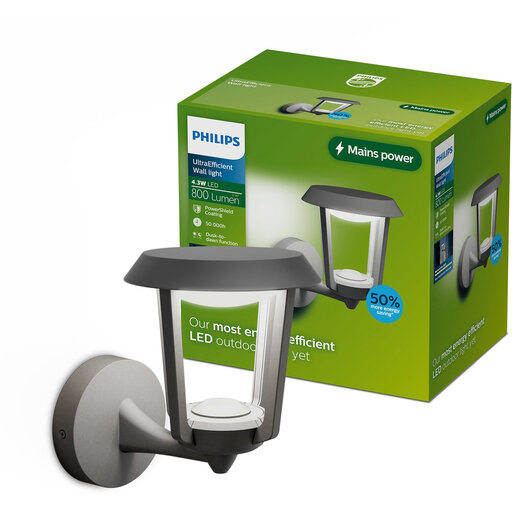
Why it suits this profile: The Nuvy is a fixed wall light for a wall, balcony or garden. According to the product description, it combines an integrated LED light source with an aluminium housing and PowerShield coating.
There’s no need to order a separate E27 or GU10 bulb. The specifications list an IP44 rating, 800 lumens, 2700K and an integrated LED.
Warm white light, 800 lumens and a compact wall-mounted design; Philips gives the LED’s stated lifespan as 50,000 hours.
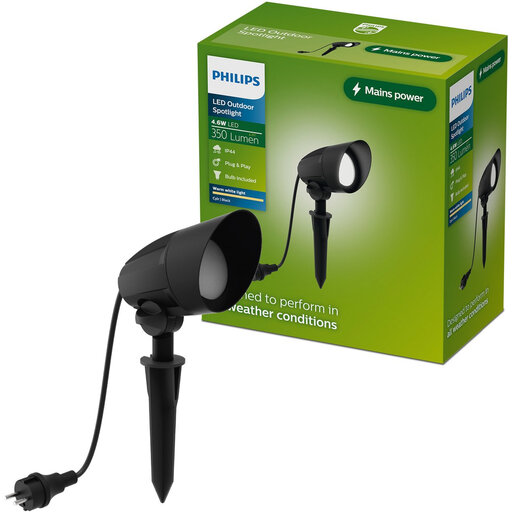
Why it suits this profile: This adjustable ground spotlight is designed for driveways, gates and lawns, and for lighting up a tree or shrub. Its stake fitting is handy if you want to change the direction of the light regularly.
The GU10 LED spotlight is included, according to the product specifications. The IP44 rating doesn’t mean you can expose it to direct jets of water or submerge it.
350 lumens, 2700K, 4.6 watts and a 150 cm cable; aluminium and glass construction with an adjustable spotlight head.
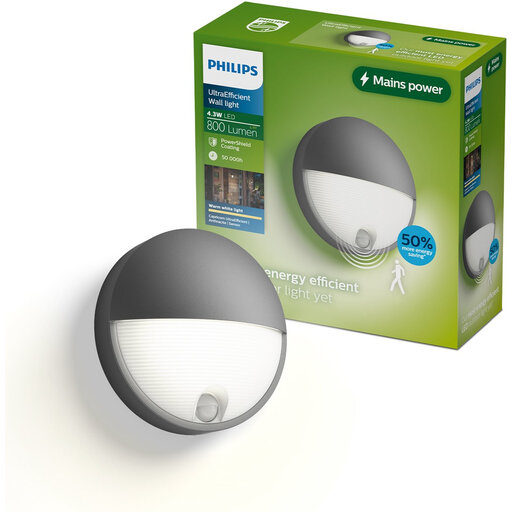
Why it suits this profile: This wall light is designed for an entrance, exterior wall or balcony where you want the light to come on as someone approaches. The product specifications list motion and dusk sensors.
The built-in light source means there’s no risk of choosing the wrong bulb. Positioning still matters: a sensor won’t necessarily work optimally on every wall or driveway.
800 lumens, 2700K, 4.3 watts and an IP44 rating; the product information states that it has an integrated LED light source.
We’ve put together a complete, up-to-date list of products that meet these strict selection criteria and current European safety regulations.
IP44 is suitable for many sheltered locations, such as an exterior wall, balcony, covered area or entrance. The rating means protection against splashing water; it doesn’t mean the light is waterproof or suitable for submersion. Install the fitting according to the instructions and avoid exposing it to direct jets of water.
It depends on the wattage, how many hours it’s on and the power source you choose. An LED bulb rated at 4.3 watts uses less energy when left on for eight hours a day than a traditional 60-watt bulb. A motion-sensor light won’t be on all the time, either. Be sure to check the sensor settings and actual usage time.
Solar garden lights can stay outdoors all year if their product specifications allow it, but how long they stay lit will vary. Less sunlight, shade, dirt on the panel and low temperatures all affect charging performance. Clean the solar panel regularly and don’t place the light under a dense tree or covered area.
