
Vandaag of morgen in huis

Kwaliteit gegarandeerd

Welkomstaanbiedingen ontgrendelen: GRATIS bezorging | Tot 80% korting | Gratis 30 dagen JoyPlus-proefperiode
Download de app
Good outdoor lighting makes an entrance, patio or garden more useful after dark. Yet many buyers focus mainly on the number of LEDs, the light colour or a low price. This can lead to problems: a lamp gives off less light than expected, a solar outdoor light doesn’t charge sufficiently, or a fitting turns out to be unsuitable for the place where you want to install it.
Use this guide to compare garden lighting, outdoor lights and solar lighting based on verifiable specifications. That way, you can choose the right option for ambient lighting, path lighting or practical lighting around your home.
A large number of LEDs or a high lumen count sounds appealing, but it doesn’t automatically tell you how evenly the light will be spread. A narrow beam, for example, can be bright in one spot while leaving a driveway or patio inadequately lit. So also check the beam angle, the number of light sources and where the lamp will be positioned.
IP44 outdoor lighting is protected against splashing water and solid objects of a certain size. This makes a fitting suitable for many sheltered locations, such as under a canopy or next to a wall. However, IP44 doesn’t mean the lamp can be exposed to a direct jet of water or submerged.
For a more exposed location, IP65 outdoor lighting is generally more practical. The stated IP rating still depends on the product and installation. Always check the installation instructions and don’t use a fitting outside the applications specified.
A solar garden light relies on sunlight. In winter, in cloudy weather or when a panel is heavily shaded, it may not stay lit for as long. So consider where the panel will be positioned, the stated charging time and the battery capacity. A solar lantern or solar path light is convenient without a cable, but don’t expect the same consistent lighting duration as with a mains-powered light.
For decorative lighting, a warm colour temperature and modest light output are often pleasant. Think of a solar lantern, outdoor string lights or small garden lights along a flower bed. For a driveway, garage or back door, lumens, detection range and coverage angle are more important.
An outdoor light with a motion sensor can be a good choice for a back door or garage. If you want to avoid it switching on unnecessarily, don’t position the sensor directly opposite a busy road.
Choose the level of protection based on exposure to rain and splashing water:
An outdoor wall light with IP44 can work well under a canopy. A fitting with IP65 offers more flexibility for installation on an exposed wall, but also check the cable entry, mounting and manufacturer’s instructions.
Solar outdoor lighting works without a permanent power cable, but needs direct or indirect sunlight. For mains-powered lighting, such as an outdoor wall light or outdoor ground spotlight, the connection must be suitable for outdoor use. Have fixed electrical installations carried out by a qualified installer.
Also check:
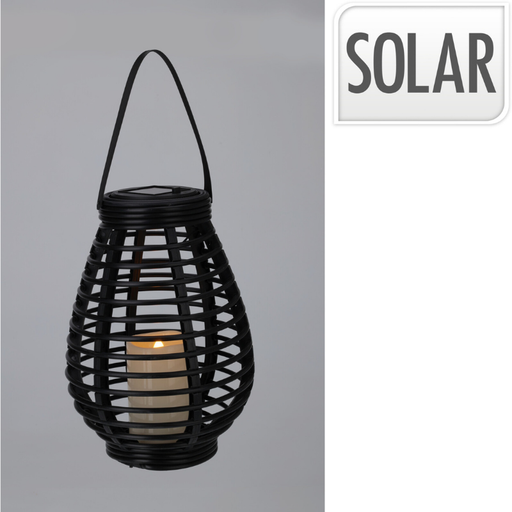
Why it suits this need: This compact solar lantern works without a cable and is designed to cast a soft glow on a patio, balcony or garden path.
The product description lists an integrated solar panel, a 1.2V AA Ni-MH battery and an on/off switch. Its light output is designed to create ambience, not to illuminate a large area.
Cord-free positioning, warm yellow light and dimensions of 18 × 18 × 26 cm.
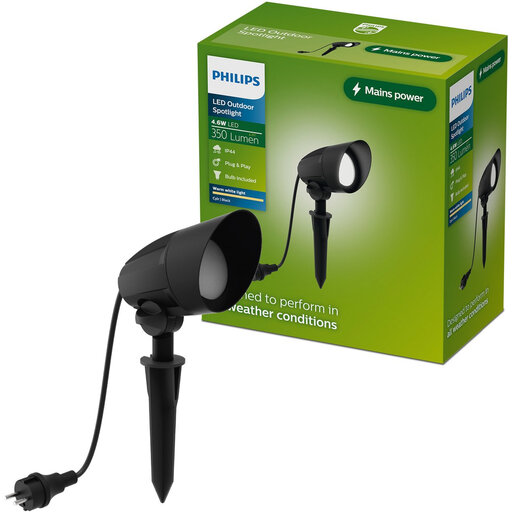
Why it suits this need: A fixed outdoor ground spotlight is a good choice if you want to highlight trees, shrubs, a driveway or a wall, with a light source included.
The specifications list a GU10 LED bulb, 350 lumens and a colour temperature of 2700K. The IP44 rating means it needs to be positioned away from direct jets of water.
Adjustable spotlight, aluminium and glass construction, 230V connection and an included GU10 LED bulb.

Why it suits this need: This solar outdoor light is designed for larger areas such as a garage, driveway, garden or patio, where motion detection and wide coverage are useful.
The stated specifications include a detection range of 60 feet, a 180-degree angle, three lighting modes and IP65 protection. Before installation, check that the solar panel will receive enough direct sunlight.
302 LEDs, a stated output of 3000 lumens, three adjustable heads and a 1800 mAh lithium-ion battery.
We’ve put together a complete, up-to-date list of products that meet these strict selection criteria and the applicable European safety regulations.
For a driveway, a wide spread of light, sufficient lumens and, where useful, a motion sensor are practical features. A lamp with multiple light heads can cover a larger area. With solar models, check that the panel won’t be shaded by a wall, tree or fence.
How long it stays lit depends on sunlight, battery capacity, temperature and how the lamp is used. Manufacturers sometimes state a maximum lighting time, but the actual duration can vary from season to season. Keep the solar panel clean and position it in as open a spot as possible, facing the daylight.
LED outdoor lights generally use less power than traditional light sources with a similar light output. With solar lighting, the energy comes from a charged battery. For mains-powered lights, consumption depends on the wattage and the number of hours they are on. A timer or motion sensor can help reduce unnecessary lighting hours.
