
Vandaag of morgen in huis

Kwaliteit gegarandeerd

Welkomstaanbiedingen ontgrendelen: GRATIS bezorging | Tot 80% korting | Gratis 30 dagen JoyPlus-proefperiode
Download de app
Good outdoor lighting needs to suit the location, the purpose and the British weather. A lamp for a garden path requires different features to an outdoor wall light by the front door. Yet many shoppers focus mainly on appearance and light colour. This leads to problems: a solar light doesn’t get enough sun, an IP44 outdoor light is placed on an exposed wall, or a sensor light reacts to every movement.
This buying guide helps you compare with confidence. You’ll learn what to look for in garden lighting, which specifications make a real difference, and which models suit different situations.
Lumens indicate how much light a lamp emits according to the product specification. A high value isn’t automatically right for every spot. For ambient garden lighting, 180 to 400 lumens can be enough, whereas a driveway or a dark back garden needs more focused illumination.
Also pay attention to light distribution. A path light that directs light downwards illuminates the walkway without you looking directly into the light source. A wide floodlight with multiple heads works better for a driveway or large patio.
The IP rating describes protection against solid objects and water. IP44 means protection against splashing water; this is generally suitable for a covered entrance, balcony or sheltered exterior wall. IP44 does not mean a light is waterproof or suitable for submersion.
IP54 offers extra protection against dust, while IP65 indicates protection against dust and water jets according to the relevant classification. Always install a light according to the product instructions. Even an IP65 outdoor light needs correct installation, especially at connections and cable entries.
A solar wall light or solar garden light needs direct daylight to charge the built-in battery. Shade from a canopy, tree or tall fence can limit the running time. According to the product description of the Huacan lights, the charging time in sunlight is 4 to 6 hours and the stated burn time is 5 to 8 hours. This is a product specification under the stated conditions, not a fixed guarantee for every garden or season.
An integrated LED outdoor light is compact and usually requires little maintenance, as you don’t need to replace a separate bulb. With a light that has a GU10 or E27 fitting, you choose the bulb yourself. Then check the maximum wattage and whether the desired LED bulb fits.
An outdoor light with a sensor can be practical by a front door or garage. Check the detection angle, detection distance and adjustable modes. The UME solar outdoor light, for example, states a detection distance of 60 feet, an angle of 180 degrees and three lighting modes. Use these figures as a comparison point and always check that the mounting height matches your situation.
Choose between mains power, solar or a rechargeable battery:
Check the accessories included. A path light with a ground spike is easy to install, while a fixed outdoor wall light requires fixing materials and sometimes an electrical connection.
Aluminium, plastic and polycarbonate are common materials for outdoor lighting. Don’t just look at the material, but also at the placement and sealing. Clean solar panels and sensor windows regularly with a soft, dry or slightly damp cloth according to the instructions. With outdoor light strings, make sure connections are not lying in standing water.
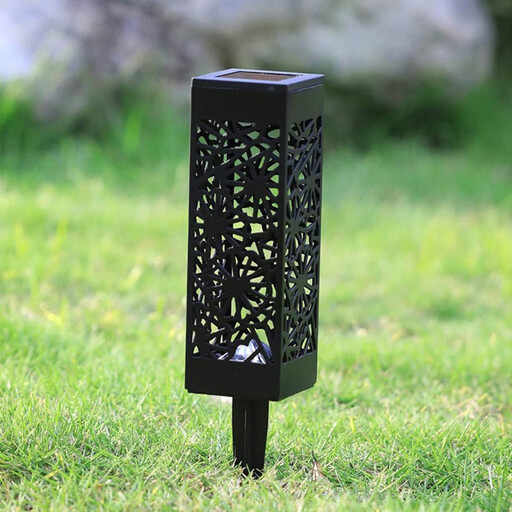
Why this fits the profile: This set is designed for anyone who wants to light up garden paths, borders or a balcony without cables. The six lights can be placed individually in the ground.
The specification states IP65, automatic on/off switching and a recommended placement with sufficient sunlight. This lets you know in advance when solar lighting is suitable.
Six pieces per set, warm white LED, ground spike installation and a stated running time of 5 to 8 hours after a full charge.

Why this fits the profile: A practical choice for anyone looking for a solar wall light by the entrance, shed or patio, with two modes and a motion sensor.
The product information explicitly mentions IP44, direct sunlight, a daylight sensor and a motion sensor. This makes the placement requirements clear.
400 lumens per light point, warm white light at 2700K, two light modes and an integrated LED.

Why this fits the profile: The three adjustable heads are designed for broad illumination of a driveway, garage, patio or larger garden area.
The product description mentions IP65, three modes, a detection angle of 180 degrees and a range of 60 feet. Check before purchase whether these values suit your installation spot.
302 LEDs, a stated light output of 3000 lumens, three heads and installation without fixed wiring.
For a modern garden path, the vidaXL LED Outdoor Lamp - Oval, Black could be of interest. This path light has an aluminium housing, integrated LED, 550 lumens, 9 watts and IP54 protection. According to the product description, the light shines downwards.
If you mainly want ambience on a patio or balcony, look at an outdoor light string. The VIVREAL G40 string is 30 metres long, has 50 plus 2 LEDs, replaceable bulbs and a timer function. The stated IP rating is not mentioned in the product information provided; therefore, place connections in a sheltered spot away from standing water.
With a fixed outdoor wall light with a GU10 or E27 fitting, you choose the bulb yourself. The Philips Fylx has a GU10 fitting and IP44 rating. The Brilliant Newport uses an E27 fitting and is also IP44. Both are supplied without a bulb according to the product information. A fixed connection requires installation in line with local regulations.
We’ve put together a full, up-to-date list of products that fully meet these strict selection criteria and comply with current European safety regulations.
IP44 is designed for protection against splashing water and can be suitable for sheltered outdoor locations, such as a covered entrance or balcony. Always check the installation instructions. For a completely exposed spot, a higher IP rating may be more appropriate.
The running time per evening depends on sunlight, battery capacity, temperature, light mode and the age of the battery. Manufacturers often state a burn time under certain conditions. Place the panel free from shade and keep it clean for the most predictable results.
LED lights generally use little power relative to their light output. The actual consumption depends on the wattage and the number of hours of use. A sensor, timer or solar power supply can help to limit the burn time and electricity consumption.
