
Vandaag of morgen in huis

Kwaliteit gegarandeerd

Welkomstaanbiedingen ontgrendelen: GRATIS bezorging | Tot 80% korting | Gratis 30 dagen JoyPlus-proefperiode
Download de app
Good outdoor lighting needs to do more than look attractive in a product photo. In a Dutch garden, a light has to cope with rain, wind, damp ground and limited hours of sunshine in winter. Yet many shoppers focus mainly on design or the number of LEDs. The result can be disappointing light output, a solar light that runs out of charge quickly or a wall light that isn’t suitable for its intended location.
Use this guide to compare solar garden lights, LED outdoor lights, garden path lights and electric lights based on verifiable features.
The number of LEDs doesn’t automatically tell you how much light a lamp produces. It’s better to check the lumens. A decorative solar garden light producing 10 lumens per light gives a soft marker along a path. A driveway or entrance will generally need more light. Check the colour temperature too: 2700K to 3000K gives a warm glow, while 7000K looks much cooler and whiter.
IP65 waterproof outdoor lighting is dust-tight and protected against water jets. That doesn’t mean the light can be placed underwater. An IP44 outdoor light is protected against splashing water and solid objects, but is best suited to a sheltered wall, veranda or covered area.
So don’t place an IP44 wall light where rain will continually hit the fitting directly. Always check the installation instructions too, and have a qualified installer carry out any fixed 230V connection.
Solar garden lights only charge well when the panel gets enough direct daylight. Shade from a fence, tree or building will shorten the time the light stays on. Check the stated charging time, operating time and battery capacity. These figures are generally based on favourable conditions and may be lower in winter.
Start with how you plan to use the light:
Consider the beam angle too. An adjustable outdoor ground spotlight can highlight a tree or architectural detail, while a wall light with a diffused shade casts a softer light over a wider area.
Check the full product details, not just the title. Aluminium, ABS, plastic and glass each have different properties. A metal housing may feel sturdy, while plastic is often lighter and easier to install.
For solar garden lights, the seal, solar panel and battery position matter too. Make sure ground lights are firmly installed to reduce the risk of tripping. Clean solar panels and sensors regularly with a soft, slightly damp cloth.
Solar garden lights are usually easy to install using a ground stake. An electric wall light needs a fixed connection and professional installation. An outdoor light with a sensor can be useful by an entrance or garage, but check the detection angle, range and available lighting modes.
For RGB models, important buying considerations include Bluetooth control, the ability to connect multiple devices and cable length. Also check that both the light and solar panel can be fitted in a suitable position.
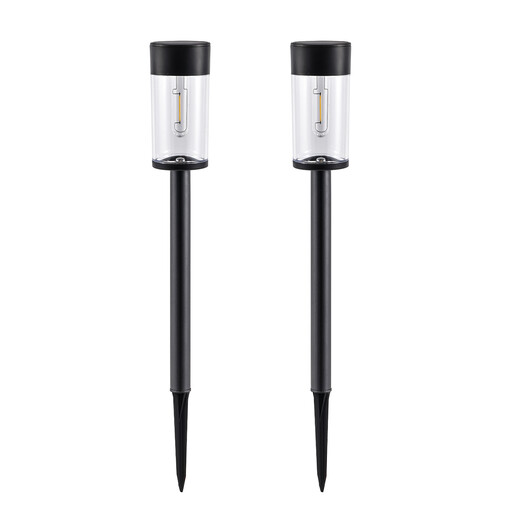
Why it suits this need: This set is designed to provide simple garden path lighting without wiring. According to the product description, each light produces 10 lumens of warm 3000K light, and the built-in sensor switches on automatically at dusk.
The light output and IP65 rating are clearly stated. Don’t expect powerful driveway lighting: these specifications are best suited to marking a path and creating atmosphere.
Solar-powered, with automatic on/off, ground installation and a stated running time of 8 to 12 hours in suitable conditions.
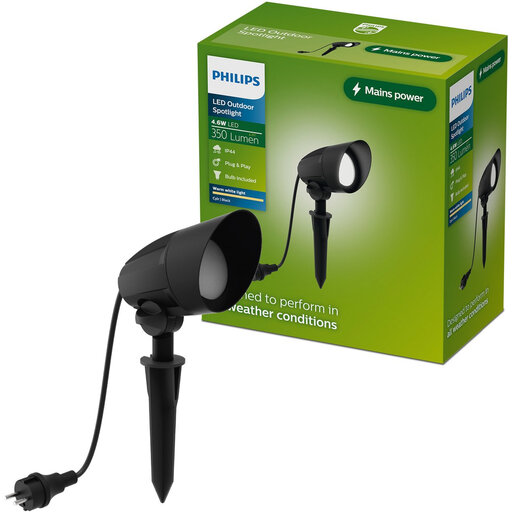
Why it suits this need: This plug-in ground spotlight is ideal if you want a permanent, directional light source near a tree, gate, driveway or flower bed. The supplied GU10 LED bulb is rated at 350 lumens and 2700K.
The light source, colour temperature, cable and IP44 rating are all specified. Don’t place the light in water or somewhere exposed to powerful water jets.
Adjustable ground spotlight, supplied with a 4,6 W GU10 LED bulb, and connects via an outdoor socket.

Why it suits this need: For a garage, patio, driveway or larger garden area, this model offers three lighting modes, three adjustable heads and a motion sensor with a range of 60 feet and a 180-degree angle, according to the product description.
The sensor, lighting modes, IP65 rating and stated light output of 3000 lumens are listed separately. The stated colour temperature is 7000K, giving a cool white light.
Solar-powered, with adjustable light heads, motion detection and broad coverage for larger outdoor spaces.
We’ve put together a complete, up-to-date list of products that meet these strict selection criteria and comply with current European safety regulations.
They can be, but shorter days, cloudy weather and shade can reduce how long they stay lit. Position the panel in as open a spot as possible, facing south, or somewhere else with plenty of direct daylight. Clean the panel regularly and check that the on/off switch is in the correct position before first use.
Lifespan depends on the light source, battery, housing, installation and weather conditions. If the light uses a replaceable GU10 or E27 bulb, you can change the bulb. Integrated LEDs often can’t be replaced. Check the stated lifespan, warranty and availability of replacement parts before you buy.
This mainly depends on its wattage and how many hours it’s on. A 4,6 W light used for a few hours each evening uses considerably less energy than a 60 W light. A motion sensor or timer can reduce the time it stays on. Solar garden lights don’t use mains electricity while in use, but the battery and solar panel still determine how well they work in practice.
