
Vandaag of morgen in huis

Kwaliteit gegarandeerd

Welkomstaanbiedingen ontgrendelen: GRATIS bezorging | Tot 80% korting | Gratis 30 dagen JoyPlus-proefperiode
Download de app
Good outdoor lighting needs to do more than just look attractive. An outdoor lamp must be suitable for where you intend to use it, provide enough light and withstand the elements. Yet many shoppers focus mainly on colour and shape. This leads to problems such as a lamp that doesn't give enough light, a sensor that reacts awkwardly, or a fitting that isn't suitable for direct rain.
An IP44 outdoor lamp is protected against solid objects larger than 1 millimetre and splashing water. That doesn't mean the lamp is suitable for submersion, a direct water jet or any completely exposed location.
An IP54 outdoor lamp also offers higher protection against dust. IP65 outdoor lighting is better protected against dust and water jets. Still, check the installation instructions: the IP rating applies to the product as a whole and not automatically to a plug, cable connection or wall socket.
Wattage mainly tells you about energy consumption, not directly about the amount of light. So look at lumens instead. An LED outdoor lamp of 4.3 watts can, for example, deliver 800 lumens, while another lamp with a similar wattage gives less light.
For ambience on a balcony or patio, warm white light around 2700K is often pleasant. For a driveway or entrance, a higher light output may be more important. A colour temperature of 6500K to 7000K looks noticeably cooler than warm white light and doesn't suit every garden or facade.
An outdoor lamp with a sensor is handy by a front door, garage or driveway, but the placement determines how well the sensor works. A sensor aimed at a busy pavement or moving branches can switch on more often than desired.
A solar outdoor lamp doesn't need a fixed mains connection, but its performance depends on the amount of direct sunlight, the season and the battery capacity. So don't place the solar panel under a canopy or in the shade of a tall fence if you expect a longer burn time.
Check whether the light source is included and whether it is replaceable. With a GU10 or E27 fitting, you choose a suitable LED lamp yourself. This gives you flexibility in light colour and brightness, but you may need to buy the light source separately.
An integrated LED is more compact and ready to use straight away. In that case, pay attention to the stated light output, colour temperature and any lifespan. Claims about lifespan or energy efficiency are product information from the brand; the actual service life depends on factors such as use, temperature and installation.
Use IP44 mainly in places sheltered from direct water jets, such as a covered balcony or a protected facade. For an open driveway, garden path or a spot more exposed to rain, a higher protection level can be more practical.
A weather-resistant outdoor lamp is not automatically resistant to all conditions. Also check the material, the fixing and the cable. Aluminium, plastic and stainless steel can have different maintenance requirements.
Measure the available space before ordering a wall light or ground spot. A freestanding garden lamp of 108 centimetres, for example, can be too tall for a narrow balcony, while a compact wall light takes up hardly any room.
Also pay attention to the mounting type:
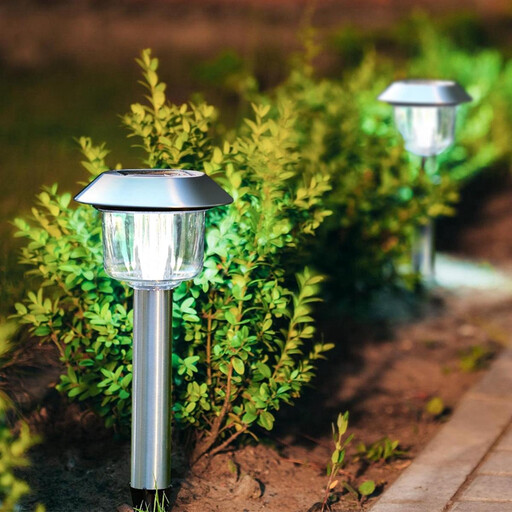
Why this fits the profile: This compact solar outdoor lamp is ideal for anyone who wants simple garden lighting along a border, patio or balcony without cables. The lamp has a height of 36.6 cm and runs on solar power.
The product details clearly state the power supply and dimensions. Do bear in mind the influence of sunlight on the burn time.
Solar power, stainless steel and a compact size for decorative lighting.
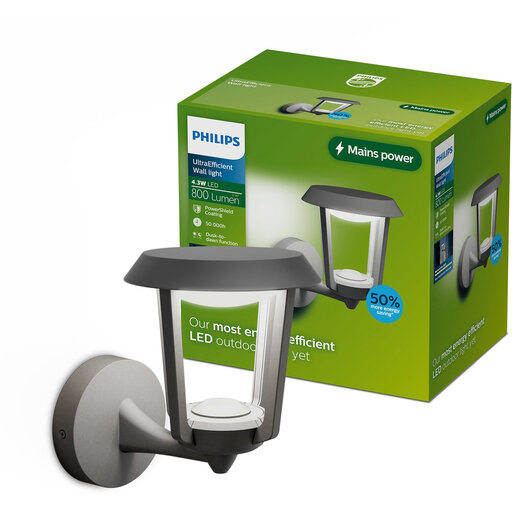
Why this fits the profile: This outdoor wall light suits an entrance, facade, garden or balcony where fixed lighting with warm white light is desired. The product information states integrated LED, 800 lumens, 2700K and an IP44 rating.
The light colour and light output are specified, so you don't have to rely on appearance alone. IP44 does mean that direct water jets should be avoided.
Integrated LED, 800 lumens, warm white light at 2700K and a built-in dusk sensor according to the product description.

Why this fits the profile: This solar outdoor lamp is aimed at a driveway, garage, yard or larger patio where motion detection and a wide light distribution are important. The lamp has three adjustable heads and a stated IP65 protection rating.
The detection angle, detection distance and three light modes are stated in the product details. Place the panel free of shade for a better chance of regular charging.
IP65, solar power, motion sensor and three adjustable light heads for wide coverage.
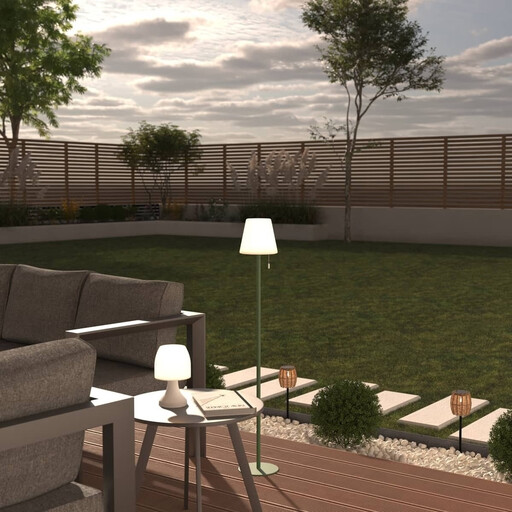
Why this fits the profile: This portable lamp is designed for a patio or balcony where ambience and flexibility are key. The lamp runs on battery, has a stated run time of up to ten hours and offers three light modes.
The lamp doesn't need a fixed connection and the three modes are specified in advance. With IP44, protection against splashing water is present, but placing it in a sheltered spot remains sensible.
108 cm tall, battery powered, plastic shade for outdoor use and a choice of multicolour, flame effect and white light.
First, decide whether you mainly need functional lighting, mood lighting or both. For an entrance, a wall light with a sensor or a fixed LED outdoor lamp often makes sense. For a border or garden path, solar-powered path lighting may suffice. A ground spot is more suitable when you want to accentuate a tree, facade detail or plant border.
Then check the IP rating, light source, dimensions and installation. With fixed 230V connections, you must switch off the power and have the installation carried out in accordance with the applicable regulations. A certified electrician can assess whether the connection is safely suitable for outdoor use.
We've put together a full, up-to-date list of products that fully meet these strict selection criteria and comply with current European safety regulations.
That depends on the application. For decorative balcony or patio lighting, a limited light output may be sufficient. For an entrance, driveway or garage, you generally need more lumens. Always compare the stated lumen value and the light distribution, not just the wattage.
An IP44 outdoor lamp is designed for protection against splashing water. Do not place the model in a spot where it is exposed to direct water jets, submersion or open connections for long periods. Follow the manufacturer's installation instructions.
A solar outdoor lamp uses no mains electricity during normal charging. The practical burn time depends on sunlight, battery capacity, temperature and the chosen light programme. Clean the panel regularly and place it as free from shade as possible.
