
Vandaag of morgen in huis

Kwaliteit gegarandeerd

Welkomstaanbiedingen ontgrendelen: GRATIS bezorging | Tot 80% korting | Gratis 30 dagen JoyPlus-proefperiode
Download de app
Good outdoor lighting makes a driveway, balcony, garden or patio more usable after dark. But a light that looks appealing in a product photo won’t necessarily suit your space. Specifications can be particularly vague for solar garden lights and outdoor lights with motion sensors.
Look out for these common pitfalls:
The IP code consists of two digits. The first indicates protection against solid objects, while the second indicates protection against water.
Lumens indicate the total amount of light. A low light output may be enough to help you find your way along a garden path. For example, according to its product description, the UME solar pathway light provides 10 lumens per light at a colour temperature of 3000K. It’s designed to softly light and mark out a path, not to illuminate an entire driveway.
A motion-activated floodlight has a different purpose. According to the product information, the UME Solar Outdoor Lights 302 LED provides 3,000 lumens, has three light modes and a detection angle of 180 degrees. A model like this is a more suitable choice for a garage, large garden or driveway than for creating an inviting atmosphere next to a garden table.
Also consider the colour temperature:
Solar garden lights don’t need fixed wiring, but where you put them matters. Position the panel somewhere with as much direct sunlight as possible and clean its surface regularly. The UME solar pathway light has a stated operating time of 8 to 12 hours after around 6 to 8 hours of sunlight. This figure comes from the product description and may vary depending on the season and location.
For a fixed wall light, check whether you have a power connection and whether installation needs to be carried out by a qualified person. A 230 V light fitting should be installed with the power switched off and in line with local regulations, as set out in the safety instructions. A portable, battery-powered light avoids fixed wiring, but still needs to be recharged regularly.
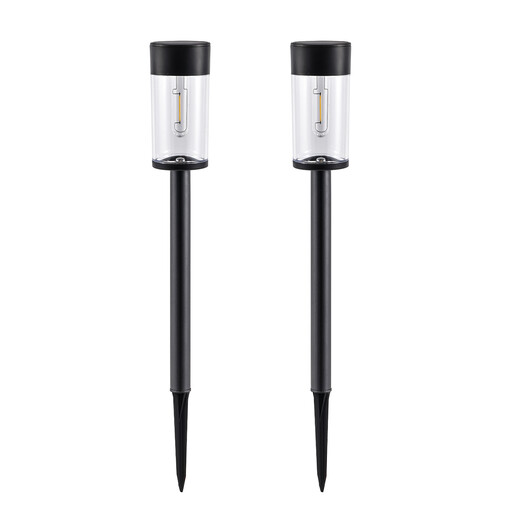
Why it suits this type of buyer: This set is easy to push into the ground and doesn’t need a fixed power connection. That makes it a practical way to add lighting quickly to a garden path, flower bed or balcony.
The product description specifies an output of 10 lumens per light and an IP65 rating. That makes it clear this model is intended for marking out a path and creating atmosphere, rather than providing powerful security lighting.
Solar-powered, switches on automatically at dusk, warm white 3000K light and two lights per pack.
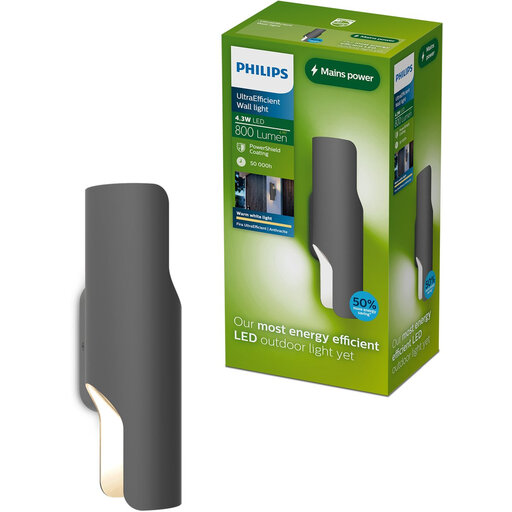
Why it suits this type of buyer: This fixed outdoor wall light is designed for anyone looking for a neatly finished wall lighting solution with integrated LED and warm light.
The specifications clearly state IP44, integrated LED, 800 lumens and 2700K. So there’s no need to choose a separate bulb and fitting.
Two-way lighting, 800 lumens, warm white 2700K light and an aluminium housing, according to the product information.

Why it suits this type of buyer: The three adjustable light heads and motion detection are designed for larger areas such as a driveway, garage, patio or back garden.
The product information states a detection range of 60 feet, a 180-degree angle, three modes and IP65. Do check that the installation spot gets enough sunlight.
302 LEDs according to the product description, three modes, three light heads and installation without fixed wiring.

Why it suits this type of buyer: With magnetic mounting, USB-C charging and a battery, this outdoor light is a good choice if you don’t want to drill or run permanent wiring through a wall.
The product information states IP44 and notes that the light is splash-resistant, but isn’t suitable for submersion or direct water jets.
300 lumens according to the specifications, 3000K light, motion sensor, built-in battery and magnetic mounting.
We’ve put together a complete, up-to-date list of products that meet these strict selection criteria and current European safety regulations.
Low-level lights spaced evenly along a garden path are usually enough. Solar pathway lights with a low output mark the route without lighting up the whole area. Space the lights evenly and check that the solar panels aren’t left in the shade for long periods.
It depends on where you’re putting it. An IP44 outdoor light may be suitable for a sheltered wall, balcony or covered entrance. For an exposed spot with lots of rain, dust or splashing dirt, IP65 outdoor lighting offers a higher level of protection. Always install the light fitting according to the instructions; an incorrect seal can reduce the protection it’s designed to provide.
A solar outdoor light doesn’t use electricity from the mains while it’s on. However, how well it works in practice depends on sunlight, battery capacity, temperature and maintenance. Clean the panel and sensor regularly, and choose a spot with enough daylight. To compare fixed LED outdoor lighting, look at the wattage and the number of hours it’s switched on.
