
Vandaag of morgen in huis

Kwaliteit gegarandeerd

Welkomstaanbiedingen ontgrendelen: GRATIS bezorging | Tot 80% korting | Gratis 30 dagen JoyPlus-proefperiode
Download de app
Good outdoor lighting does more than make a garden or entrance look attractive. A lamp helps you find your way along a garden path, makes a keyhole visible and can make a patio more enjoyable to use in the evening. Yet many people choose an outdoor lamp based solely on its colour, shape or the number of lumens stated on the packaging.
This can lead to disappointment. For example, a lamp with a motion sensor may switch on too late, a solar outdoor lamp may not receive enough charging light on a shady wall, and an IP44 outdoor lamp is not automatically suitable for every exposed location. Use the points below to compare outdoor lighting based on practical, verifiable features.
The number of lumens indicates how much light a lamp produces according to the product specifications. The light distribution is at least as important. An outdoor wall lamp that mainly shines downwards is useful by an entrance, but less suitable for evenly lighting a large patio.
For atmosphere, warm white light of around 2700 to 3000 K is often sufficient. For a driveway, shed or side passage, cooler white light of around 4000 K may be more practical. Also consider the mounting height and the direction of the light beam.
A solar outdoor lamp does not require a permanent mains connection. This makes installation appealing for a balcony, fence or garden shed. However, performance depends on the amount of direct sunlight, the position of the panel and the battery’s charge level.
On a north-facing wall, beneath a canopy or among tall trees, the lamp may stay lit for less time. So check that the panel has an unobstructed view of the sky. According to Philips’ own information, various solar products use a daylight or dusk sensor and a motion sensor; the actual operating time remains dependent on factors such as sunlight and usage.
The IP protection rating consists of two digits. The first digit refers to protection against solid particles, while the second concerns water. An IP44 outdoor lamp is protected against solid objects measuring 1 millimetre or more and against splashing water from various directions. This does not mean that the lamp is waterproof or suitable for submersion.
An IP54 outdoor lamp offers additional protection against dust, but is still designed for splashing water. An IP65 outdoor lamp is better protected against dust and water jets. It is therefore best to position an IP44 lamp where it will not be exposed to a direct jet of water or prolonged pooling. Always check the product specifications rather than relying solely on terms such as “weather-resistant”.
First choose between mains power, a plug or solar energy:
For a lamp with a replaceable bulb, check whether the light source is included. For example, the Philips Fylx has a GU10 fitting, but according to the product information it is supplied without a GU10 bulb. With an E27 outdoor lamp, such as the Philips Juli, you can choose a compatible LED bulb with your preferred colour temperature and brightness.
For a garden path, an even, modest light output is often sufficient. For a driveway or side passage, an outdoor lamp with a motion sensor and higher light output may be better suited to the way it will be used. Pay attention to:
A sensor does not guarantee that a dark area will be fully illuminated. Position the lamp so that the sensor is not blocked by a wall, roof edge or bush.
Aluminium is generally sturdy and suits a modern black outdoor lamp. Plastic may be lighter and is practical for solar products. Also check the dimensions, cable length, mounting method and included fixing materials.
A stable surface is important for ground spotlights and garden path lighting. Cables must not create a tripping hazard. An integrated LED is not always replaceable; once the light source reaches the end of its service life, the entire fitting may need to be replaced.

Why it suits this profile: This solar outdoor lamp is suitable for anyone who wants to light a façade, balcony or entrance without installing wiring. The product information lists two lighting modes, a daylight sensor and a motion sensor.
Choosing between Auto and On makes operation straightforward. However, bear in mind the stated IP44 rating and position the solar panel in direct sunlight.
400 lumens per light point, warm white light and installation without a mains connection.
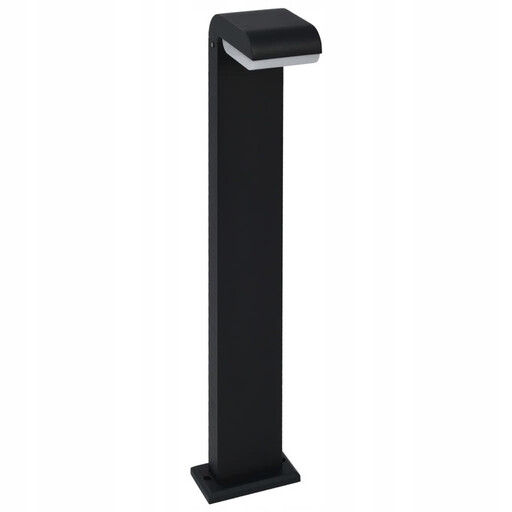
Why it suits this profile: This black garden path light has a fixed, free-standing 80 cm design and is suitable for a driveway, walkway or border where a constant light source is preferred.
The specifications state both the power and light output, as well as the IP54 rating. This allows you to match the lamp more precisely to its installation location.
Integrated 9 W LED, 550 lumens, black cast aluminium and an opal diffuser for downward light.

Why it suits this profile: This solar security light is designed for a driveway, side passage or large façade where a wide, powerful beam and motion detection are important.
The IP65 rating is higher than IP44, making it suitable for a location with greater exposure to dust and water jets. Installation in direct sunlight is still essential.
According to the product specifications: 4000 lumens, 3000 K, an adjustable lamp head and motion detection up to 8 metres when approached directly.
We have put together a complete, up-to-date list of products that fully meet these strict selection criteria and the applicable European safety regulations.
For a sheltered façade or canopy, IP44 may be suitable. In a more exposed location with plenty of dust or water jets, IP65 offers greater protection. No IP rating automatically means that a lamp may be placed underwater. Always follow the product’s installation instructions.
During normal use, a solar outdoor lamp does not draw electricity from the mains. However, its operating time depends on sunlight, the season, shade and the battery charge. For constant lighting throughout the night, mains power may be more predictable.
Lifespan varies by model and operating conditions. Some product descriptions state an expected lifespan, such as 15,000 or 25,000 hours of operation. With an integrated LED, the light source is often not replaceable. Before buying, check whether the fitting uses a separate GU10 or E27 bulb, or has a fixed LED module.
