
Vandaag of morgen in huis

Kwaliteit gegarandeerd

Welkomstaanbiedingen ontgrendelen: GRATIS bezorging | Tot 80% korting | Gratis 30 dagen JoyPlus-proefperiode
Download de app
Good outdoor lighting should suit the location, how you’ll use it and the weather conditions. A light for a sheltered front door has different requirements from a powerful outdoor light with a motion sensor for the driveway. Yet many buyers focus mainly on appearance or lumen output, which can lead to disappointment in practice.
The most common pitfalls:
The IP code indicates how well a light fitting is protected against solid particles and moisture. IP44 may be suitable for a sheltered veranda or entrance. This rating means the light is protected against splashing water from different directions. Don’t install an IP44 outdoor light where it will be directly exposed to powerful jets of water or prolonged, extreme weather.
For an exposed wall, garden or driveway, IP65 is a practical choice when protection against dust and rain is important. Also check that the cable, connection and fixings are suitable for outdoor use. A high IP rating on the light alone doesn’t automatically make the whole installation waterproof.
Lumens indicate the amount of light produced. A lower lumen output is often enough for atmospheric patio lighting. You may want more light for a driveway or entrance. A 180-lumen light has a different purpose from a 3000-lumen solar-powered outdoor light.
Colour temperature is measured in Kelvin:
Also consider how the light is distributed. A compact GU10 outdoor light can direct light downwards, while a light with several heads illuminates a larger area.
A fixed LED outdoor light runs on mains electricity and usually needs to be installed by a qualified electrician. A light with a GU10 fitting lets you choose a suitable bulb, but always check the maximum wattage.
Solar lighting works without a fixed power connection. Its performance depends on where the solar panel is positioned, the number of daylight hours and the battery capacity. Clean the panel regularly.
An outdoor light with a motion sensor can be useful by a back door, garage or driveway. Check the detection range and angle. A wide angle is practical in an open area, but may also detect movement more often than you’d like.
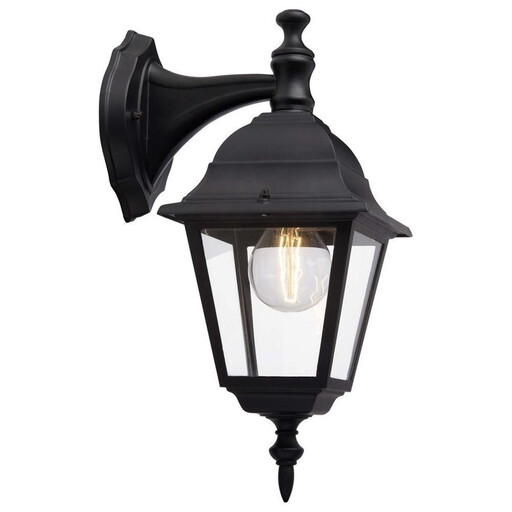
Why it suits this profile: This classic outdoor wall light is suitable for a sheltered entrance, veranda or patio, and works with a standard E27 bulb.
The IP44 rating and maximum fitting load of 60W are clearly stated. Bear in mind that it should be installed in a sheltered spot and that the bulb isn’t included.
E27 fitting, metal housing, classic black design and externally dimmable when used with a suitable dimmable bulb and dimmer.

Why it suits this profile: This solar-powered outdoor light is designed for larger areas such as a driveway, garden, garage or patio where broad lighting is needed.
The specifications state 3000 lumens, three lighting modes, a 180° detection angle and IP65 protection. For the stated performance, install it somewhere that receives enough direct sunlight.
Three adjustable light heads, a solar panel, an 1800mAh battery and motion detection up to 60 feet, according to the product specifications.

Why it suits this profile: This decorative lighting is designed for festive exterior walls, balconies and trees, or as outdoor Christmas lights.
The length, number of LEDs, 6W adapter and IP44 rating are specified. Use this string of lights outdoors in a sheltered spot, and not as general security lighting.
192 LEDs, eight hanging points, a memory function and a 5 × 0.3-metre span with a 5-metre extension cable.

Why it suits this profile: This rechargeable wall light with magnetic mounting is handy on a balcony or patio, or in a rented home where permanent wiring isn’t wanted.
The light doesn’t need a fixed power connection. Bear in mind the magnetic mounting, the need for regular charging and the IP44 rating: splash-resistant doesn’t mean waterproof.
Integrated LED, 300 lumens, 3000K, USB-C charging and a motion sensor for automatic activation.
We’ve put together a complete, up-to-date list of products that meet these strict selection criteria and the applicable European safety regulations.
For a sheltered spot, such as under a canopy, IP44 may be suitable. For an exposed wall, garden or driveway, IP65 offers greater protection against dust and water. Always check the complete installation and the fitting instructions.
It can be, as long as the solar panel receives enough direct light during the day. Don’t place it under dense tree cover or in a permanently dark, north-facing spot. Operating time may be shorter during darker seasons.
Energy use depends on the wattage and the number of hours it’s on. An LED outdoor light with a motion sensor usually only uses energy when it detects movement. A solar-powered outdoor light gets its energy from the built-in battery, but the battery still needs to be recharged regularly using sunlight. For a wired light, check the wattage; for a rechargeable model, check how often it needs charging and the battery specifications.
