
Vandaag of morgen in huis

Kwaliteit gegarandeerd

Welkomstaanbiedingen ontgrendelen: GRATIS bezorging | Tot 80% korting | Gratis 30 dagen JoyPlus-proefperiode
Download de app
Good outdoor lighting needs to do more than look attractive. You want enough light to see when you arrive home on the drive, a welcoming ambience on the patio, and a sensor outdoor light can be practical by the front door. Yet many people choose a light based only on its appearance or the number of LEDs. This can lead to a product that’s quickly put in the wrong place, doesn’t provide enough light or needs more maintenance than expected.
So, look out for these three common pitfalls:
The IP code indicates how well a light fitting is protected against solid particles and moisture. For outdoor lighting in a sheltered entrance or on a balcony, IP44 is often suitable. This rating protects against splashing water from different directions, but it doesn’t make a light waterproof.
For an exterior wall, shed or open garden where the light is exposed to more rain, IP65 outdoor lighting may be a better choice. The IP65 rating indicates protection against dust and water jets. Always check the installation instructions and positioning, though: even a fitting with a higher IP rating must be installed correctly.
With LED outdoor lighting, it’s also worth checking whether the light source is integrated or replaceable. A GU10 or E27 fitting gives you more flexibility when choosing the light colour and brightness. An integrated LED light is often compact, but the light source can’t always be replaced by the user.
A solar garden light or solar wall light doesn’t need to be connected to the mains. Its performance depends on the position of the solar panel, the season and the amount of daylight. For a model with a motion sensor, the detection angle, range and lighting duration are useful details to check.
A fixed outdoor wall light usually needs wiring. Switch off the power before installation and make sure any work on the mains connection complies with local regulations. A battery-powered or rechargeable outdoor wall light can be handy in a rented home, on a balcony or anywhere without an available cable.
The right choice depends on where you’ll use it and what you need it to do. Here are some options with product specifications you can check.
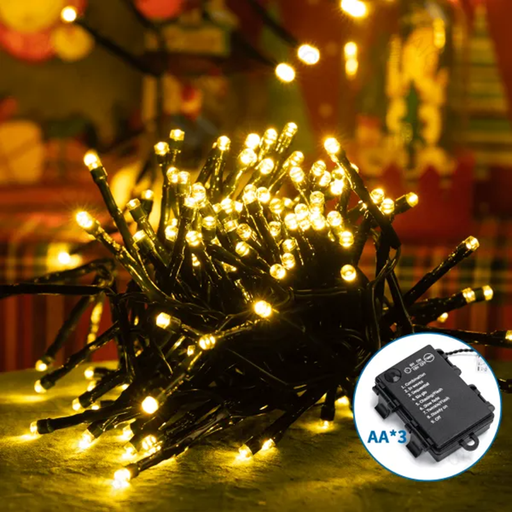
Why it suits this profile: These battery-powered string lights are an easy choice for a sheltered balcony, veranda or patio. At 5 metres long with eight lighting modes, they’re a simple way to get started with ambient garden lighting.
The product specifications explicitly state that it’s battery-powered and has a timer, memory function and IP44 rating. Make sure you place the lights in a sheltered spot: IP44 doesn’t protect against direct water jets.
200 LEDs, 5 metres long, eight lighting modes, a timer and power from three AA batteries.
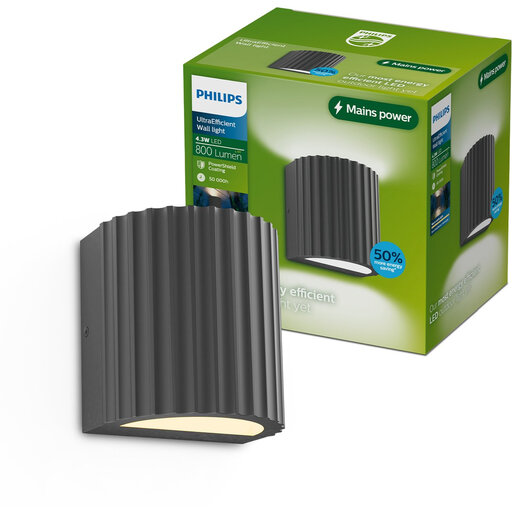
Why it suits this profile: If you’re looking for a fixed, modern wall light for an exterior wall, balcony or garden path, this model offers integrated LED lighting with a warm white colour temperature of 2,700 K.
Light directed in two directions prevents it from shining only on one small spot beneath the light. Its IP44 rating makes it suitable for sheltered outdoor use.
800 lumens, integrated LED, 4.3 W, 2,700 K, aluminium and plastic construction.

Why it suits this profile: This model is designed for drives, garages, gardens and larger outdoor spaces where wide coverage and motion detection are needed without fixed wiring.
According to the product information, this model has IP65 protection, three lighting modes and three adjustable heads. Point the solar panel towards direct daylight and keep it clean.
302 LEDs, stated light output of 3,000 lumens, 180° detection angle and solar power.

Why it suits this profile: The magnetic mounting and rechargeable battery are handy if you don’t want to install a fixed connection, for example on a balcony, in a rented home or at a temporary entrance.
The specifications list USB-C charging, a motion sensor and IP44. Bear in mind that it needs regular charging, and place the magnetic plate on a stable, flat surface.
300 lumens, 3,000 K, integrated LED, motion sensor and wireless mounting.
We’ve put together a full, up-to-date list of products that meet these strict selection criteria and the applicable European safety regulations.
Look for a model with plenty of lumens, a motion sensor and a wide spread of light. For an open drive, IP65 can offer extra protection against dust and water jets. Also check whether the solar panel has an unobstructed view of the sky, or choose a fixed connection.
A solar outdoor light doesn’t use electricity from the mains while it’s on. How long it provides light in practice depends on sunlight, battery capacity, temperature and the lighting mode selected. It may run for less time in winter or in a shady spot. Clean the solar panel regularly and check the battery as described in the instructions.
You can usually fit a battery-powered or solar wall light yourself, provided the surface is suitable. A fixed 230-volt outdoor light must be connected in accordance with the product information and local regulations. Have electrical work carried out by a qualified electrician. Also check the maximum wattage, fitting and whether the light is supplied without a bulb.
