
Vandaag of morgen in huis

Kwaliteit gegarandeerd

Welkomstaanbiedingen ontgrendelen: GRATIS bezorging | Tot 80% korting | Gratis 30 dagen JoyPlus-proefperiode
Download de app
Finding the right outdoor lighting seems simple, until you realise that not every light is suitable for the place you want to use it. A string of lights for a covered balcony has different requirements from a light by the driveway. Terms such as “waterproof”, “extra bright” and “energy-efficient” do not always tell the whole story either.
Use these tips to avoid a poor purchase and choose more confidently from garden lighting, solar outdoor lighting, outdoor wall lights and LED outdoor lights.
The IP rating indicates how well a product is protected against solid particles and moisture. IP44 means protection against splashes in practice, but not against direct jets of water or immersion. For example, various IP44 wall lights are suitable for a sheltered exterior wall, veranda or covered patio, but not for a completely exposed spot where rain falls directly onto the light.
According to the product information, a product with IP65 offers greater protection against dust and jets of water. That still does not automatically mean you can submerge the light. Always check the installation instructions and intended mounting location.
A high number of LEDs does not automatically mean the light will be pleasant or useful. For ambient garden lighting, balcony lighting or outdoor string lights, colour temperature, light distribution and length are just as important. Warm white light around 2700 to 3000 K generally feels softer than cool white light.
For a driveway or entrance, a motion sensor may be more practical than lighting that stays on continuously. A light with a high output can be useful there, while string lights are mainly intended for decoration.
Solar outdoor lighting is easy to install, but its performance depends on the amount of direct sunlight it receives. In winter or in a shady spot, the operating time may be shorter. Battery-powered lights need new batteries or recharging from time to time. A fixed wall light usually requires a power connection and installation by a qualified electrician.
Also check what is included. Some fittings do not come with a light source, while others have an integrated LED that cannot be replaced.
Match the IP rating to the actual location:
So, “waterproof outdoor light” is more than just a marketing term. Check the specific IP rating and read whether the manufacturer advises against direct contact with water or immersion.
An LED outdoor light generally uses little energy and often has a long stated lifespan. With a fitting that takes a GU10 or E27 bulb, you can choose the light source yourself. This gives you flexibility over colour temperature and dimming, but a bulb is not always included.
Check:
A fixed colour temperature of 3000 K, for example, suits a warm entrance or patio. For decorative garden lighting, a softer, lower light level may be more pleasant.
A solar light with automatic dusk-to-dawn control is handy if you do not want to run a cable. Position the solar panel somewhere with plenty of direct daylight and keep its surface clean. For an outdoor light with a motion sensor, the detection range, detection angle and adjustable lighting mode are all worth considering.
For a large patio or festive decorations, a mains-powered outdoor string of lights may be more suitable than battery-powered lights. You will not need to keep replacing batteries, but you will need to consider a power socket, cable routing and protection from moisture.
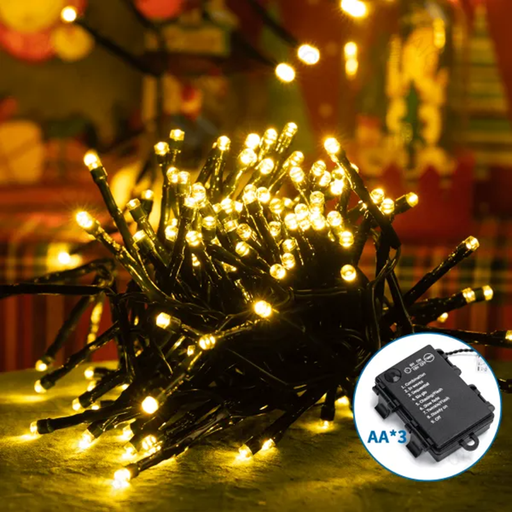
Why it suits this need: This string of lights runs on 3 AA batteries and, at 5 metres long, is suitable for a balcony, small garden or covered seating area.
The product information clearly states the length, number of LEDs, timer and IP44 rating. It is therefore best used in a sheltered spot, away from direct jets of water.
200 LEDs over 5 metres, 8 lighting modes, a timer and memory function; no fixed power connection needed.
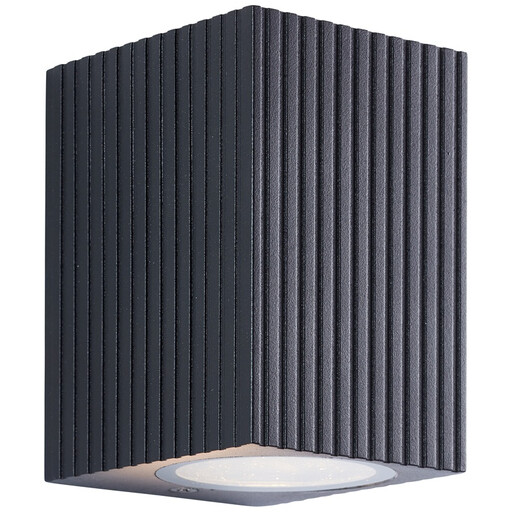
Why it suits this need: If you are looking for a fixed outdoor wall light, the GU10 fitting lets you choose a suitable LED bulb.
The light is supplied without a bulb. This avoids any confusion, but you will need to check that you choose the right GU10 bulb and stay within the maximum power of 10 W.
Aluminium, glass and plastic; compact dimensions of approximately 10 × 7 × 8 cm; IP44 for sheltered outdoor locations.

Why it suits this need: This solar outdoor light is designed for driveways, garages, courtyards and larger outdoor spaces where automatic lighting is useful.
According to the product information, the light has three lighting modes, a motion sensor and IP65 protection. Make sure you position the solar panel somewhere with direct sunlight.
Three adjustable light heads, a stated detection angle of 180 degrees and solar power with no fixed wiring.
We have put together a complete, up-to-date list of products that meet these strict selection criteria and the applicable European safety regulations.
A compact string of lights, a solar lantern or a wireless LED wall light are practical options for a balcony. Check the IP rating, the fixing and whether the product is mounted in a sheltered spot. A light with IP44 is designed to withstand splashes, not direct jets of water.
That depends on the wattage, how long the light is on and its power source. A low-wattage LED bulb generally uses less electricity than a traditional bulb with a higher wattage. Solar lighting does not use mains electricity while it is on, but its operating time varies with the amount of sunlight and the battery capacity.
The stated lifespan varies by product and operating conditions. Check whether the lifespan is given in hours and whether the light source can be replaced. With integrated LEDs, the light source is part of the fitting. With GU10 or E27 bulbs, you can usually replace the bulb separately.
