
Vandaag of morgen in huis

Kwaliteit gegarandeerd

Welkomstaanbiedingen ontgrendelen: GRATIS bezorging | Tot 80% korting | Gratis 30 dagen JoyPlus-proefperiode
Download de app
Good outdoor lighting needs to suit the place where you’ll use it. A light for a covered balcony has different requirements from an outdoor light beside the driveway or a bright light by the garage. Yet many buyers focus mainly on appearance, lumens or a low price. This can lead to problems such as insufficient light, the wrong IP rating or a complicated installation.
Use this practical guide to compare garden lighting, outdoor wall lights, solar lighting and LED lights based on what really matters outdoors in the UK.
A high lumen count may sound appealing, but it won’t suit every application. A powerful light can work well on a driveway, but feel too bright on a small patio. For a garden path, even, gentle light is often more important than maximum brightness.
As well as lumens, consider:
IP44 outdoor lighting is splashproof and suitable for many sheltered exterior walls, balconies and patios. Don’t assume that a light with this rating can be installed somewhere exposed to heavy rain or water jets.
IP65 outdoor lighting offers greater protection against dust and water jets. This makes it a more sensible choice for an exposed driveway, garden wall or solar outdoor light that has to cope directly with changeable weather. The installation location and correct fitting are still important.
A solar outdoor light doesn’t rely on battery capacity alone. The position of the solar panel, shade from trees and the amount of direct daylight all affect performance. In winter or in a cloudy location, the light may stay on for less time than stated in the product information.
So check:
First, consider where the light will be installed. An outdoor wall light beneath an overhang may be fine with IP44, while a light on a freestanding shed or an exposed garden wall is better with a higher rating. Also check that the fixings are suitable for brick, concrete, wood or another surface.
A fixed 230V light, such as some Philips outdoor lights, needs to be connected to the mains. Any work on the fixed electrical installation should be carried out in accordance with the relevant regulations.
Solar garden lights are handy if you don’t want to run a cable. However, a light with an integrated battery needs to get enough charge regularly. A cordless, rechargeable LED outdoor light is easy to position, but needs to be charged periodically via USB.
A fixed light with a GU10 or E27 fitting gives you more choice. You can replace the bulb later or choose a different colour temperature. Always check that the fitting, maximum wattage and dimensions are compatible.
An outdoor light with a motion sensor is useful by a front door, garage or side path. Check the detection range and angle. A sensor set too sensitively may be triggered by pets or moving branches.
Integrated LED lighting is compact and often energy-efficient, but the light source can’t be replaced in many models. A GU10 outdoor light or an E27 bulb offers more flexibility, although the total cost will also depend on the light source you choose.
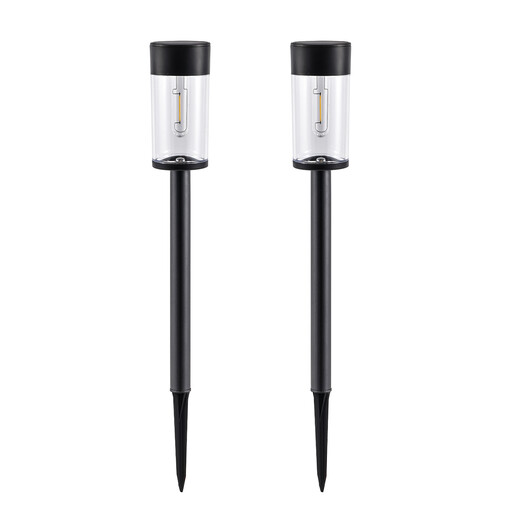
Why it suits this profile: This set is designed for garden paths, borders and driveways, and works without fixed wiring. The two lights are installed using ground stakes.
The product information lists an IP65 rating and automatic dusk activation. Make sure you place the panels somewhere that gets enough direct sunlight.
Two lights, 3000K warm white light according to the product specifications, and installation with ground stakes.
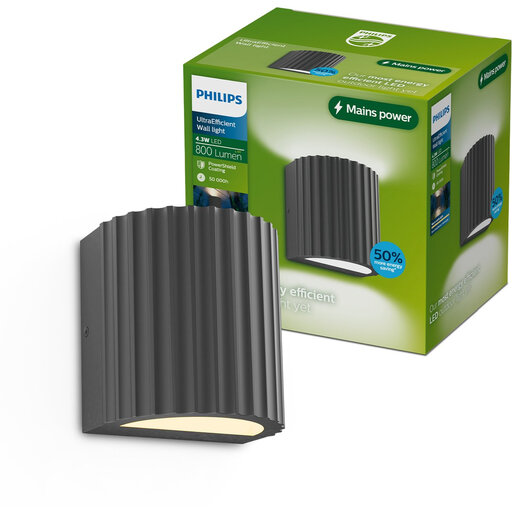
Why it suits this profile: This modern fixed outdoor light is suitable for an exterior wall, balcony or garden wall if you’re looking for an integrated light source and a sleek design.
The specifications list 2700K, 800 lumens and light directed in two directions. This makes it easier to judge how the light will be distributed than with a light that has no clear lighting specifications.
Integrated LED, aluminium and plastic construction, 230V connection and IP44 rating according to the product specifications.

Why it suits this profile: This solar outdoor light is designed for larger areas such as a garage, driveway, patio or spacious garden, and combines multiple light heads with a motion sensor.
The product information lists IP65, three lighting modes, a 180-degree detection angle and installation without electrical wiring. Check beforehand that the chosen wall gets enough sunlight.
According to the product information, it has 302 LEDs, three adjustable heads and a stated light output of 3000 lumens.
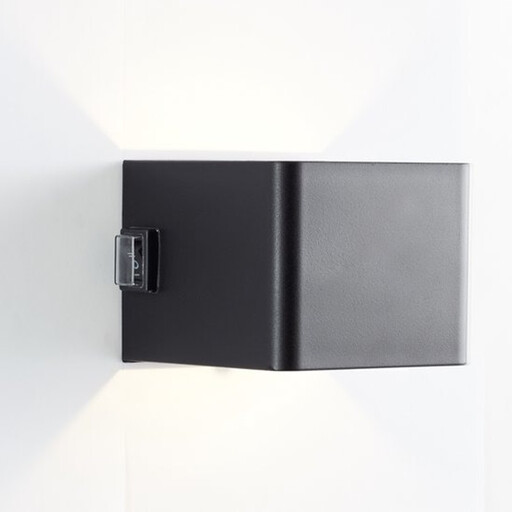
Why it suits this profile: Magnetic mounting and a rechargeable battery are handy for renters or anyone who doesn’t want to run cables.
The IP44 rating makes it clear that this light is splashproof, but not designed for immersion or direct water jets. The mounting plate needs to be securely fixed.
Cordless positioning, USB-C charging, motion sensor and, according to the product information, 300 lumens at 3000K.
We’ve put together a complete, up-to-date list of products that meet these strict selection criteria and the applicable European safety regulations.
IP44 may be suitable for a sheltered exterior wall or balcony. For a light in a more exposed location, such as a driveway or garden wall, IP65 generally offers greater protection against dust and water jets. Always follow the manufacturer’s installation instructions.
Solar garden lighting doesn’t use a fixed mains connection, so electricity use while it’s operating can be low. Performance depends on sunlight, the season, panel position and battery capacity. Clean the panel regularly and don’t place it under trees or a canopy.
Lifespan varies depending on the model, how long it’s used, heat dissipation and weather conditions. With integrated LED lighting, it’s often not possible to replace the light source alone. A light with a GU10 or E27 fitting gives you more choice if you want to fit a new light source later.
