
Vandaag of morgen in huis

Kwaliteit gegarandeerd

Welkomstaanbiedingen ontgrendelen: GRATIS bezorging | Tot 80% korting | Gratis 30 dagen JoyPlus-proefperiode
Download de app
Good outdoor lighting should suit the location, how it will be used and the British weather. A light for a sheltered balcony has different requirements from an outdoor light beside a driveway. Even so, many shoppers focus mainly on appearance or the number of lumens. This can lead to a poor purchase: not enough light on a dark path, a solar light that barely charges or a fitting that is not suitable for direct rain.
A high lumen output does not automatically mean that a light will provide comfortable or practical illumination. 3000 lumens, for example, is suitable for a large area or security lighting, but may be too bright beside a patio where you want to relax. For pathway lighting or decorative solar garden lighting, lower light levels are often sufficient.
Also consider the colour temperature:
IP44 outdoor lighting is protected against solid objects and splashing water. This makes IP44 suitable for sheltered façades, balconies and covered areas, but not automatically for locations exposed to direct jets of water or prolonged heavy rain.
With IP65 outdoor lighting, the housing is dust-tight and better protected against water jets. This is a logical choice for an open driveway, garden wall or large outdoor area. However, always check the full product description and installation instructions. An IP rating remains valid only when the light is installed and sealed correctly.
Solar outdoor lighting works without mains electricity, but the solar panel needs sufficient direct daylight. Do not place a solar garden light beneath a dense tree, next to a tall north-facing fence or under a covered area without access to daylight. In winter and on dark, cloudy days, the operating time may also be shorter.
According to the manufacturer's product description, some solar lights are designed to provide several hours of illumination after charging. Actual operating time depends on sunlight, temperature, battery condition and the selected lighting mode.
As well as lumens, consider the beam angle and mounting height. An outdoor wall light with 800 lumens can illuminate a façade beautifully upwards and downwards, while a compact 300-lumen light may be better suited to an entrance or balcony. For a path, several small light points often provide more even illumination than one bright lamp.
A motion sensor can save energy and provide light when someone approaches the driveway, shed or front door. Check the detection angle and range. A sensor with a wide angle is useful in an open area, but may also respond to movement beside the path.
First, distinguish between:
A light with a GU10 or E27 fitting gives you more choice. However, be aware that some fittings are supplied without a light source.
Aluminium, glass, plastic and stainless steel are commonly used for garden lights. When choosing a black garden light, check that the material and finish suit its intended location. On a façade or fence, secure mounting is more important than design alone.
For electrical models, you must take local installation regulations into account. Have a fixed outdoor wall light installed by a qualified electrician. For in-ground spotlights, the ground must be stable and the cable must not create a trip hazard.
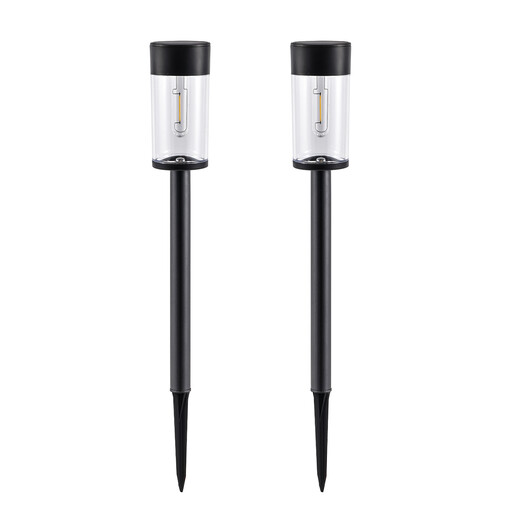
Why it suits this profile: This set is ideal if you want to mark out a garden path, border or driveway without wiring. The ground spikes make installation simple.
The product description states an IP65 rating and automatic activation. Positioning in direct sunlight is still necessary for charging.
Two lights per pack, warm white 3000K illumination and a sensor for automatic switching on and off.
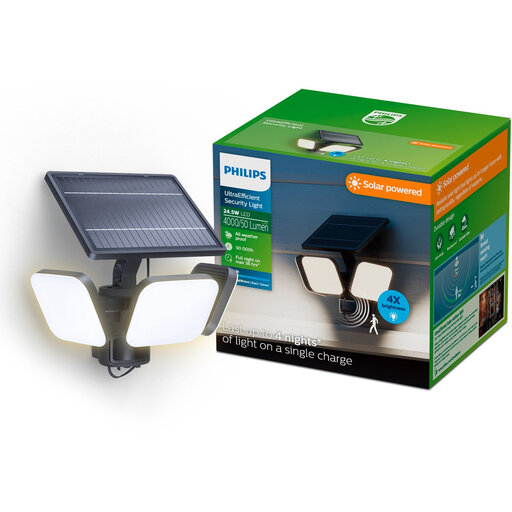
Why it suits this profile: This solar outdoor light is designed for anyone looking for a fixed wall light with broad illumination and motion detection beside a driveway, garage or larger garden.
The stated IP65 rating is better suited to a more exposed installation location than IP44, provided the light is mounted according to the instructions.
According to the product description, 4000 lumens, an integrated LED, a range of up to 8 metres when approached directly and a 3-metre cable for the solar panel.

Why it suits this profile: This light is ideal for users who want to brightly illuminate a large area around a garage, driveway, patio or garden without electrical wiring.
The three adjustable heads and stated 180-degree detection angle help avoid creating a single narrow beam. However, the installation location must receive sufficient sunlight.
According to the product specifications, 302 LEDs, 3000 lumens, three lighting modes and IP65 protection.
We have put together a complete, up-to-date list of products that fully meet these strict selection criteria and the applicable European safety regulations.
For a sheltered façade, balcony or covered area, IP44 outdoor lighting may be suitable. For an open location with greater exposure to dust and water, IP65 outdoor lighting is generally the more logical choice. Always check the installation instructions and the exact product information.
The operating time per evening depends on the amount of sunlight, battery capacity, temperature and lighting mode. Clean the solar panel regularly with a soft, damp cloth. During dark winter days, do not expect the same charging performance as after a sunny day.
An LED outdoor light generally uses less energy than traditional light sources, but consumption depends on the wattage and operating time. A motion sensor, timer or dimming function can reduce unnecessary use. Solar lighting does not use mains electricity, but it does require a suitable, sunny location for reliable operation.
