
Vandaag of morgen in huis

Kwaliteit gegarandeerd

Welkomstaanbiedingen ontgrendelen: GRATIS bezorging | Tot 80% korting | Gratis 30 dagen JoyPlus-proefperiode
Download de app
Good outdoor lighting needs to suit the location, the weather and its purpose. A lamp for creating ambience on a balcony has different requirements to an outdoor light with a motion sensor for the driveway. Yet many buyers focus mainly on design or lumen values. This can mean a lamp disappoints in practice: the battery runs out quickly, the light shines in the wrong place, or the housing isn't suitable for direct rain.
Joybuy's Product Recommendation Officer selects products based on verifiable specifications. This helps you separate marketing claims from features you can actually check.
An IP44 outdoor light is protected against solid objects larger than 1 millimetre and splashing water. That doesn't mean the lamp is suitable for a spot where it's constantly exposed to rainwater or powerful water jets. For a sheltered wall, canopy or balcony, IP44 can be appropriate.
IP65 outdoor lighting offers a higher level of protection against dust and water jets. Always check the installation instructions, though. Even a lamp with an IP65 rating must be correctly mounted and shouldn't be submerged without further consideration.
A solar-powered outdoor light doesn't work independently of its location. A north-facing wall, a spot under a tree, or a balcony with little direct sunlight will limit the charging capacity. According to the product description of some models, the run time after a full charge can be several hours, but the actual duration depends on sunlight, season, temperature and battery condition.
Therefore, place a solar wall light outside so that the panel gets as little shade as possible during the day. Clean the panel regularly with a soft, dry cloth.
More lumens means more light output, but it doesn't automatically mean a better solution. For decorative garden lighting, warm light with a low brightness can be perfectly adequate. For an entrance or driveway, direction, sensor range and mounting height are more important than a high number on the packaging.
Also pay attention to the light colour. Around 2700–3000 kelvin gives warm white light for garden and patio lighting. Around 5000 kelvin, the light appears cooler and brighter, which can be more suitable for functional lighting.
Solar outdoor lighting doesn't need a fixed mains connection. This makes installation easy, especially in a garden, on a balcony or along a path. Look at the stated charging time, run time and battery type. In areas with little sun, a USB charging option can be handy.
A fixed LED outdoor light running on 230 volts generally provides a constant power supply, but installation on a wall must be done in accordance with local regulations. For models with a GU10 or E27 fitting, the light source is sometimes not included. So check whether you need to buy a suitable LED bulb separately.
An outdoor light with a motion sensor switches on when movement is detected. Check the range, the detection direction and whether the sensor can be adjusted separately. An outdoor light with a dusk sensor switches on based on ambient light levels. Some models combine both functions.
Also look at the available modes. A lamp might, for example, stay on permanently, only switch on when motion is detected, or alternate between different brightness levels. This affects both ease of use and the available battery life.
Aluminium, plastic, glass and ABS plastic are common materials for outdoor lights. As well as the material, check the weight, dimensions and mounting method. A magnetic lamp is flexible, but the mounting plate must be securely fixed to a suitable surface.
For ground spots and path lights, stability is important. Position them so they don't create a trip hazard. A lamp with an integrated LED is often ready to use straight away, but the light source usually can't be replaced by the user.
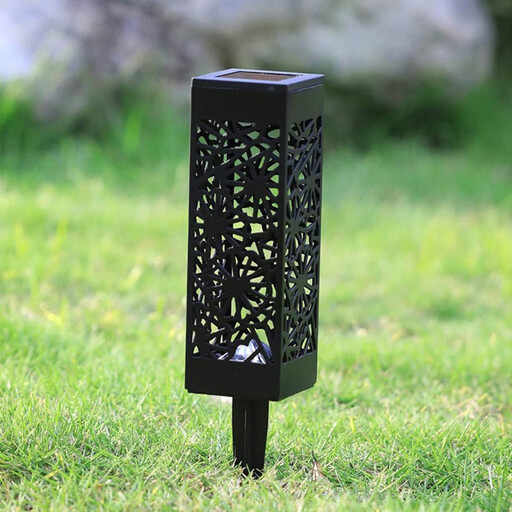
Why this fits the profile: This set is designed for paths, borders, flower beds and patios. The lights are placed in the ground without any wiring.
The product description states a charging time of 4–6 hours, a run time of 5–8 hours and an IP65 rating. Placement in the shade remains unsuitable.
Set of 6, warm white LEDs, automatic on/off switching and tool-free installation.
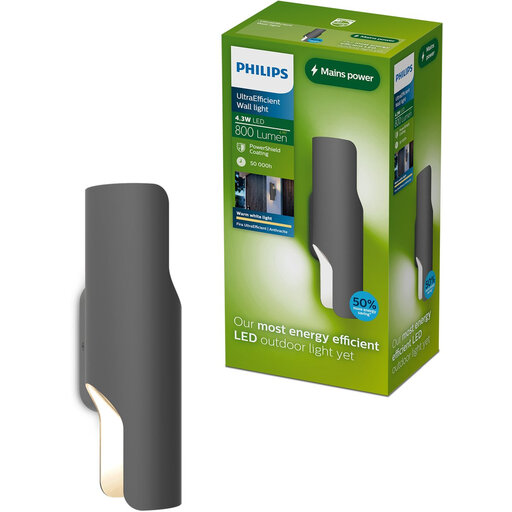
Why this fits the profile: This fixed outdoor wall light is suitable for a facade, entrance, garden wall or balcony where a constant light source is desired.
The specifications state 800 lumens, 2700 kelvin, 4.3 watts and IP44. This means the light colour, energy consumption and splash-water protection are clearly defined.
Integrated LED, dual-sided light emission, aluminium housing and a stated lifespan of up to 50,000 hours according to the product information.
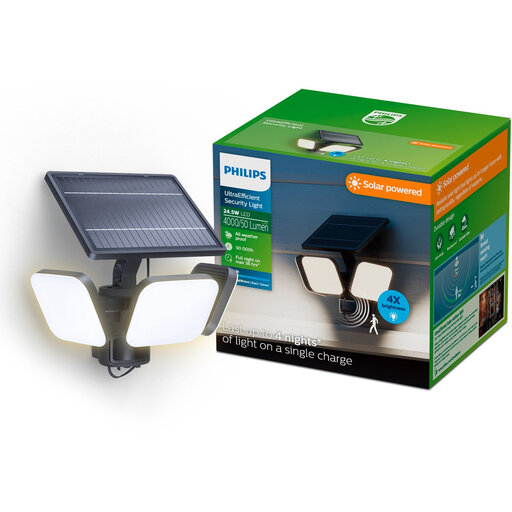
Why this fits the profile: This solar security spotlight is aimed at driveways, back paths and larger wall areas where a lot of light is needed temporarily.
The product data mentions a PIR range of 8 metres for direct approach and 16 metres sideways, plus an IP65 rating. Check beforehand whether the installation spot gets enough sun.
4000 lumens, adjustable light head, dusk sensor, motion sensor and two light modes according to the product specifications.

Why this fits the profile: This string light is intended for Christmas trees, facades, canopies and temporary decoration indoors or outdoors.
The set explicitly states an IP44 rating and a 220–240V adapter of 6 watts. Therefore, do not use the lights in a completely exposed spot with direct water jets.
192 coloured LEDs, 8 hanging points, a coverage of 5 × 0.3 metres and a memory function for the chosen light setting.
We've put together a full, up-to-date list of products that fully meet these strict selection criteria and comply with current European safety regulations.
Solar outdoor lighting doesn't use any electricity from the mains during normal use. You do need to factor in battery wear and possible replacement of parts. The output depends on the amount of direct sunlight. In winter, the run time can therefore be lower than in summer.
That depends on the installation spot. An IP44 outdoor light is designed for protection against splashing water and is usually suitable for a sheltered wall, canopy or balcony. Don't place the light in a location where it's constantly exposed to heavy rain, water jets or submersion. For harsher conditions, IP65 outdoor lighting may be more appropriate.
Mount the light so that the sensor crosses the desired walking route, for example near a front door, back path or driveway. Don't point the sensor directly at a busy street or moving branches. Check the stated detection range and make sure that, for solar models, the solar panels receive direct sunlight during the day.
