
Vandaag of morgen in huis

Kwaliteit gegarandeerd

Welkomstaanbiedingen ontgrendelen: GRATIS bezorging | Tot 80% korting | Gratis 30 dagen JoyPlus-proefperiode
Download de app
Good outdoor lighting needs to do more than look attractive. A light by the front door should provide practical illumination, a solar outdoor light needs enough sunlight, and a garden light must withstand rain, dust and changes in temperature. Yet purchases often go wrong because of three common pitfalls.
A high light output doesn’t automatically make a light pleasant to use on a balcony or patio. IP44 outdoor lighting is sometimes presented as fully waterproof, even though this rating only indicates protection against splashing water. Finally, buyers often forget to check whether a light comes with a bulb, or whether they’ll need to buy a GU10 or E27 bulb separately.
Use the following points to compare outdoor lights by how you’ll use them, where you’ll place them and how much maintenance they need.
The IP code consists of two digits. The first indicates protection against solid particles, such as dust. The second relates to water.
So, a water-resistant outdoor light isn’t necessarily suitable for every location. Also consider exposure to driving rain, whether there’s a covered area and the quality of the installation.
Light output is measured in lumens. A small wall light for ambient lighting often needs fewer lumens than an outdoor light with a motion sensor for a driveway.
Also consider the colour temperature. 2700 to 3000 K usually gives a warm white light, while a higher value can look cooler. For example, the UME light is listed as having 3000 lumens and 7000 K in the product specifications. This gives a powerful, cool-looking light, rather than the soft warmth of ambient lighting.
With solar lighting, sunlight hours and placement also play a big part. According to the product information, the Philips Fyns runs on solar power and has built-in dusk and motion sensors. However, actual running time can vary depending on the season, cloud cover, orientation and shade.
A solar wall light or portable LED outdoor light is usually easy to install, as it doesn’t need a fixed power connection. A wired 230-volt outdoor wall light, on the other hand, must be connected by a qualified installer.
Before buying, check:
With a light that has a GU10 fitting, you can choose a suitable LED bulb yourself. According to the product specifications, the Brilliant Jelani and Philips Fylx are supplied without a bulb. The Philips Cylr ground spotlight, by contrast, comes with a GU10 LED spotlight.

Why it suits this profile: This solar wall light is a good choice for an entrance, balcony or sheltered exterior wall where you don’t want to install wiring. It offers 1000 lumens, 3000 K, two light modes and a built-in motion sensor.
The product specifications clearly state that it has an integrated LED, an IP44 rating and solar power. It’s still best to place it out of the path of direct water.
No fixed wiring, 1000 lumens, warm white light at 3000 K and a dusk sensor, according to the product information.
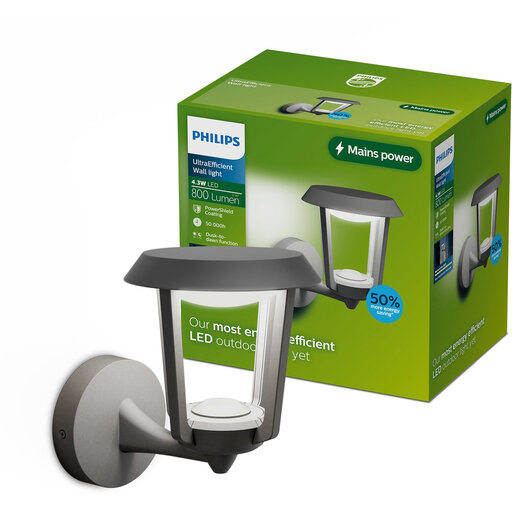
Why it suits this profile: The Nuvy combines an integrated LED with an aluminium casing, 800 lumens and 2700 K. It’s a good fit for a permanent entrance, patio wall or balcony where creating the right atmosphere matters.
The key details are clearly stated: 230 volts, 4,3 watts, IP44 and an integrated LED. Bear in mind that it needs a fixed power connection.
Aluminium casing, 800 lumens, warm light at 2700 K and a stated IP44 rating.

Why it suits this profile: This solar outdoor light is designed for larger areas such as a driveway, garage or spacious garden. It has three adjustable heads, a stated detection range of 60 feet and three light modes.
Its stated IP65 rating makes it more suitable for an exposed spot than an IP44 light. For it to work well, the solar panel needs to receive direct daylight.
302 LEDs, a stated light output of 3000 lumens, three light modes and a motion sensor with a 180-degree detection angle.
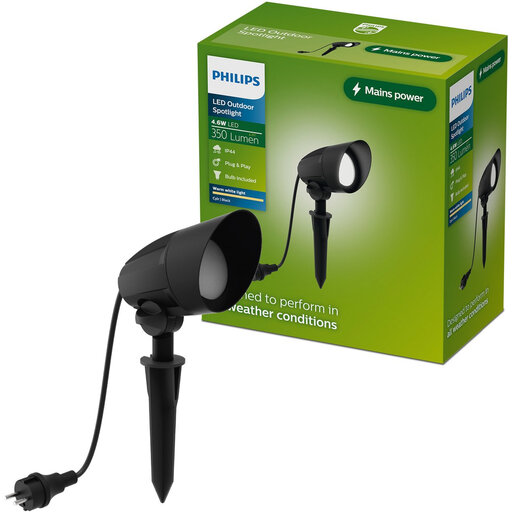
Why it suits this profile: This ground spotlight is designed to highlight shrubs, trees, a garden path or driveway. It can be rotated, is installed in the ground and runs from an outdoor socket.
The bulb is included and the IP44 rating is clearly stated. Don’t place the spotlight where it will be exposed to direct water jets or could be submerged.
Includes a GU10 LED, 350 lumens, 2700 K and a rotatable casing for focused lighting.
We’ve put together a complete, up-to-date list of products that meet these strict selection criteria and comply with the applicable European safety regulations.
Yes, IP44 outdoor lighting can be suitable for sheltered outdoor locations such as a balcony, a patio beneath a covered area or an exterior wall by the entrance. The rating protects against splashing water, but not direct water jets or submersion. For a fully exposed location, an IP65 outdoor light may be more suitable.
A solar outdoor light uses solar energy during the day to charge its internal battery, so it doesn’t need to be connected to the mains. Its performance depends on the amount of daylight, its position, the battery and the selected light mode. Running time may be shorter in winter or during prolonged cloudy weather.
Lifespan varies depending on the model, how long it’s used, the temperature and its protection against moisture. Manufacturers may state an expected lifespan, but this isn’t a guarantee for every use scenario. So, check not only the number of operating hours, but also whether the LED is integrated, whether any parts can be replaced and what warranty or statutory guarantee rights apply.
