
Vandaag of morgen in huis

Kwaliteit gegarandeerd

Welkomstaanbiedingen ontgrendelen: GRATIS bezorging | Tot 80% korting | Gratis 30 dagen JoyPlus-proefperiode
Download de app
An outdoor light may seem like a simple purchase, until you discover that not every model is suitable for the place where you want to install it. A light for a sheltered entrance has different requirements from a fitting on an exposed wall, balcony or garden shed. A low purchase price can also be misleading if the bulb isn’t included, the fitting isn’t compatible or the light isn’t sufficiently protected against moisture.
This guide helps you compare the key specifications of outdoor lighting and find options to suit different situations.
An IP44 outdoor light is protected against solid objects larger than 1 millimetre and water splashes from different directions. This doesn’t mean the light is suitable for direct jets of water, prolonged submersion or every exposed location.
It’s therefore best to install an IP44 fitting under an overhang or somewhere rainwater can’t get directly into the housing. Also check the instructions for any restrictions on fitting it to an exposed wall.
A modern outdoor light may suit your exterior perfectly, but still be inconvenient if the bulb isn’t included. With a GU10 outdoor light, for example, you’ll need to buy a suitable GU10 LED spotlight separately. This gives you flexibility over colour temperature and brightness, but increases the total cost.
Consider the direction of the light, too. A downlight mainly illuminates the wall or paving beneath it. That may be enough for an entrance, while a garden path might need several fittings.
A solar outdoor light works without a fixed mains connection, but its performance depends on the amount of daylight, the position of the solar panel and the battery capacity. A shady north-facing wall is usually less suitable than a spot that gets several hours of direct sunlight.
For smart outdoor lighting, check that the light itself is suitable for outdoor use. A smart bulb with IP20 is designed for dry indoor spaces and shouldn’t be used in an outdoor fitting without suitable protection.
A fitting with a replaceable bulb gives you more choice. For example, you could use GU10 LED spotlights to create warm white lighting for a patio, neutral white lighting for an entrance or smart lighting controlled via an app. Always check:
A fitting with integrated LED lighting is ready to use straight away. However, you generally can’t replace the light source yourself when it reaches the end of its working life.
The IP rating is a useful thing to check. The first digit indicates protection against solid objects, while the second refers to water. IP44 is available for many sheltered areas around the home, but always check the specific installation instructions.
A 230 V outdoor wall light must be connected safely, in accordance with the product information and local regulations. Switch off the power before installation or maintenance. If you don’t have the necessary expertise, have a qualified installer carry out the fixed connection.
Lumens indicate how much light a bulb produces. Kelvin indicates its colour temperature:
Don’t look at wattage alone. An LED bulb can produce a useful amount of light with relatively little power. For models with integrated lighting, the stated lumen output, wattage and colour temperature matter more than power consumption alone.
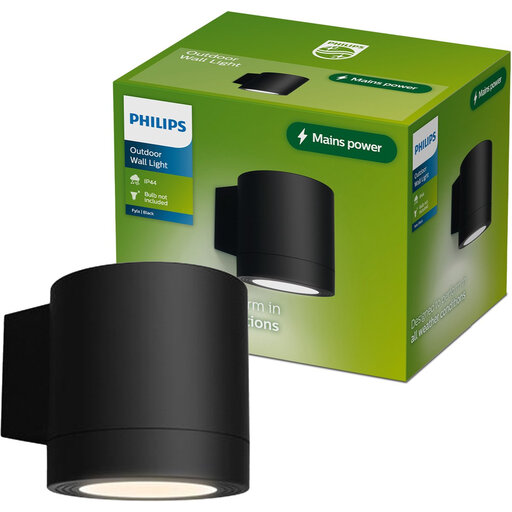
Why it suits this profile: This compact black outdoor wall light uses a replaceable GU10 bulb. You can change the bulb later without replacing the fitting.
The IP44 rating makes it clear that this light is protected against splashes, not fully waterproof. The GU10 fitting is also clearly specified.
Aluminium housing, one GU10 fitting, compact dimensions of approximately 8,9 × 11,6 × 9 cm and a choice of different GU10 LED spotlights.
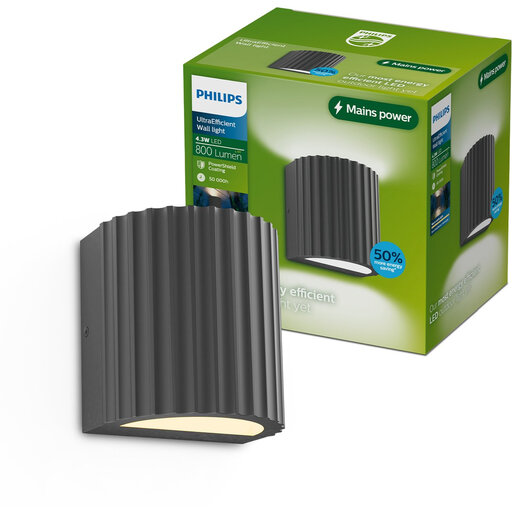
Why it suits this profile: This fixed outdoor wall light is ideal if you’re looking for a finished fitting with integrated lighting and a clearly defined light pattern.
The bulb, colour temperature and brightness are specified in advance, so there’s no need to find a separate fitting and spotlight to match.
Integrated LED, 800 lumens, warm white light at 2700K, 4,3 W power and light directed in two directions. According to the product information, the stated lifespan is up to 50.000 hours.

Why it suits this profile: This wireless solar pendant light is a good fit for a patio, balcony or garden where there’s no fixed mains connection.
The solar design eliminates the need for cables, but does require plenty of sunlight. Automatic switching and battery information make it clear how the light works.
Bluetooth control, lithium iron phosphate battery, automatic switching on in the dark and colour settings according to the product description. The stated luminous flux varies between the specifications, so check the current product page.
We’ve put together a complete, up-to-date list of products that meet these strict selection criteria and the applicable European safety regulations.
An IP44 outdoor light is often used in sheltered locations. This rating provides protection against splashes, but not direct jets of water. A higher IP rating may be suitable for a fully exposed location. Always check the installation instructions for the specific model.
A solar outdoor light doesn’t use mains electricity while charging. However, how long it stays lit depends on sunlight, the position of the panel, temperature and battery capacity. For consistent lighting at a dark entrance, a mains-powered LED outdoor light may be more reliable.
Lifespan varies by product and conditions of use. Integrated LED models often state an expected operating life in the product specifications. With a GU10 fitting, you only need to replace the bulb. Clean the housing carefully and regularly check the connections and seals. Don’t clean the light with a powerful jet of water.
