
Vandaag of morgen in huis

Kwaliteit gegarandeerd

Welkomstaanbiedingen ontgrendelen: GRATIS bezorging | Tot 80% korting | Gratis 30 dagen JoyPlus-proefperiode
Download de app
A dark driveway, poorly lit entrance or uninviting patio does not automatically call for the brightest lamp. When it comes to outdoor lighting, it is about finding the right balance between light output, protection against moisture, power supply and installation. If you focus only on design or a high lumen rating, you could end up buying a lamp that is hung in the wrong place, does not receive enough charge or wears out sooner than expected.
An IP44 outdoor lamp is protected against splashing water, but not against powerful water jets or immersion. This makes this type suitable for, for example, a covered entrance, balcony, veranda or sheltered patio. For a façade that is constantly exposed to rain, an IP65 outdoor lamp is generally the more logical choice.
Also pay attention to the difference between splash-proof and fully waterproof. Always check the complete product description and the recommended mounting location.
A solar-powered outdoor lamp only works well when the solar panel receives enough direct light during the day. Shade from a wall, tree or canopy can lengthen charging time and shorten the operating time. In the Netherlands, cloudy weather and shorter days are particularly important factors in winter.
Claims about, for example, a certain operating time depend on the weather, positioning and battery condition. Treat such figures as product specifications under the stated conditions, rather than as a guaranteed daily result.
More lumens means more light, but it does not always mean a better solution. A 4,000-lumen lamp may be unnecessarily bright beside a front door, while a subtle wall lamp may work better there. For patio lighting and balcony lighting, light colour, dimmability and glare are often more important than maximum brightness.
Also consider the light source. An integrated LED is easy to use, but it usually cannot be replaced by the user. A fitting with an E27 or GU10 socket gives you more freedom to choose your own LED bulb.
The IP code consists of two digits. The first digit refers to protection against solid particles, while the second refers to protection against water.
Lumens indicate how much light a lamp produces according to its product specifications. Kelvin indicates the colour temperature:
An LED outdoor lighting product with an integrated LED requires little attention during everyday use. However, check whether the light source is replaceable and whether the lamp is dimmable.
Solar lighting does not require fixed wiring, but it does need a location with enough sunlight. USB-rechargeable lamps are flexible, but need to be charged regularly. A fixed 230V wall lamp will generally need to be installed by a qualified electrician.
With an outdoor lamp with motion sensor, the detection range, activation time and mounting height are all relevant. Do not point the sensor directly at a busy street or moving branches, to limit unnecessary activation.
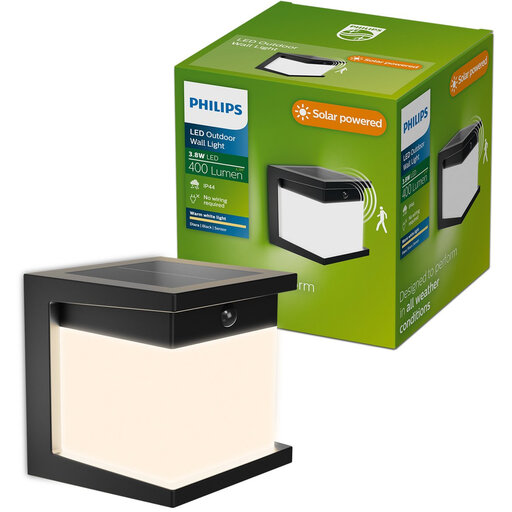
Why it suits this profile: This solar-powered outdoor wall lamp works without fixed wiring and has an integrated motion sensor. This makes it practical for a balcony, garden path or entrance where wiring is difficult.
The product description clearly states IP44 and the need for direct sunlight. This makes it clear in advance that this lamp is mainly suitable for sheltered locations.
400 lumens, warm white light at 2700K, two lighting modes and integrated solar power.
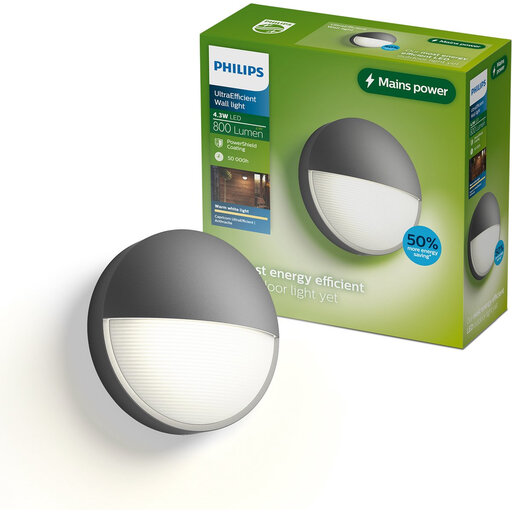
Why it suits this profile: A fixed wall lamp with an aluminium housing and integrated LED is ideal if you want sleek façade lighting with a fixed light colour and high light output.
The specifications state 800 lumens, 2700K and IP44. This allows you to compare the light output and suitable mounting location in advance, rather than choosing based on appearance alone.
Aluminium and plastic, 800 lumens, 2700K and a stated lifespan of up to 50,000 operating hours.

Why it suits this profile: This solar security light is designed for a driveway, garage, back garden or other large outdoor area where broad, powerful lighting is required.
With IP65, its stated protection against water and dust is higher than that of IP44 models. However, the lamp requires secure mounting and a location where the solar panel receives light.
4,000 lumens, IP65, motion detection and a detection range stated in the specifications as 8 metres for a direct approach and 16 metres for a sideways approach.
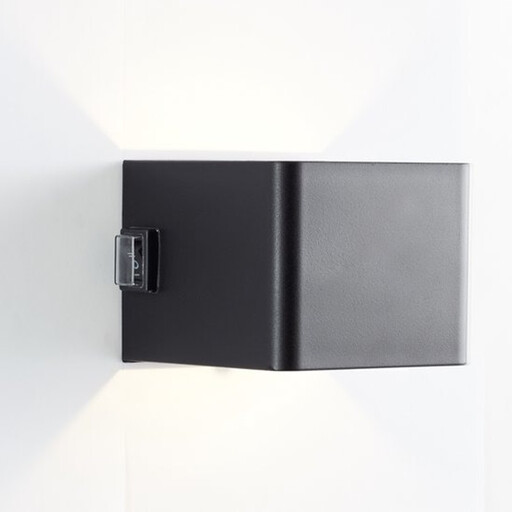
Why it suits this profile: This wireless, rechargeable lamp with magnetic mounting is convenient for rented homes, balcony lighting and locations where you do not want to install a fixed connection.
The lamp runs on a rechargeable battery and requires no fixed wiring. IP44 makes it suitable for splashing water, but not for direct water jets.
300 lumens, 3000K, integrated LED, USB charging and a motion sensor.
We have put together a complete, up-to-date list of products that fully meet these strict selection criteria and the applicable European safety regulations.
Yes, provided the solar panel receives enough direct daylight and the lamp is suitable for outdoor use. Cloudy weather, shade and shorter days can affect charging time and operating time. Position the panel in an unobstructed location and keep its surface clean.
Lifespan varies depending on the model and conditions of use. Manufacturers sometimes state an expected lifespan, such as 15,000 or 50,000 operating hours. This is a product specification, not a guarantee of a fixed period of use. With an integrated LED, the entire lamp will generally need to be replaced when the light source reaches the end of its lifespan.
A sensor can limit operating time because the lamp only switches on when motion is detected. Actual consumption depends on the wattage, the number of activations and the set operating time. With solar garden lighting, energy comes from the battery; fixed LED lighting uses electricity from the mains.
