
Vandaag of morgen in huis

Kwaliteit gegarandeerd

Welkomstaanbiedingen ontgrendelen: GRATIS bezorging | Tot 80% korting | Gratis 30 dagen JoyPlus-proefperiode
Download de app
The right outdoor lighting needs to do more than look attractive. In the Netherlands, outdoor lights have to cope with rain, wind, temperature fluctuations and limited sunlight in winter. Yet many buyers focus mainly on design or the number of lumens. This can lead to a lamp that is too dim, poorly positioned or less practical than expected after a short time.
As a Joybuy Product Recommendation Officer, I focus on specifications you can check, such as IP rating, brightness, power supply, materials and installation. Below, you’ll find the main pitfalls to avoid, along with options to suit different situations.
A lamp with an IP44 outdoor lighting rating is protected against solid objects larger than 1 millimetre and splashing water from different directions. This makes IP44 suitable for many sheltered exterior walls, balconies and covered patios. It doesn’t mean the lamp can withstand immersion or powerful jets of water.
For a more exposed location, IP65 outdoor lighting may be more practical. IP65 offers protection against dust and water jets, but the lamp must still be installed according to the instructions. So don’t rely on the word “waterproof” in an advert alone: check the official IP rating.
A bright lamp isn’t automatically right for every purpose. An outdoor ground spotlight for a tree needs a different level of brightness from a subtle garden light beside a path. For ambience, warm white tones of around 2700 to 3000 K often feel more relaxing. You may want brighter lighting for a driveway or security.
As well as lumens, check the beam angle and light colour. A directional spotlight illuminates a smaller area, while a wall light with a diffuser spreads the light more widely.
A solar outdoor light is easy to install, but works most reliably when its solar panel gets several hours of direct daylight. Shade from a fence, tree or canopy can affect how long it stays lit. Output may also be lower during the darker months.
A fixed LED outdoor light connected to 230 volts often needs a suitable outdoor power connection and professional installation. A light with an E27 or GU10 fitting gives you more flexibility, but check whether the bulb is included. With some models, you’ll need to buy it separately.
Choose the rating to suit the location:
An integrated LED outdoor light doesn’t need a separate bulb. Check the stated lumen count, wattage and colour temperature. A product description may list a lifespan in operating hours; treat this as a stated product specification, not a guarantee of how long the light will last in use.
With a separate GU10 or E27 bulb, you can replace the light source later. This is useful if you want a different colour temperature or dimming function. Always check the fitting’s maximum wattage.
Measure the available space beforehand. A large outdoor wall light may get in the way at a narrow entrance. Also check:
For an outdoor light with a motion sensor, the detection angle, range and adjustment options are all relevant. A sensor light pointed at a busy pavement may switch on more often than you’d like.
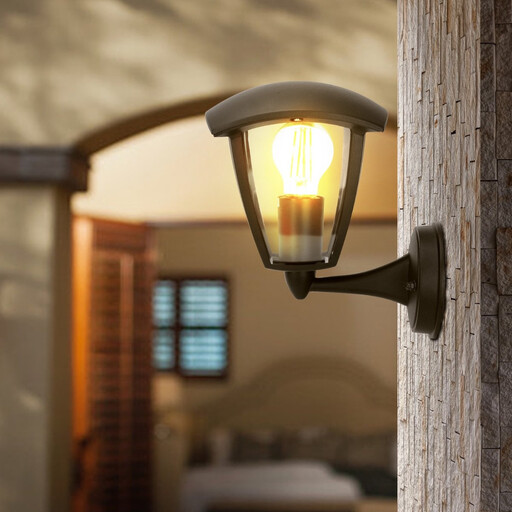
Why it suits this type of buyer: This outdoor wall light has an E27 fitting, so you can choose a suitable bulb for your balcony, covered patio or entrance.
The product information clearly states that the bulb isn’t included, so you can factor in the extra purchase beforehand.
E27 fitting, maximum 60 W and an IP44 rating for sheltered outdoor locations.
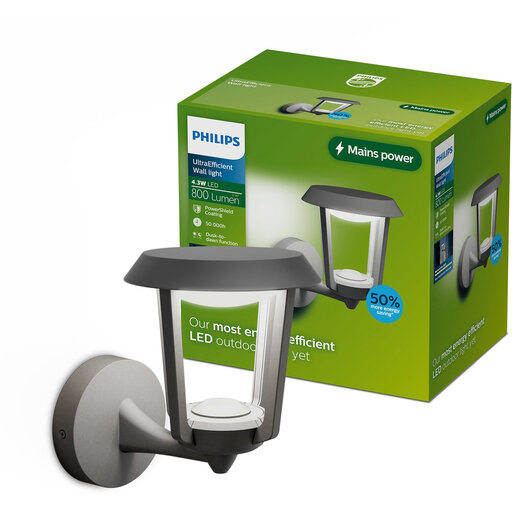
Why it suits this type of buyer: A fixed wall light for anyone looking for warm lighting at an entrance or patio, with an integrated LED and a classic lantern shape.
The specifications list 800 lumens, 2700 K, 4.3 W and IP44. This makes it easy to assess the light colour, energy use and protection rating in advance.
Integrated LED, warm 2700 K light and a stated lifespan of 50,000 operating hours.

Why it suits this type of buyer: Ideal for a driveway, garage, back garden or spacious patio where wide light coverage and motion detection are useful.
The stated IP65 rating and three lighting modes give you more useful information than a general claim about weather resistance alone.
According to the product specifications: 3,000 lumens, three adjustable light heads, a 180-degree detection angle and solar power.
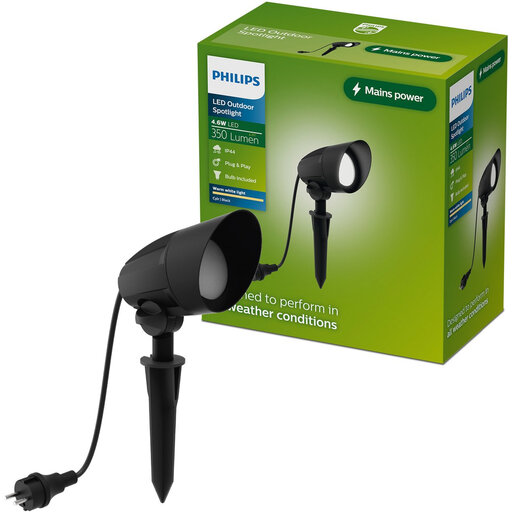
Why it suits this type of buyer: For anyone who wants to highlight a shrub, tree, exterior detail or driveway without installing a wall fitting.
The product information lists the included GU10 LED, 150 cm cable and IP44 rating. It still needs to be positioned away from direct water jets.
Rotatable ground spotlight, warm 2700 K light and 350 lumens for directional accent lighting.
We’ve put together a complete, up-to-date list of products that meet these strict selection criteria and the applicable European safety regulations.
That depends on where it’s installed. IP44 is suitable for splashing water and is often a good fit beneath the eaves, on a balcony or on a sheltered exterior wall. For a fully exposed location with direct rain or lots of dust, IP65 may be a better choice. Always check the installation instructions and keep an IP44 fitting away from direct water jets.
Expected lifespan varies by model and conditions of use. Manufacturers sometimes state a number of operating hours, such as 15,000 or 50,000 hours. This is a stated specification. Clean the fitting and solar panel regularly, and make sure the connections are installed correctly.
A solar outdoor light doesn’t use electricity from the mains during normal operation. Its solar panel charges an internal battery. How long it stays lit in practice depends on sunlight, the season, where it’s installed, battery capacity and the selected lighting mode. This means the light may stay on for less time in winter.
