
Vandaag of morgen in huis

Kwaliteit gegarandeerd

Welkomstaanbiedingen ontgrendelen: GRATIS bezorging | Tot 80% korting | Gratis 30 dagen JoyPlus-proefperiode
Download de app
Good outdoor lighting should suit the location, purpose and available power supply. A light for creating atmosphere on the patio has different requirements from security lighting by a garage or driveway. Yet many product pages focus mainly on lumens, design and smart features. As a result, it is not always clear whether a light is suitable for rain, prolonged use or a dark garden.
Look out for these three common pitfalls:
The IP rating consists of two digits. The first indicates protection against solid particles, while the second indicates protection against water.
Also check the installation instructions. An IP44 light may be technically suitable for outdoor use, but still not intended for a fully exposed location.
Colour temperature is measured in kelvins:
Light output is measured in lumens. A low lumen count is often enough for path lighting. A wide wall light with a motion sensor may need more output to cover a driveway or side garden. Also consider the beam and whether it can be adjusted: an adjustable outdoor ground spotlight can highlight a tree or part of a wall without lighting up the whole garden.
A 230-volt light needs a suitable outdoor connection. Have fixed wiring and connections installed by a qualified electrician in line with local regulations. For a GU10 light, also check whether the bulb is included and what the maximum permitted wattage is.
Solar-powered garden lights are easier to position because they don’t need a fixed cable. However, they need a spot with enough direct daylight. Clean the solar panel regularly with a soft cloth and keep the motion sensor free of dirt. For a solar outdoor light with a sensor, the detection angle, range and light settings are also important.
The selection below matches specific product features to different situations. Always check the current product page, dimensions and installation requirements before buying.

Why it suits this need: This compact solar garden light is designed to provide simple guidance along a flower bed, garden path or patio. It can be installed without a fixed power connection.
The product information specifies an IP44 rating, a polycrystalline solar panel and a charging time of 4 to 6 hours. So expect guidance lighting, not powerful security lighting.
Stainless steel housing, ground stake for installation and a stated run time of 8 to 12 hours under the specified conditions.
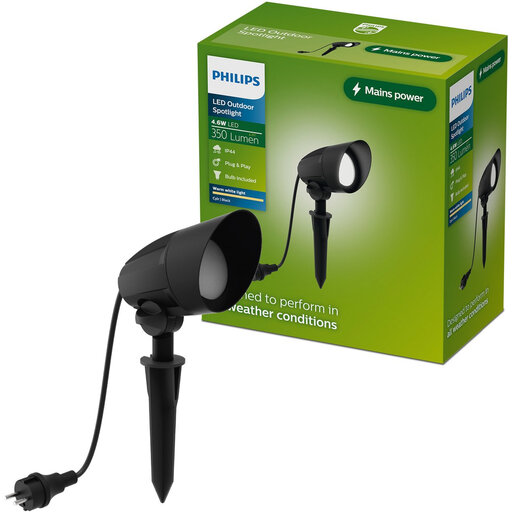
Why it suits this need: This adjustable outdoor ground spotlight is suitable for homeowners looking for a fixed power supply and focused lighting for a driveway, gate, lawn or planting.
The specifications clearly state IP44, 350 lumens, 2700 K and a 150 cm cable. So don’t use the light where it will be exposed to direct jets of water.
Includes a GU10 LED spotlight, aluminium and glass construction, an adjustable head and warm white light at 2700 K.

Why it suits this need: This solar outdoor light with sensor is designed for large outdoor areas where plenty of light is needed, such as a driveway, the side of a garage or a wide garden wall.
The product details specify IP65, with motion detection up to 8 metres when approached head-on and 16 metres when approached from the side. Adjust the head carefully to reduce glare.
4000 lumens, integrated LED, solar power and two light settings, according to the product information.
We’ve put together a complete, up-to-date list of products that meet these strict selection criteria and the applicable European safety regulations.
For a garden path, soft, even path lighting is usually more practical than a very bright floodlight. Solar stake lights are easy to position, but check that the spot gets enough daylight. For a dark path with little sun, a wired outdoor LED light may be a better choice.
It depends on the location. IP44 is designed to protect against splashing water and is often suitable for sheltered outdoor areas. For a fully exposed wall, driveway or location that gets a lot of rain, IP65 is a more suitable specification. Always follow the manufacturer’s installation and safety instructions.
A solar light doesn’t use electricity from the mains while it’s on. Its performance in practice depends on sunlight, battery capacity, temperature and the selected light setting. Clean the panel and position the light away from shade to make the best possible use of the available charging energy.
