
Vandaag of morgen in huis

Kwaliteit gegarandeerd

Welkomstaanbiedingen ontgrendelen: GRATIS bezorging | Tot 80% korting | Gratis 30 dagen JoyPlus-proefperiode
Download de app
An outdoor light needs to do more than look attractive in a product photo. In the Netherlands, outdoor lighting has to cope with rain, wind, temperature fluctuations and occasional splashing water. Yet important differences between a garden light, outdoor wall light and ground spotlight often only become clear after purchase.
The most common pitfalls:
An IP code consists of two digits. The first digit indicates protection against solid particles; the second relates to water.
An IP rating does not automatically make a light suitable for every location. Also check the installation instructions, the cable entry and whether the light will be continuously exposed to direct water jets.
Pay attention to the difference between integrated LED and a replaceable fitting.
For a pathway, even lighting is often more important than a high light output. For a driveway or entrance, you may instead want better visibility and a sensor function.
According to the product information for several models, a mains-powered outdoor wall light running at 230 volts must be connected by a qualified electrician. Switch off the power before installation or maintenance.
A battery-powered or solar light can be positioned more flexibly. Bear in mind that:
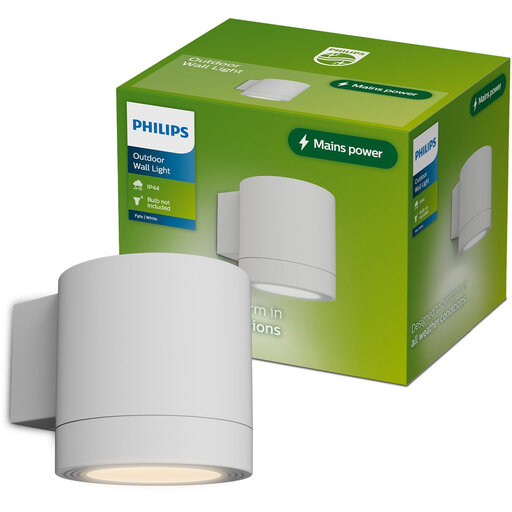
Why it suits this profile: This compact outdoor wall light has a GU10 fitting, allowing you to choose a suitable LED bulb and colour temperature yourself. Its dimensions are 8.9 × 11.6 × 9 cm.
The product information clearly states that the GU10 light source is not included. This makes it easier to estimate the total purchase cost in advance.
IP44 rating, aluminium housing and replaceable GU10 fitting.
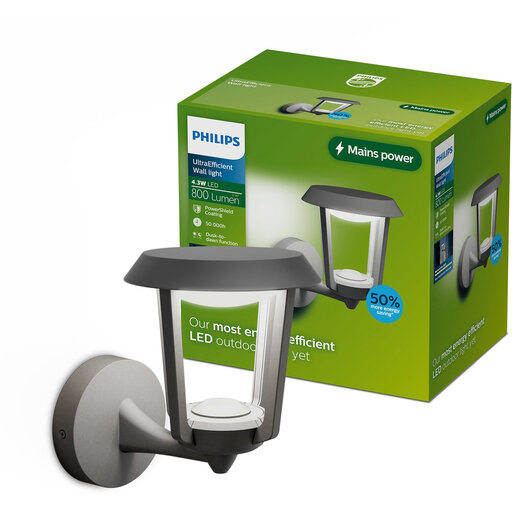
Why it suits this profile: According to the product specifications, the integrated LED provides 800 lumens at 2700 K. This makes the light suitable for an entrance, patio or balcony where warm white light is preferred.
You do not need to select a separate fitting or bulb. The light source is integrated and the light colour is set in advance.
800 lumens, 4.3 watts, integrated LED and IP44 protection.

Why it suits this profile: This solar outdoor light is designed for locations such as a garage, driveway or garden where a permanent power connection is not desired. According to the product information, it has three light modes and a motion detection angle of 180 degrees.
The IP65 rating is higher than IP44. However, check that the location receives enough direct sunlight for the solar panel.
302 LEDs, stated luminous flux of 3000 lumens, three light modes and installation without fixed wiring.
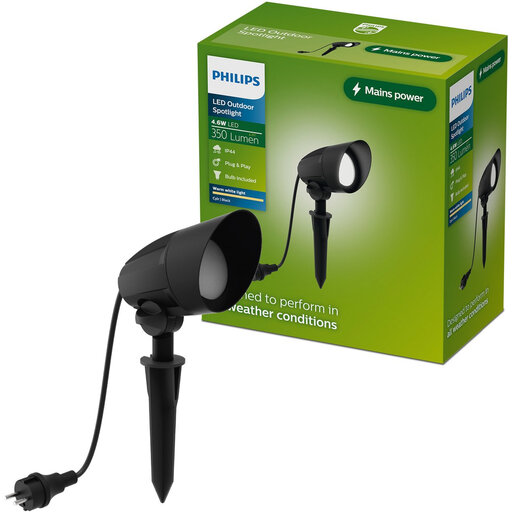
Why it suits this profile: This outdoor ground spotlight can be rotated and is supplied with a GU10 LED bulb. Use it to highlight a tree, flower bed or another garden feature.
The product information explicitly mentions IP44 and warns against immersion and direct water jets. Therefore, place the spotlight on stable ground and not in a puddle.
350 lumens, warm white light at 2700 K, 1.5-metre cable and included GU10 LED bulb.
We have put together a complete, up-to-date list of products that fully meet these strict selection criteria and the applicable European safety regulations.
Clean the housing regularly with a soft, dry or slightly damp cloth, depending on the manufacturer’s instructions. For solar outdoor lighting, also clean the panel and sensor window. With a wall light, check that the seal remains intact after replacing a light source.
Position a sensor light so that animals, passing cars or moving branches are not detected unnecessarily. For a permanent connection, have the installation carried out in accordance with local regulations. This will help prevent an attractive outdoor light from being installed unsafely or impractically.
A lower light output may be sufficient for atmospheric garden lighting. More light is often practical for an entrance, driveway or motion sensor. In addition to lumens, consider the direction of the light: a downward-facing beam illuminates a path differently from a light that spreads light all around.
IP44 is suitable for many sheltered outdoor applications and protects against splashing water. It does not protect against powerful water jets or immersion. For an open, heavily exposed location, a higher IP rating may be more suitable.
An LED outdoor light generally uses few watts in relation to its light output. Actual consumption depends on the wattage, the number of hours it is switched on and whether a sensor is used. A light with a motion sensor may stay on for less time than a light that remains on continuously throughout the evening.
