
Vandaag of morgen in huis

Kwaliteit gegarandeerd

Welkomstaanbiedingen ontgrendelen: GRATIS bezorging | Tot 80% korting | Gratis 30 dagen JoyPlus-proefperiode
Download de app
Good outdoor lighting needs to do more than just look attractive. A light by the front door needs to be safe and practical, while garden lighting on a patio can focus more on creating atmosphere. Yet many buyers concentrate mainly on design, lumens or an appealing product claim. This can lead to problems: a light turns out to be too dim, solar outdoor lighting barely works in winter, or an IP44 outdoor light is installed in a spot that is too exposed.
Before you buy, look out for these three common pitfalls:
The IP code indicates how well a light fitting is protected against dust and water. For many uses in the Netherlands, this is a useful starting point:
An IP44 outdoor light isn’t automatically suitable for every outdoor location. IP44 is often practical for an outdoor wall light under a roof; where the light is directly exposed to rain and dirt, a higher level of protection may be more suitable.
Lumens indicate the amount of visible light. A lower light output is often enough to create atmosphere on a patio. A driveway, garage or back path may need more light. Also consider how the light is distributed:
Colour temperature affects the look and feel of the light. Around 2700–3000 K usually gives a warm white light. Higher values look cooler and brighter. Check that the colour temperature listed in the product information matches the atmosphere you want; marketing terms such as “warm white” can be confusing.
Solar outdoor lighting works without a fixed mains connection, but needs a spot with enough direct sunlight. For a mains-powered LED outdoor light, you’ll need to consider the wiring and safe installation. Have a fixed 230 V connection installed in accordance with the applicable regulations.
Also check the type of light source:

Why it suits this type of buyer: This solar wall light is suitable for an entrance, balcony or garden without a power point. Its automatic and manual lighting modes make it an easy way to get started with solar-powered outdoor lighting.
The product information clearly states that it’s solar-powered, has a motion sensor and carries an IP44 rating. Position the light so that the panel gets direct sunlight and is sheltered from direct water jets.
1,000 lumens, 3000 K, integrated LED, motion sensor and installation without a mains connection.
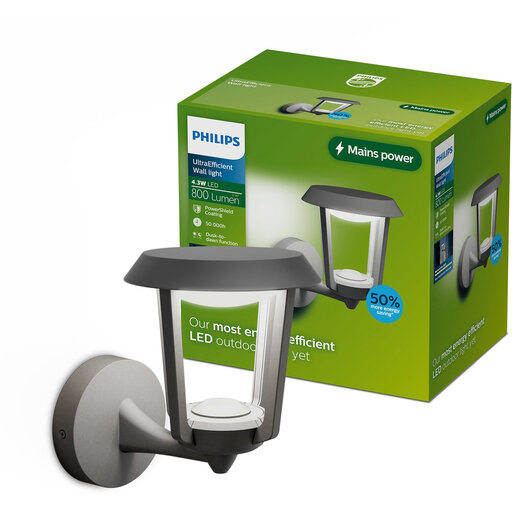
Why it suits this type of buyer: This mains-powered wall light suits a wall, balcony or entrance where a subtle look and warm light are important.
The specifications list 800 lumens, 2700 K and IP44. This makes it easier to match the brightness and colour to a sheltered outdoor spot, rather than choosing on appearance alone.
Integrated LED, 800 lumens, warm white light at 2700 K and an aluminium housing with PowerShield coating, according to the product information.

Why it suits this type of buyer: This solar outdoor light is designed for larger areas such as a driveway, garage, garden or patio, where wide coverage and motion detection are useful.
The product description lists three lighting modes, a 180° detection angle and IP65. Do check first whether its high output of 3,000 lumens is right for your setting.
Three adjustable light heads, 270° coverage, 3,000 lumens, a 1800 mAh solar battery and IP65, according to the product specifications.
We’ve put together a complete, up-to-date list of products that meet these strict selection criteria and the applicable European safety regulations.
An IP44 outdoor light is often sufficient for a sheltered balcony, such as an outdoor wall light or compact solar lighting. Check that the light won’t be exposed to direct water jets. For a freestanding light, you could also consider a portable model with an integrated LED.
Run time each night depends on the battery capacity, the amount of sunshine during the day, the temperature and the selected lighting mode. Manufacturers sometimes give a maximum run time, but this isn’t guaranteed in every type of Dutch weather. Keep the solar panel clean and place it somewhere free from shade.
An LED outdoor light generally uses less power than traditional light sources with a similar light output. Actual consumption depends on the wattage, the number of hours it’s on and whether a sensor is used. A motion sensor can reduce the time the light is on, while solar outdoor lighting doesn’t use electricity from the mains.
