
Vandaag of morgen in huis

Kwaliteit gegarandeerd

Welkomstaanbiedingen ontgrendelen: GRATIS bezorging | Tot 80% korting | Gratis 30 dagen JoyPlus-proefperiode
Download de app
The right outdoor lighting makes a driveway, exterior wall, patio or balcony more usable after dark. But a good product photo isn’t enough to help you make the right choice. Some outdoor lights are suitable only for a covered patio, while others are designed for an open garden. Terms such as “waterproof”, “powerful lighting” and “long-lasting” can also give an incomplete picture.
So, keep an eye out for these common pitfalls:
The IP rating consists of two digits. The first indicates protection against solid particles, while the second indicates protection against water.
An IP rating doesn’t tell you everything about frost resistance, impact resistance, cable quality or how the light is secured. So, don’t install an IP44 model somewhere it will be exposed to heavy rain or splashing water for long periods.
With LED outdoor lighting, the LEDs are usually built in. If so, check the lumen output, colour temperature and whether the light source can be replaced. With an E27 or GU10 fitting, you can choose a suitable LED bulb yourself, but check the maximum wattage.
For example:
An outdoor wall light with warm white light at around 2700–3000 K usually creates a soft glow. For practical lighting, a more neutral or cooler colour temperature may work better.
A fixed 230 V light needs a suitable outdoor connection. Hardwired models must be installed by a qualified electrician. A plug-in ground spotlight is easier to position, but you’ll need an outdoor socket.
A solar outdoor light works without fixed wiring. However, its performance depends on where the solar panel is positioned, the season and the number of hours of direct sunlight it receives. A rechargeable or USB-C light is portable and flexible, but needs to be charged in good time.
For an outdoor light with a sensor, check whether it has a motion sensor, a day/night sensor or both. Also consider the detection angle and the recommended installation height.
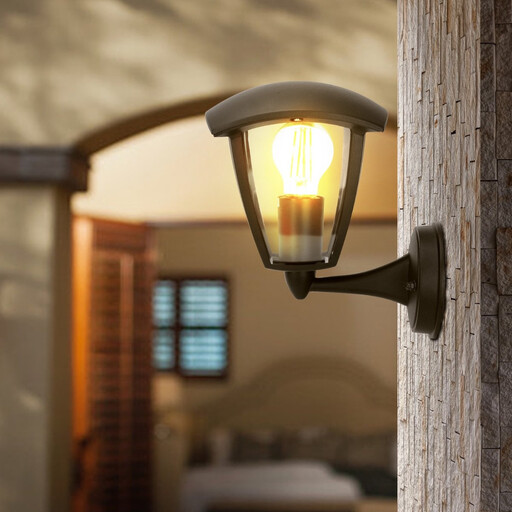
Why it suits this type of user: This wall light has an E27 fitting, so you can choose a suitable LED bulb and light colour for a balcony, walkway or covered entrance.
The product information clearly states that it has an IP44 rating and that the bulb isn’t included. Install the light in a sheltered spot and choose a suitable E27 LED bulb yourself.
E27 fitting, aluminium and PMMA construction, maximum 60 W and compact dimensions of 215 × 170 × 235 mm.
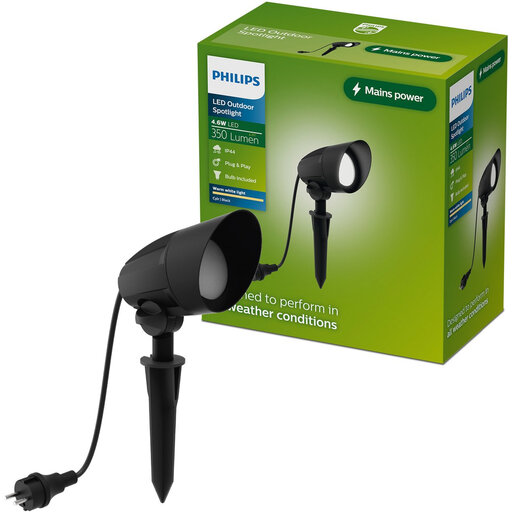
Why it suits this type of user: Ideal if you want to spotlight a shrub, tree, driveway or gate without installing a fixed wall light.
The GU10 LED bulb is included, and the specifications state an output of 350 lumens, a colour temperature of 2700 K and an IP44 rating. Bear in mind that it needs to be connected to a suitable outdoor socket.
Adjustable spotlight, 150 cm cable, 4.6 W LED bulb and a stated lifespan of 15,000 hours.

Why it suits this type of user: This solar outdoor light is designed for larger areas, such as a driveway, garden, garage or patio, where wireless installation is preferable.
The stated IP65 rating makes it suitable for a more exposed outdoor location. For the light to work properly, it still needs to be positioned somewhere that gets enough direct sunlight.
Three adjustable heads, motion detection, three lighting modes and a stated light output of 3000 lumens.
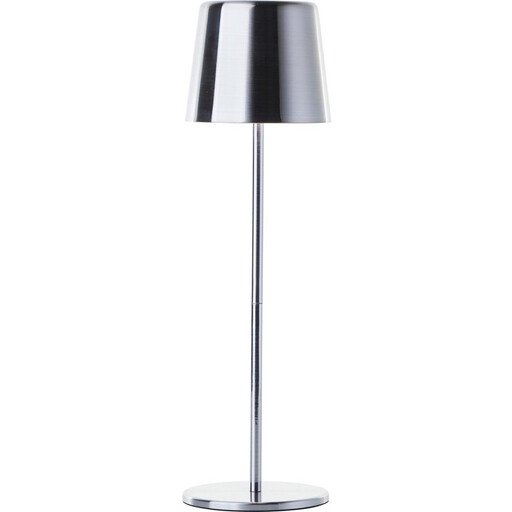
Why it suits this type of user: A portable outdoor table lamp is handy if you don’t want to run cables and would like to bring the light indoors after use.
The IP44 rating makes clear that the light is splash-resistant, but isn’t suitable for immersion or direct water jets.
Integrated 4 W LED, 300 lumens, touch dimming and adjustable colour temperature from 3000–6500 K.
We’ve put together a complete, up-to-date list of products that meet these strict selection criteria and comply with current European safety regulations.
An IP44 outdoor light may be suitable for a sheltered spot. For an exposed exterior wall, garden or driveway, IP65 outdoor lighting is often more practical, as it offers better protection against dust and water jets. Always check the installation location and the instructions.
LED lights generally use little energy. The actual cost depends on the wattage, the number of hours they’re on and the price of electricity. A solar outdoor light doesn’t use mains electricity while it’s on, but relies on sunlight and battery capacity.
Lifespan varies depending on the light source, battery, housing and exposure to the weather. Integrated LED models sometimes have a stated lifespan, such as 10,000 or 15,000 hours. This is a product specification, not a guarantee of a particular lifespan in every outdoor setting in the Netherlands. Limit exposure to moisture, clean solar panels and sensors, and store portable lights in a sheltered place during prolonged bad weather.
