
Vandaag of morgen in huis

Kwaliteit gegarandeerd

Welkomstaanbiedingen ontgrendelen: GRATIS bezorging | Tot 80% korting | Gratis 30 dagen JoyPlus-proefperiode
Download de app
Good outdoor lighting needs to suit the place where you use it. A light for a covered entrance has different requirements from garden path lighting beside a wet lawn, or an outdoor light with a motion sensor by the driveway. Yet many buyers focus mainly on design and brightness. This can lead to a purchase you regret.
A light with an IP44 outdoor lighting rating is protected against water splashes from different directions. That doesn’t mean you can install it anywhere exposed to direct jets of water or prolonged rain. Also check that the fitting is installed and sealed correctly.
According to the technical classification, IP65 offers greater protection against dust and water jets. Installation still matters, though. A poor seal, damaged cable or open connection can reduce the level of protection.
An outdoor wall light with an E27 socket or GU10 socket may be supplied without a bulb. You’ll then need to buy a suitable LED bulb separately. So check:
A warm colour temperature of around 2700K to 3000K usually works well on a patio or by an entrance. Cooler light can be more practical for a driveway, shed or back door.
Solar garden lights are easy to install, but need direct sunlight to charge sufficiently during the day. Shade from a fence, tree or canopy can reduce how long they stay lit. The stated running time also depends on the season, cloud cover, positioning and battery condition.
If you’re considering a solar outdoor light with a motion sensor, check whether it stays on continuously, only switches on when it detects movement, or offers several modes.
Start by choosing where you’ll install the light. IP44 may be suitable for a sheltered balcony wall. For a spot where the light will be exposed to more dust and rain, IP65 may be more practical. Also check the installation instructions: some models are designed for wall mounting, while others are made to be placed in the ground or connected to an outdoor socket.
Lumens indicate how much light a lamp emits according to the product details. A path light with 10 lumens is mainly intended to subtly mark a route or border. A 3000-lumen floodlight illuminates a much larger area.
Pay attention to the beam direction, too. An outdoor ground spotlight can highlight a tree or exterior wall, while a downlight directs most of its light downwards. Warm white light is often better suited to creating atmosphere on a patio than cool white light.
Solar lights don’t need a fixed mains connection, but they do need to be positioned correctly. A wired outdoor wall light usually runs on 230 volts and must be installed in accordance with local regulations. With models such as a GU10 outdoor light or E27 outdoor light, you can often choose the bulb yourself, but always check the product manual.
An outdoor light with integrated LED has no separate socket. This makes the fitting compact, but the light source cannot be replaced by the user in some models.
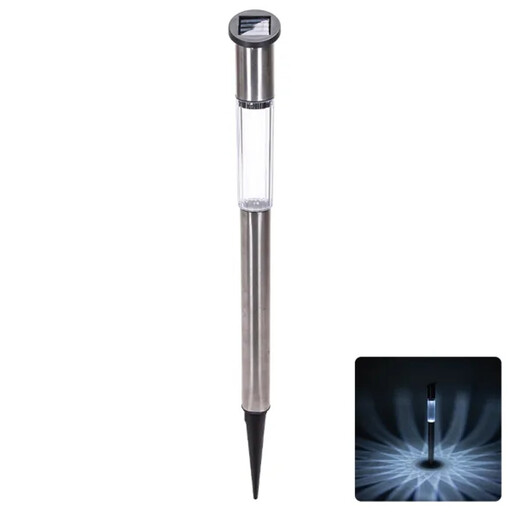
Why it suits this type of buyer: This solar spike light is designed for simple garden path lighting without fixed wiring. At 55 cm tall, it’s easy to position along borders and paths.
The product details clearly state the IP44 rating, NiMH battery and charging time of 4 to 6 hours. It still needs to be positioned in a spot with sufficient sunlight.
Stainless steel housing, a solar panel and a stated running time of 8 to 12 hours in suitable conditions.
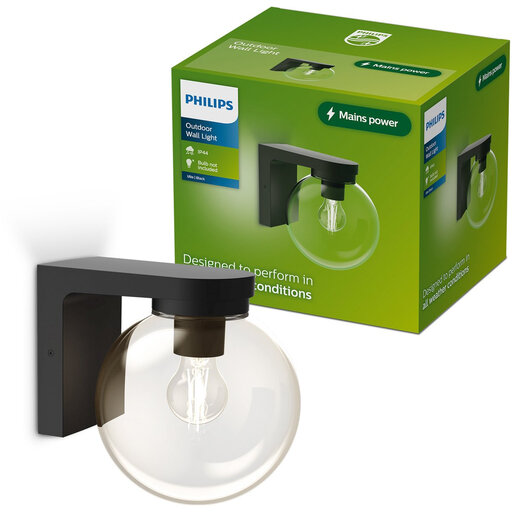
Why it suits this type of buyer: This outdoor wall light is well suited to an entrance, exterior wall or covered patio where you want a fixed fitting with a light source of your choice.
The product information states that it has an E27 socket and that no light source is included. You can therefore choose your preferred colour temperature and type of LED bulb.
Aluminium and glass construction, one light point, diffused light distribution and IP44 protection for outdoor use according to the product specifications.

Why it suits this type of buyer: This solar outdoor light with a motion sensor is designed for driveways, garages, patios and larger areas where you need plenty of light temporarily.
The product information lists IP65, three lighting modes and a sensor range of 60 feet with a 180-degree detection angle. Check that the installation spot gets enough sunlight.
302 LEDs, a stated light output of 3000 lumens, three adjustable heads and installation without fixed wiring.
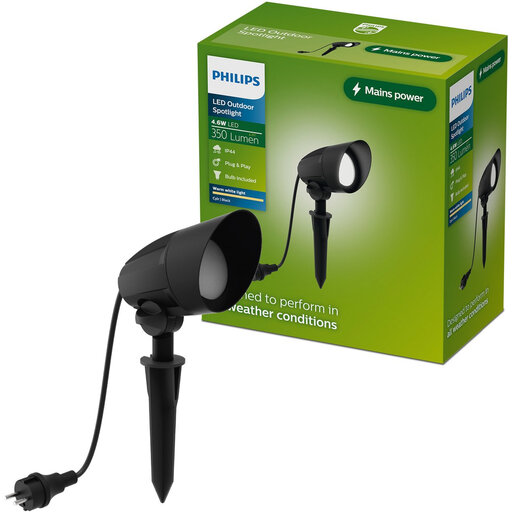
Why it suits this type of buyer: A good choice if you want to direct light onto a shrub, tree, driveway or exterior wall without installing a fixed wall light.
The product details list a GU10 LED bulb and cable. The IP44 rating makes it suitable for outdoor installation, but not where it will be exposed to direct water jets.
Warm white light at 2700K, 350 lumens, an adjustable spotlight and an included GU10 bulb.
We’ve put together a complete, up-to-date list of products that meet these strict selection criteria and the applicable European safety regulations.
It depends on where you’re installing it. IP44 is suitable for many sheltered locations and offers protection against water splashes. IP65 provides greater protection against dust and water jets. Always check the installation instructions, and avoid direct high-pressure water jets or immersion.
Lifespan varies from product to product. Some product specifications state, for example, 10,000, 15,000 or 30,000 hours of use. With solar lighting, charging cycles, temperature, sunlight and battery capacity also play a part. Treat the stated lifespan as a product specification based on certain conditions, not a guarantee for every situation.
A solar light doesn’t use mains electricity while it’s operating. Instead, it runs on energy stored in its battery during the day. Its actual running time depends on the amount of sunlight, the light’s settings and the battery. If you need consistent lighting throughout the night, wired garden lighting may be a better choice.
