
Vandaag of morgen in huis

Kwaliteit gegarandeerd

Welkomstaanbiedingen ontgrendelen: GRATIS bezorging | Tot 80% korting | Gratis 30 dagen JoyPlus-proefperiode
Download de app
Good outdoor lighting should suit the location, the weather and how you plan to use it. A light for a covered entrance has different requirements from one along a driveway or decorative outdoor Christmas lights. Yet many product pages focus mainly on lumens, the number of LEDs or eye-catching designs. As a result, you might buy a light that’s too bright, needs frequent maintenance or isn’t suitable for the place where you want to install it.
An IP44 outdoor light is protected against solid objects and splashing water. That doesn’t mean it can withstand a direct jet of water or immersion. IP44 may be suitable for a sheltered wall, balcony or covered area. Take extra care when choosing a light for a completely exposed location.
IP65 outdoor lighting offers a higher level of protection against dust and water jets according to its rating. Even then, correct installation is important: cable connections, sockets and mounting points must also be suitable for outdoor use.
A high number of LEDs doesn’t automatically mean the light will be comfortable or distributed usefully. A sensor light with a wide beam can be handy for a driveway, while a compact LED outdoor light may be a better fit for a narrow entrance. As well as lumens, consider:
A wired outdoor light operating at 220–240 V must be mounted securely and connected safely. Some models require installation by a qualified electrician. Solar outdoor lighting works without a fixed cable, but needs enough direct daylight. A rechargeable outdoor light with a motion sensor, meanwhile, needs to be recharged regularly.
Also check whether a bulb is included. Some wall lights have only an E27 or GU10 fitting, so you’ll need to buy a suitable bulb separately.
Use IP44 outdoor lighting mainly in sheltered locations, such as a covered veranda, balcony or entrance. For an exposed wall, garden path or spot that gets a lot of rain and dust, a model with a higher IP rating may be more practical.
An IP rating doesn’t tell you everything about a light’s overall durability. Check the material, cable, mounting requirements and care instructions too. A light made from aluminium, glass or sturdy plastic may be suitable for outdoor use, but it still needs to be installed according to the instructions.
An LED outdoor light usually uses little energy and often comes with an integrated light source or a GU10 fitting. A separate fitting gives you more choice of light colour and brightness. Always check the maximum wattage.
An outdoor light with a sensor is handy by an entrance, garage or driveway where you don’t need the light on all the time. Check the detection range, angle and adjustable modes. A sensor that’s too sensitive may switch on unnecessarily often.
With solar outdoor lighting, the position of the panel and the amount of sunlight are crucial. Don’t place the panel under a roof edge or near tall plants if little direct light reaches it. Solar lighting can be practical for decorative garden lighting or temporary use; for constant illumination, a fixed connection is more predictable.
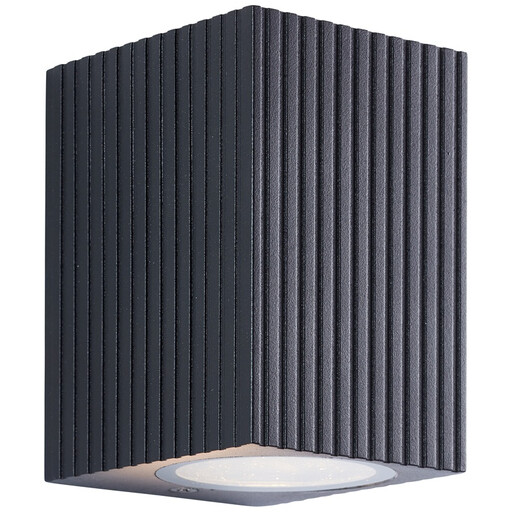
Why it suits this need: This compact wall light is suitable for a sheltered entrance, balcony or patio. The GU10 fitting lets you choose a suitable LED bulb yourself.
The product information clearly states that the bulb isn’t included and that IP44 is intended for sheltered outdoor locations. That way, you know what to expect before you buy.
Compact size of approximately 10 × 7 × 8 cm, GU10 fitting and a maximum of 10 W according to the product specifications.
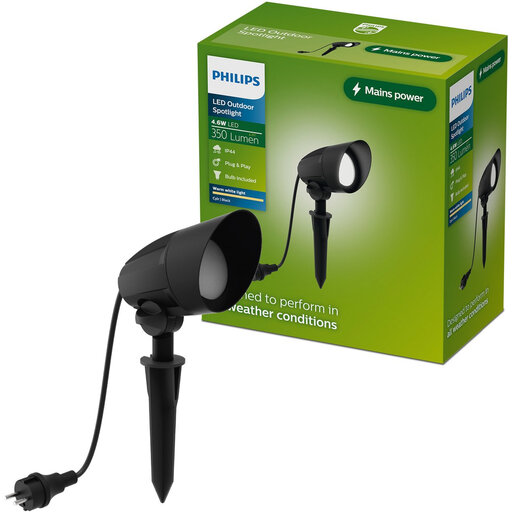
Why it suits this need: This ground spotlight is a good choice if you want to highlight a tree, flower bed, driveway or entrance without mounting a light permanently on a wall.
The product specifications list the included GU10 bulb, 150 cm cable and IP44 rating. This makes the limits of its splash protection clear.
Warm white light at 2700K, 350 lumens, adjustable positioning and an included 4,6 W GU10 LED according to the product details.

Why it suits this need: This solar outdoor light is designed for driveways, large gardens, garages and patios where wide coverage and motion detection are useful.
The product specifications list a 180° detection angle, three lighting modes and IP65 protection. The panel still needs to be placed in direct sunlight to charge the 1800mAh battery.
Three adjustable heads, 302 LEDs according to the product description and a stated light output of 3000 lumens.

Why it suits this need: This rechargeable wall light is handy for rented homes, balconies and places where you don’t want to run a cable.
The product information lists magnetic mounting, USB-C charging and IP44 protection. This makes the light easy to position, but it isn’t designed for immersion or direct water jets.
Integrated LED, 300 lumens, 3000K, motion sensor and cable-free mounting according to the product specifications.
For creating ambience, string lights and meteor lights are a different category from functional outdoor lights. According to the product information, the M.TK Meteor Shower Lights have 192 multicolour LEDs, eight hanging points, a coverage area of 5 × 0,3 metres and IP44 protection. This makes them suitable for festive decoration in a sheltered outdoor spot. For a wall, tree or balcony, always check that the adapter and connections can be kept dry.
If you’d like more control over fixed exterior lighting, look for a wall light with an E27 or GU10 fitting. For paths and flower beds, an outdoor ground spotlight may be a better choice. This helps you avoid using one type of light for situations with different lighting needs.
We’ve put together a complete, up-to-date list of products that meet these strict selection criteria and the applicable European safety regulations.
IP44 is often used in sheltered locations. For an exposed spot, IP65 may be more suitable. Also check the installation instructions and make sure the plug, cable and connection are suitable for outdoor use.
That depends on the amount of direct sunlight, the battery capacity and the lighting mode you choose. Position the solar panel in an unshaded spot and keep it clean. For lighting that needs to stay on for a long time and work reliably, a fixed connection may be more practical.
Energy consumption depends on the wattage and the number of hours the light is on. A 5 W light that’s on for four hours a day uses approximately 0,02 kWh per day. Check the wattage, usage time and current electricity rate for your own situation.
