
Vandaag of morgen in huis

Kwaliteit gegarandeerd

Welkomstaanbiedingen ontgrendelen: GRATIS bezorging | Tot 80% korting | Gratis 30 dagen JoyPlus-proefperiode
Download de app
Good outdoor lighting needs to do more than look attractive. On a Dutch house front, balcony or driveway, a light has to withstand rain, wind, dust and changing temperatures. Yet many buyers focus mainly on design and brightness. This can lead to problems: a light may not be suitable for where you want to install it, a solar outdoor light may not get enough sun, or a wall light may still need to be connected by an electrician.
An IP44 outdoor light is protected against solid objects and splashing water. This makes it suitable for sheltered spots, such as a covered entrance, balcony or patio. IP44 does not mean the light can withstand direct jets of water or immersion.
IP65 solar lighting offers greater protection against dust and jets of water. Even so, always check the installation location and product instructions. A high IP rating does not automatically make a light suitable for every situation.
A high lumen count may sound appealing, but more light is not always more practical. A powerful light can be dazzling on a small balcony, while a dark driveway may need a wider spread of light. So consider these factors too:
A fixed outdoor light rated at 220-240 volt will generally need to be connected to the mains. For several models, the product information states that installation must be carried out by a qualified electrician. A solar outdoor light works without fixed wiring, but its output depends on how much direct sunlight it gets.
Also check what’s included. A GU10 outdoor light does not always come with a bulb. Decorative Christmas lights for outdoors may, on the other hand, need an adapter. Check the plug type, cable length, fitting and mounting materials before you order.
Ideally, use an IP44 light on a sheltered wall, under a canopy or somewhere it won’t be exposed to direct jets of water. For an open driveway or an exposed garden, a higher level of protection may be more practical. The IP code is a technical indication, not a guarantee that every product will keep working without issue in all weather conditions.
LED outdoor lighting generally uses little energy and is available with either an integrated light source or a replaceable bulb. With a GU10 outdoor light, you can choose a suitable LED bulb yourself, but check the maximum wattage. An integrated LED light is compact, but according to the product information, it may not always be replaceable by the user.
For fixed lighting, it’s easy to compare energy consumption using the wattage and how long the light is used. With a solar outdoor light, panel size, battery capacity and hours of sunlight also matter. In winter or in a shady spot, the operating time may be shorter.
An outdoor light with a motion sensor is handy by a front door, garage or back entrance. Check the detection angle, range and whether you can switch the sensor on or off. For atmospheric lighting, a steady, soft light is often more relaxing. Automatic lighting may be more practical for a driveway or entrance.
An outdoor ground spotlight works well for lighting up a tree, architectural feature or flower bed. Position the spotlight securely and make sure the cable won’t create a tripping hazard. Also check that any outdoor socket is suitable and safely protected.
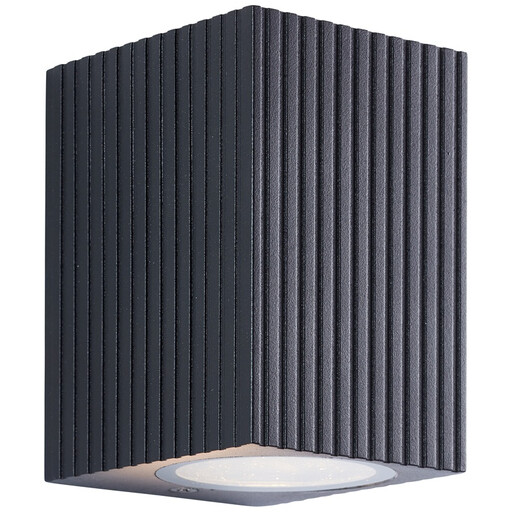
Why it suits this profile: This compact wall light has a GU10 fitting, so you can choose a suitable LED bulb yourself. That gives you control over the light colour and replacement.
The product information clearly states that the light is supplied without a bulb. It also explains that IP44 is suitable for sheltered outdoor locations, but not for direct jets of water.
Aluminium, glass and plastic; dimensions of approximately 10 × 6,9 × 7,8 cm; maximum 1 × 10 W GU10.
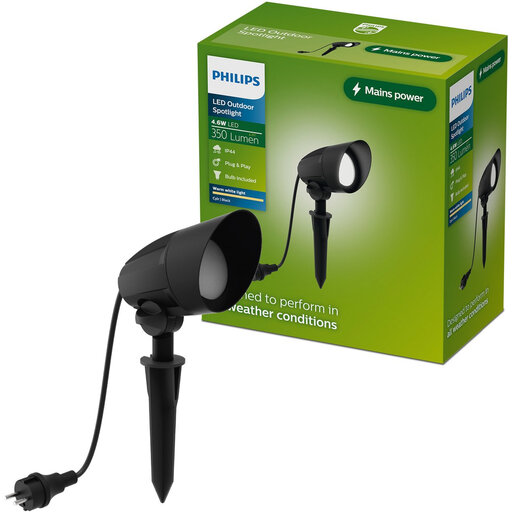
Why it suits this profile: This ground spotlight is designed for driveways, flower beds and lawns. The included GU10 light source gives off warm white light, and the spotlight can be set into the ground.
The product specifications state IP44 and warn against immersion and direct jets of water. This makes it clear in advance where the spotlight should and shouldn’t be installed.
350 lumen; 2700 K; GU10 LED included; 150 cm cable; adjustable aluminium and glass spotlight.

Why it suits this profile: This solar security light is designed for a driveway, garage, garden or large patio where wide illumination and motion detection are useful.
The product description lists three modes, a 180-degree detection angle and IP65. Make sure you position the panel somewhere with enough direct sunlight.
302 LEDs; 3000 lumen according to the product description; three adjustable light heads; solar panel and 1800 mAh battery.
Decorative lighting has different requirements from lighting for an entrance or driveway. The M.TK Meteor Shower Lights have 192 coloured LEDs, eight hanging points and cover an area of 5 × 0,3 metre. The product information lists IP44 and an adapter rated at 220-240 volt and 6 watt. This makes the lights suitable for a sheltered outdoor display, for example along a wall or under a canopy. Before use, always check the cable route, connection and protection from rain.
We’ve put together a complete, up-to-date list of products that meet these strict selection criteria and current European safety regulations.
IP44 is often a suitable specification for a sheltered spot. If the light will be fully exposed to rain and dust, look for a higher level of protection, such as IP65. Always check the full product instructions and placement requirements.
It can be, provided the solar panel gets enough direct daylight. Shade, a north-facing wall and short winter days can limit charging time. Position the panel in an open spot and keep it clean for the most consistent performance.
That depends on the wattage, hours of use and type of power supply. LED lights often have a low wattage. With solar lighting, you don’t pay for mains electricity while it’s in use, but you do need to consider the effect of sunlight and battery capacity. So compare not only the purchase price, but also the technical specifications.
