
Vandaag of morgen in huis

Kwaliteit gegarandeerd

Welkomstaanbiedingen ontgrendelen: GRATIS bezorging | Tot 80% korting | Gratis 30 dagen JoyPlus-proefperiode
Download de app
Good outdoor lighting should suit the location, how it is used and the weather. An outdoor light by the front door needs different features from patio lighting or a powerful light for the driveway. Yet many products are mainly promoted with terms such as “waterproof”, “extra bright” or “energy efficient”, without making it clear what these claims mean in practice.
So watch out for these three common pitfalls:
The IP rating indicates how well a product is protected against solid particles and water.
An IP rating does not automatically make a light suitable for every situation. Also check the installation instructions, and do not place an IP44 outdoor light where it will be continuously exposed to heavy rain or direct water jets.
Lumens indicate the amount of visible light. As a practical guide:
Colour temperature is measured in Kelvin. 2700K to 3000K usually produces warm white light for a patio or entrance. Higher values produce whiter light and may be suitable for functional lighting, but tend to look less soft.
Also consider the light distribution. A directional GU10 outdoor light can highlight a façade or pathway. A light with multiple heads illuminates a larger area. With an outdoor wall light featuring a motion sensor, the detection angle is also important.
A solar outdoor light does not need a fixed cable. However, the solar panel must receive direct daylight for the light to work effectively. Shade from a roof edge, tree or wall can reduce charging performance.
A USB rechargeable outdoor light can be positioned flexibly and is convenient on a balcony or table. The trade-off is that you need to recharge it periodically. A fixed LED outdoor light is suitable for daily use, but requires more attention to installation and electrical connection.
Also check whether the light source is included. A GU10 outdoor light or E27 outdoor light is sometimes supplied without a bulb. This allows you to choose the colour temperature and light output yourself, but you will need to purchase a suitable bulb separately.

Why it suits this profile: This wireless outdoor wall light is suitable for a balcony, small entrance or patio where a fixed connection is not wanted. It features an integrated LED, a rechargeable battery, USB-C charging and magnetic mounting.
The specifications clearly state 300 lumens, 3000K, IP44 and a motion sensor. This makes it clear from the outset that the light is intended for splashing water, not direct water jets.
300 lumens, warm white light, motion sensor, magnetic mounting and no fixed wiring required.
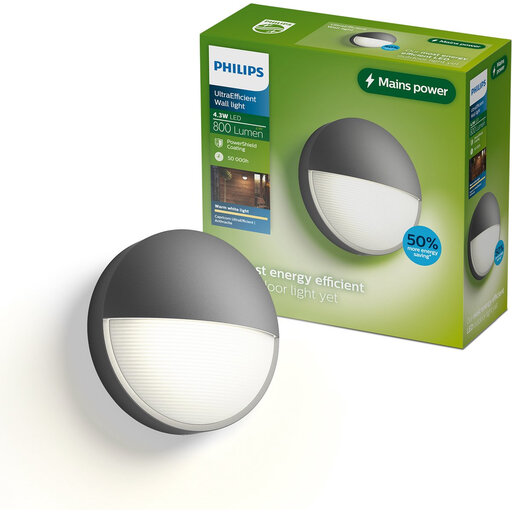
Why it suits this profile: This fixed outdoor wall light is suitable for an entrance, balcony or façade where a well-finished fitting with an integrated LED is preferred. According to the product information, the light produces 800 lumens and warm white light at 2700K.
The product information states the IP44 rating and specifies that professional installation is required. You therefore know that this is not a wireless light for placing anywhere.
800 lumens, 2700K, integrated LED, aluminium housing and a stated lifespan of up to 50,000 operating hours according to the product description.

Why it suits this profile: This solar outdoor light is designed for larger areas such as a driveway, garage, garden or rear courtyard. The three light heads and wide coverage are practical when you want to illuminate a large area with a single fitting.
The specifications state IP65, a detection distance of around 18 metres, a detection angle of 180 degrees and three lighting modes. It is still essential to install the light where it receives sufficient direct sunlight.
302 LEDs, 3000 lumens according to the product information, three adjustable heads, three modes, solar panel and IP65 protection.
We have put together a complete, up-to-date list of products that fully meet these strict selection criteria and the applicable European safety regulations.
With a fixed outdoor wall light, the power must be switched off before you begin the installation. According to the product information, products with a 220-240V or 230V connection should be installed by a qualified installer.
For wireless models, consider the mounting surface. A magnetic light must be firmly attached to a flat, clean and suitable surface. With a solar outdoor light, position the panel in as much direct sunlight as possible. Clean the panel and sensor regularly with a soft cloth.
An IP44 light must not be submerged and is not intended for direct water jets. Use an IP65 model when the location is less sheltered, but even then, follow the manufacturer’s installation and safety instructions.
For a balcony, a rechargeable outdoor light, compact outdoor wall light or table lamp is often practical. If space is limited, choose a model without fixed wiring. IP44 is suitable when the light is sheltered from direct rain; for a completely open balcony, a higher level of protection may be more appropriate.
For decorative patio lighting, around 100 to 200 lumens is often sufficient. For an entrance or small path, you can look at around 250 to 500 lumens. A driveway or larger garden area will generally require more light. Also check the beam angle, as this determines how much of the area is actually illuminated.
During normal use, a solar outdoor light does not draw electricity from the mains. However, its performance depends on the amount of daylight, the condition of the solar panel and the battery capacity. In winter or on cloudy days, the operating time may therefore vary. Keep the panel clean and choose a position with as much direct sunlight as possible.
