
Vandaag of morgen in huis

Kwaliteit gegarandeerd

Welkomstaanbiedingen ontgrendelen: GRATIS bezorging | Tot 80% korting | Gratis 30 dagen JoyPlus-proefperiode
Download de app
Good outdoor lighting makes an entrance easier to see, creates a welcoming atmosphere on the patio and helps define a path. But an attractive product photo doesn’t guarantee that an outdoor light is right for your needs. A solar-powered light, for example, may not stay lit for as long in a shady spot, while a compact outdoor wall light isn’t necessarily suitable for exposure to direct rain.
These common pitfalls are worth looking out for:
The IP code tells you how well a fitting is protected against dust and water. IP44 outdoor lighting can work well on many sheltered walls, under covered areas and on patios. The second 4 indicates protection against splashing water from different directions.
If you’re placing a light in an open area where it will get a lot of rain, a higher rating such as IP65 may be more practical. Always check the product details and installation instructions. An IP rating doesn’t automatically make a light suitable for every type of weather.
Lumens indicate the amount of light a lamp produces. A 270-lumen lamp, such as the Atmosphera Kiara, is best suited to use as portable table or patio lighting. A higher light output is often more practical for a large driveway or a light with a motion sensor.
Colour temperature is measured in kelvin:
Also consider how the light is distributed. Path lights direct light along a route, while an outdoor wall light usually illuminates a smaller area around the wall.
Solar outdoor lighting doesn’t need an outdoor socket, but the solar panel must receive enough direct sunlight during the day. Trees, walls and a north-facing position can reduce how long the light stays on. Some models have a built-in battery; check whether it can be replaced.
An electric 230 V outdoor light provides a steady power supply, but it must be installed in line with local regulations. If it needs fixed wiring, it’s sensible—and sometimes necessary—to have it installed by a qualified electrician. A light with a GU10 or E27 fitting gives you more choice, but check the maximum wattage and whether a bulb is included.
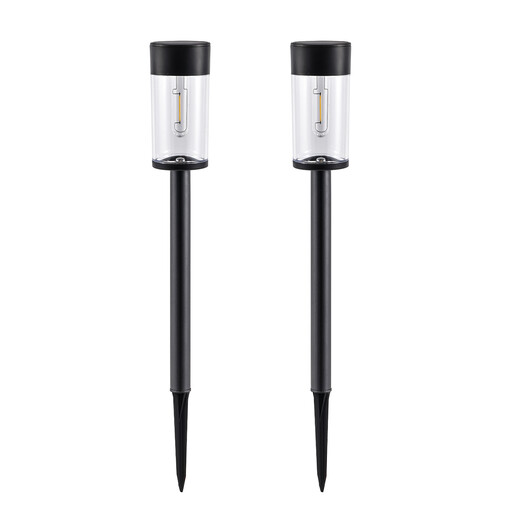
Why it suits this type of buyer: This set is designed for anyone who wants to mark out a garden path, flower bed or driveway without installing wiring. The ground stakes make it easy to position.
The product details state that each light produces 10 lumens and has an IP65 rating. This makes it clear that these are soft path lights, not powerful floodlights.
Solar-powered, switches on automatically, emits warm white light at 3000 K and comes as a pack of two.
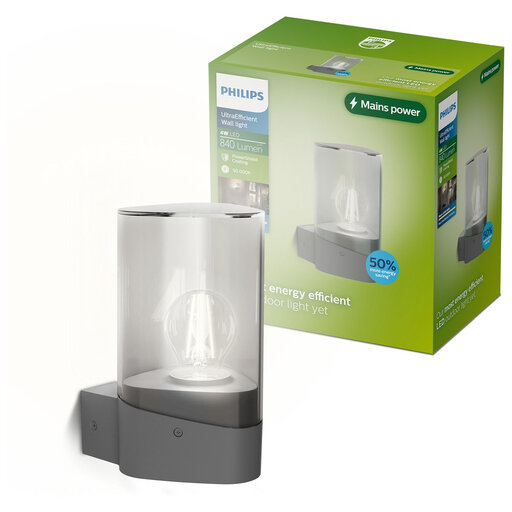
Why it suits this type of buyer: This outdoor wall light is a good choice for a permanent entrance, exterior wall or covered patio where you want a reliable light source and a classic look.
The specifications list an E27 fitting, 840 lumens, 2700 K and IP44. This means you can check the light source and replace it as needed, in line with the instructions.
Made from aluminium and plastic, supplied with an E27 LED bulb according to the product description, and emits warm white light at 2700 K.

Why it suits this type of buyer: This solar outdoor light is designed for larger areas such as a driveway, garage, back garden or entrance, where a motion sensor and wide light coverage are useful.
The listed specifications include 3000 lumens, three lighting modes, a 180-degree detection angle and IP65. This makes it clearer where the light is best used than with decorative garden lighting.
Three adjustable light heads, solar power, motion detection and a stated light output of 3000 lumens.
We’ve put together a complete, up-to-date list of products that meet these strict selection criteria and the applicable European safety regulations.
Check the following before you buy:
IP44 outdoor lighting is splashproof and may be suitable for sheltered walls, balconies and covered patios. It doesn’t protect against immersion or powerful water jets. A higher IP rating may be more suitable for a fully exposed area.
It depends on the wattage, how many hours the light is on and its power source. An LED outdoor light generally uses little electricity compared with older light sources. Solar outdoor lighting uses energy stored during the day, but how long it stays lit depends on sunlight, battery capacity and temperature.
Position the sensor so it faces the route where you expect movement, for example by a gate, garage or entrance. Avoid branches, reflective surfaces and areas with constant passing traffic. Before fixing the light in place, check its stated detection angle and range too.
