
Vandaag of morgen in huis

Kwaliteit gegarandeerd

Welkomstaanbiedingen ontgrendelen: GRATIS bezorging | Tot 80% korting | Gratis 30 dagen JoyPlus-proefperiode
Download de app
Good outdoor lighting needs to suit the location, the weather and how you plan to use it. A light for a sheltered balcony has different requirements from one by the driveway. Yet many buyers focus mainly on lumens, colour or a low price. As a result, the outdoor light they choose may later prove too bright, insufficiently protected from rain or difficult to install.
This guide helps you compare garden lighting using specifications you can check. Choose with confidence between solar outdoor lights, LED outdoor lighting, an outdoor wall light, a ground spotlight or outdoor string lights.
A rating such as IP44 doesn’t mean a light can be submerged or withstand a direct jet of water. IP44 is mainly suitable for splashes and sheltered outdoor locations. IP65 outdoor lighting offers better protection against dust and water jets, but you should still follow the installation instructions.
So don’t just look for the word “outdoor” in the product name. Check the exact IP rating and any warnings too. An IP44 outdoor wall light under a canopy is intended for a different setting from a light hanging on a fully exposed wall.
A solar garden light only works well if its panel gets enough daylight. Shade from a fence, tree or canopy reduces charging time. In darker or overcast periods, the light may also stay on for less time than it would on sunny days.
When choosing solar outdoor lighting, check the stated battery, charging time and run time. Position the panel somewhere as unobstructed as possible and clean it regularly. A light with a motion sensor generally uses less energy than a model that stays on continuously all evening.
A high lumen rating doesn’t automatically mean a light is right for your garden. A bright light can feel uncomfortable on a patio, while a low light output may not provide enough visibility on a driveway. Warmer colour temperatures, such as 2700K or 3000K, are often better for creating atmosphere. For practical visibility, some people prefer neutral or bright white light.
Consider the direction of the beam too. A ground spotlight directs light towards a tree or wall, while a wall light can illuminate an entrance or path more evenly.
An IP rating doesn’t replace safe installation. Don’t place cables in standing water, and use a suitable outdoor socket with plug-in models.
Solar garden lights use a built-in battery and solar panel. They don’t need a fixed mains connection, but their performance depends on the amount of sunlight they receive. Battery-powered lights are easy to position, but need to be recharged or have their batteries replaced periodically.
LED outdoor lighting usually uses less electricity than traditional lights with a similar light output. Check whether the light source is integrated. With an integrated LED, you’ll usually need to replace the whole light if the light source stops working. With a GU10 or E27 fitting, you can choose and replace a suitable bulb yourself.
Look out for:
Outdoor string lights are best suited to creating atmosphere in the garden. For visibility or lighting an entrance, you’re better off choosing a directional light or an outdoor wall light.

Why it suits this profile: This solar garden light can be placed along a path, border or lawn without fixed wiring. Its compact size and ground spike make it easy to install.
The product information states an IP44 rating and notes that the light needs sufficient sunlight. This makes it clear that it isn’t designed to be submerged or placed in a dark, fully sheltered spot.
Stainless steel housing, a polycrystalline silicon solar panel, a charging time of 4-6 hours and a stated battery life of 8-12 hours.
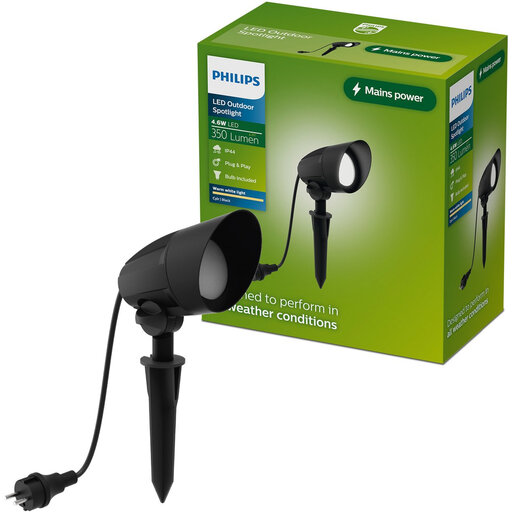
Why it suits this profile: This ground spotlight is designed for permanent installation by a driveway, gate, lawn or feature plant. The included GU10 bulb means you won’t need to look for a suitable light source straight away.
The specifications state an IP44 rating and warn against submersion and direct water jets. Make sure the spotlight is stable and away from areas where water collects.
350 lumens, warm white light at 2700K, an adjustable spotlight, a 150 cm cable and an included 4,6W GU10 LED bulb.

Why it suits this profile: This model is designed for a driveway, garage, yard or other location where you need plenty of light temporarily. Its three adjustable light heads offer flexibility across larger areas.
The stated IP65 rating is more specific than a general claim such as “for all weather”. For the light to work well, it’s still important to ensure the panel gets enough direct sunlight.
The product information lists 302 LEDs, three lighting modes, a 180-degree detection angle and three adjustable heads.
We’ve put together a complete, up-to-date list of products that meet these strict selection criteria and the applicable European safety regulations.
For a sheltered wall, balcony or patio, IP44 may be suitable as long as the light isn’t exposed to direct water jets. For a more open and dusty location, IP65 is a better choice. Always check the installation instructions and usage restrictions for the specific product.
Solar outdoor lighting doesn’t use mains electricity while in use, but its performance depends on sunlight, battery capacity and sensor settings. Position the panel out of the shade and clean it regularly. For consistent lighting over long periods, an LED light with a fixed connection may be more predictable.
Lifespan varies by product and conditions of use. Some product descriptions, for example, state 10,000 or 15,000 hours. This is a stated technical figure, not a guarantee for every installation. Also check whether the LED light source can be replaced and whether the light is protected against moisture, heat and mechanical damage.
