
Vandaag of morgen in huis

Kwaliteit gegarandeerd

Welkomstaanbiedingen ontgrendelen: GRATIS bezorging | Tot 80% korting | Gratis 30 dagen JoyPlus-proefperiode
Download de app
A good outdoor light needs to do more than look attractive in a product photo. In a Dutch garden, on a balcony or along a driveway, lighting has to cope with rain, wind, temperature changes and limited winter sunshine. Yet three common pitfalls are often overlooked:
By checking the specifications carefully, you can choose the right garden lighting, outdoor wall light, outdoor ground spotlight or decorative outdoor string lights.
Start by thinking about what you need it for. For an entrance or driveway, directional light that switches on automatically is practical. A garden light with a motion sensor only comes on when movement is detected. For a patio or balcony, it’s often more about creating atmosphere: a dimmable outdoor light, table lamp or outdoor string lights give you more control over brightness.
Also consider how the light is installed:
The IP code indicates how well a product is protected against solid particles and moisture. An IP44 outdoor light is protected against splashing water from different directions. This makes IP44 suitable for many sheltered exterior walls, balconies and covered areas. However, it doesn’t mean the product is waterproof.
IP65 outdoor lighting offers greater protection against dust and water jets. It may be a better choice for a more exposed wall, garage or garden area. Always check the full product information: the IP rating doesn’t replace correct installation.
Lumens indicate how much light a lamp produces. A lower light output can be pleasant for creating atmosphere on a table or patio. You’ll usually need a higher light output for a driveway or a large area of the garden.
Colour temperature is measured in kelvin:
Also consider how the light is directed. A downlight points the light downwards, while a ground spotlight can highlight a tree or exterior wall.
A solar light works without a fixed power connection, but its performance depends on how much sunlight it gets. If you’re considering a model with a battery, check how it charges and whether it has a USB connection.
GU10 and E27 are common fittings for fixed outdoor lighting. A GU10 outdoor light is often used for directional spotlighting. An E27 outdoor light gives you more choice of bulbs and can be made dimmable with a suitable dimmable bulb and dimmer.
A fixed 230 V wall light must be installed by a qualified electrician, as stated in the product information. Also check whether the bulb is included. Some models are supplied without one.
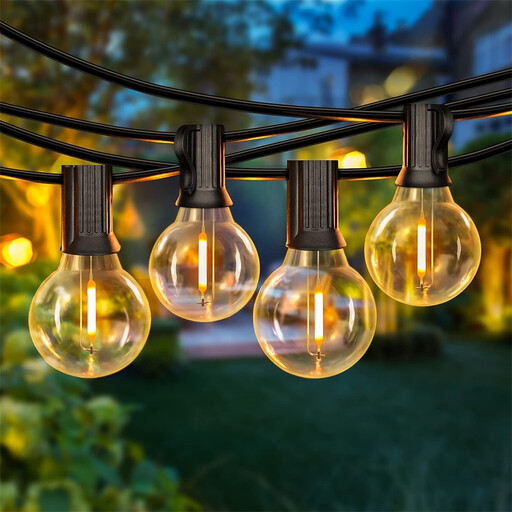
Why it suits this need: These 30-metre plug-in string lights are easy to hang on a balcony, pergola or patio. The warm white LEDs are designed for decorative lighting.
The specifications state that the bulbs are replaceable and the lights are dimmable, with a timer included. Make sure connections are kept away from standing water.
30-metre length, 50+2 LEDs, plug-in power and replaceable G40 bulbs.
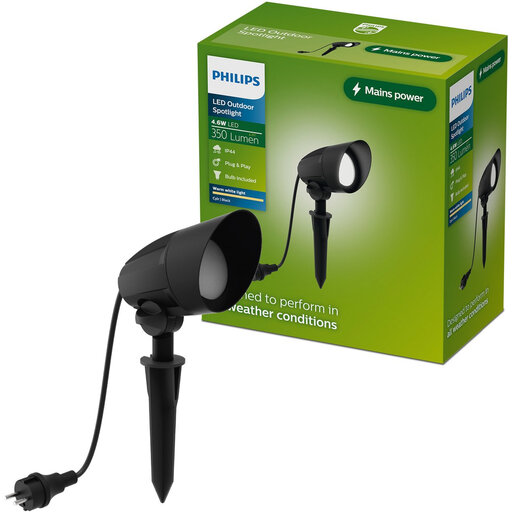
Why it suits this need: This ground spotlight is designed to illuminate shrubs, trees, gates or driveways. The included GU10 light source produces warm white light at 2700 K, according to the product specifications.
The fitting and light source are clearly specified. IP44 means protection against splashing water, so don’t place the spotlight where it will be exposed to direct water jets or immersion.
350 lumens, GU10 LED bulb included, 1.5-metre cable and an adjustable ground installation.

Why it suits this need: For a driveway, garage or large garden area, these solar outdoor lights offer a motion sensor, three adjustable heads and a wide spread of light.
The IP65 rating offers greater protection than IP44. For the light to work well, the solar panel needs direct daylight, and the panel and sensor should be kept clean.
302 LEDs, stated light output of 3000 lumens, motion detection and three lighting modes.
Don’t choose an outdoor wall light based on looks alone. Check that the surface is flat and sturdy, and that the wiring is suitable for outdoor use. Fixed 230 V installations must be fitted professionally, in line with the product information.
For solar lighting, the position of the panel is crucial. A spot beneath a balcony, dense tree or north-facing canopy can limit charging time. String lights should be secured firmly without stretching the cables taut. Keep plugs and connections away from puddles, and disconnect the power before cleaning the lights.
We’ve put together a complete, up-to-date list of products that meet these strict selection criteria and the applicable European safety regulations.
For a sheltered spot, IP44 is often suitable if the light is protected from splashing water. For a more exposed location, IP65 can offer extra protection against dust and water jets. No IP rating means a light can be placed underwater.
It can be, as long as the solar panel gets enough daylight. Charging may take longer in winter and on cloudy days. Choose a spot that isn’t regularly shaded, and clean the panel regularly.
Energy use depends on the wattage, the number of hours the light is on and the brightness setting. An LED outdoor light generally uses little electricity compared with traditional light sources. A motion sensor or timer can reduce the number of hours it’s on even further.
