
Vandaag of morgen in huis

Kwaliteit gegarandeerd

Welkomstaanbiedingen ontgrendelen: GRATIS bezorging | Tot 80% korting | Gratis 30 dagen JoyPlus-proefperiode
Download de app
Good outdoor lighting makes an entrance safer, a patio more inviting and a garden usable after sunset. But an attractive product photo is no guarantee that a light will suit your needs. The same buying pitfalls crop up time and again, especially with outdoor solar lights, outdoor wall lights and outdoor string lights.
A light with an IP44 rating for outdoor use is protected against splashing water and solid objects larger than 1 millimetre. That doesn’t mean it’s suitable for immersion, direct jets of water or prolonged exposure to driving rain. So, it’s best to place an IP44 light under a roof, canopy or sheltered wall.
For an open driveway or a spot where the light will be exposed to lots of rain and dirt, a higher IP rating may be more practical. Always check the full product description and safety instructions.
A high lumen count sounds appealing, but more light isn’t always better. A small entrance mainly needs focused light. For a patio, warm colour temperatures and even light distribution are often more important. A solar security light for a driveway, on the other hand, can be brighter and motion-activated.
Pay attention to the colour temperature too:
A solar light works without a fixed cable, but its performance depends on where you put it. A panel on a north-facing wall or beneath a dense tree will get little direct sunlight. With a battery-powered light, you’ll need to replace or recharge the batteries. A fixed outdoor wall light, on the other hand, needs a suitable power connection and will usually need to be installed by a qualified electrician.
Don’t rely on the word “waterproof” alone. Check the official IP rating. IP44 means protection against splashing water; according to the product specifications, IP65 offers greater protection against dust and jets of water. Correct installation is still important, even with IP65: make sure the seals are properly closed and don’t point the light towards an area where water can collect.
With integrated LED outdoor lighting, the light source often can’t be replaced by the user. So, check the brightness, colour temperature and expected lifespan in the product information before ordering. With a light that has a GU10 or E27 fitting, you can choose a suitable bulb yourself, but be sure to check the maximum wattage.
A motion sensor is handy by a front door or garage. Check its detection range, adjustable settings and whether the light can also be operated manually. In practice, an outdoor light with a motion sensor that keeps switching on whenever pedestrians pass may be less convenient.
Measure the wall, balcony railing or available space before buying. For string lights, check the total length, the spacing between LEDs and where the socket is. For wall lights, also check the cable route, mounting plate and clearance for fitting.
A magnetic model is easy to move, but its mounting plate needs to be secure. Don’t hang a light above a walkway if there’s a risk it could come loose.
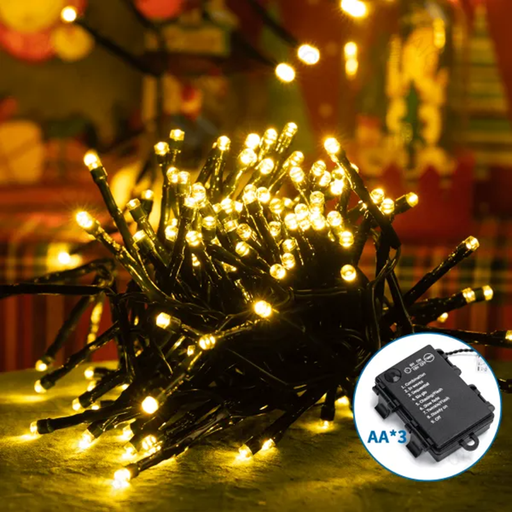
Why it suits this type of user: These outdoor string lights are easy to use on a balcony, patio or in a small garden. They run on 3 AA batteries, so you don’t need a socket near your seating area.
The specifications list a length of 5 metres, 200 LEDs and an IP44 rating. Make sure the battery box is sheltered and replace the batteries in good time.
8 lighting modes, a timer, a memory function and a stated operating temperature range of -25 to 45 °C.

Why it suits this type of user: This light is a good choice for an entrance, shed or patio where you want automatic lighting when movement is detected, without having to run a power cable.
The product information lists 180 lm, 2700 K, IP44 and an integrated motion sensor. Position the solar panel somewhere with plenty of daylight.
Solar-powered with an integrated LED, a dimming function according to the product specifications and a compact size of 11,5 × 10 × 11 cm.

Why it suits this type of user: For a driveway, garage or large garden, the broad spread of light from three adjustable heads is a practical choice.
Its stated IP65 rating is higher than IP44. According to the product specifications, it can be exposed directly to rain, but correct installation and cleaning the panel are still important.
302 LEDs according to the product listing, three lighting modes, three adjustable heads and a 180-degree motion detection angle.
We’ve put together a complete, up-to-date list of products that meet these strict selection criteria and the applicable European safety regulations.
That depends on the wattage, how long it’s used and the price of electricity. A low-wattage LED bulb generally uses less electricity than a traditional bulb used for the same amount of time. Solar outdoor lights don’t use mains electricity while they’re on, but they do need sunlight to charge the battery.
IP44 outdoor lighting is designed to withstand splashing water and may be suitable for a sheltered wall, balcony or covered patio. For fully exposed locations with lots of rain, dirt or direct jets of water, a product with a higher IP rating is often a better choice. Always follow the manufacturer’s installation and safety instructions.
Lifespan varies depending on the model, power source, temperature and usage. Integrated LEDs are usually not designed to be replaced. So, before buying, check whether the light source is replaceable, what the warranty covers and whether parts such as batteries or GU10 bulbs are available separately.
