
Vandaag of morgen in huis

Kwaliteit gegarandeerd

Welkomstaanbiedingen ontgrendelen: GRATIS bezorging | Tot 80% korting | Gratis 30 dagen JoyPlus-proefperiode
Download de app
Buying new outdoor lighting seems simple, until you have to choose between a solar-powered outdoor light, an outdoor wall light, an in-ground spotlight or decorative garden lighting. Many products look similar, but can differ significantly in how they’re installed, their brightness, protection against moisture and maintenance requirements.
Three common pitfalls are worth watching out for:
By considering how you’ll use the light, its technical specifications and where it will be installed, you can avoid making the wrong choice.
An IP code consists of two digits. The first indicates protection against solid particles, while the second indicates protection against moisture.
The term waterproof outdoor lighting is sometimes used broadly in product descriptions. Check the specific IP code rather than relying on the marketing name alone.
For a path, entrance or driveway, you mainly need lighting to help you find your way. Check the light output in lumens, how widely the light spreads and the direction of the beam. For a patio or veranda, a warmer colour temperature is often more comfortable. A value of around 2700K to 3000K generally gives a warmer look than bright white light.
When it comes to ambient garden lighting, brightness isn’t everything. An outdoor in-ground spotlight can highlight a tree or exterior wall, while an outdoor wall light directs light downwards. Use several softer light sources if you want to reduce harsh shadows.
A solar-powered outdoor light uses a solar panel and battery. Its performance depends on the amount of direct daylight it receives, where it’s positioned and whether the panel is kept clean. A mains-powered garden light provides more consistent operation, but requires a suitable outdoor power connection.
Also check:

Why it suits this profile: This portable outdoor light has a sensor and doesn’t need fixed wiring. Its magnetic mount makes it easy to position by a balcony, patio or entrance. According to the product description, it has a built-in battery and charges via USB-C.
There’s no need to run a power cable. The IP44 rating makes clear that the light is splashproof, but isn’t designed for exposure to direct jets of water.
300 lm according to the product specifications, 3000K, a motion sensor, magnetic mounting and USB-C charging.
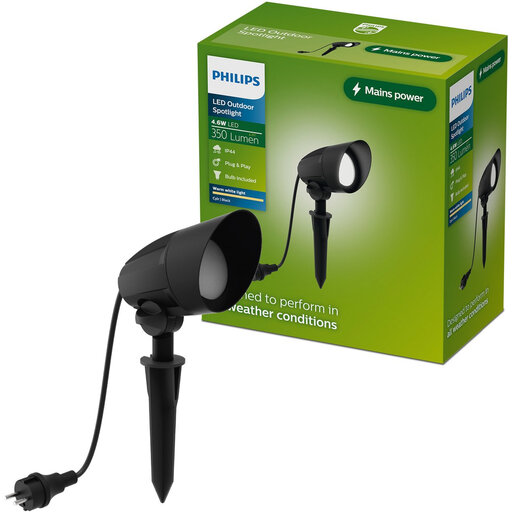
Why it suits this profile: This outdoor in-ground spotlight is designed to highlight shrubs, trees, a driveway or a garden path. According to the product specifications, the included GU10 LED bulb has a colour temperature of 2700K.
The light source and colour temperature are specified in advance. The IP44 rating also makes clear that the light must be positioned away from direct jets of water.
350 lm, 4,6 W, 2700K, a 150 cm cable and a swivelling aluminium spotlight with an included GU10 LED bulb.

Why it suits this profile: This solar-powered outdoor light is designed for larger areas such as a driveway, garage, garden or patio. According to the product description, it has three light heads, a motion sensor and three lighting modes.
The IP65 rating is clearly stated and is suitable for more exposed locations than IP44, provided you follow the installation instructions. Direct sunlight is still important for charging the battery.
302 LEDs, 3000 lm according to the description, a detection range of up to 60 feet, a 180-degree detection angle and three adjustable light heads.

Why it suits this profile: This decorative string light is designed for festive displays on a tree, pergola or exterior wall. The product description lists eight hanging points and a memory function that remembers your chosen lighting mode.
The dimensions, cable and spacing between hanging points are specified in advance. IP44 means you should install the lights in a sheltered spot and keep them away from direct jets of water.
192 LEDs, colour-changing lights in red, green, blue and yellow, a coverage area of 5 × 0,3 metres and a 220-240V, 6W adapter.
We’ve put together a complete, up-to-date list of products that meet these strict selection criteria and current European safety regulations.
For a driveway, a sensor outdoor light, an IP65 solar-powered outdoor light or several in-ground spotlights are practical options. A sensor means the light won’t stay on all the time. Check the detection range and brightness, and if you choose a solar light, make sure it will receive enough direct daylight.
IP44 is suitable for sheltered outdoor locations where the light is protected from splashing water. Think of a covered veranda or an exterior wall beneath a canopy. For a spot exposed to direct rain, splashing dirt or jets of water, a higher rating such as IP65 may be more suitable. Always follow the manufacturer’s specific instructions.
Energy use depends on the wattage, the number of hours it’s on and the type of power supply. An LED outdoor light with a low wattage generally uses less electricity than a traditional light used for the same amount of time. A solar-powered outdoor light has low running costs, but its performance depends on sunlight and battery capacity. So, as well as checking lumens, look at the wattage, battery specifications and how long you need the light to stay on.
