
Vandaag of morgen in huis

Kwaliteit gegarandeerd

Welkomstaanbiedingen ontgrendelen: GRATIS bezorging | Tot 80% korting | Gratis 30 dagen JoyPlus-proefperiode
Download de app
Buying an outdoor light may seem simple, until you find that it does not provide enough light, the battery barely charges in winter or the housing is unsuitable for the place where you want to install it. A balcony also has different requirements from a driveway or a façade directly exposed to rain.
So do not focus only on the colour and shape. Light output, IP rating, power supply and installation determine whether outdoor lighting is genuinely suitable for your home.
An outdoor light with a high lumen output can be useful for a driveway or entrance, but it is not automatically pleasant on a patio. Bright, cool-toned light can overpower the atmosphere and disturb neighbours. For decorative garden lighting or path lighting, a modest light output is often sufficient. So consider the purpose:
A brand claim about atmosphere, security or energy saving is no guarantee that a product will suit your situation. According to Philips’ own research, for example, certain models may offer a long service life or a specific sensor function. Always check the listed product specifications and the installation location as well.
The term weather-resistant says very little on its own. The IP rating provides more specific information about protection against solid particles and water.
An IP44 outdoor light is not designed to be submerged or exposed to direct water jets for prolonged periods. An IP65 outdoor light must also be installed and connected according to the instructions.
A solar outdoor light does not need a mains connection, but its battery must be able to charge sufficiently during the day. A shady north-facing wall, dense foliage or a location beneath a balcony can reduce the operating time. During the darker winter months, the available charging energy may also be lower.
When choosing solar garden lighting, consider:
A solar light with a motion sensor generally uses less energy when it only switches on when movement is detected. However, the actual operating time depends on sunlight, temperature, battery charge and usage.
An integrated LED outdoor light is ready to use straight away, but the light source cannot be replaced on some models. An outdoor wall light with an E27 or GU10 fitting gives you more choice in terms of colour temperature, dimming and brightness. Do check whether the light is supplied without a bulb.
Warm white light at 2700 K or 3000 K is often well suited to an entrance, patio or garden. For functional lighting, a more neutral colour such as 4000 K can be practical. The wattage does not directly indicate how much light you will get; compare the lumens and the direction in which the light is distributed instead.
Aluminium, plastic and glass behave differently outdoors. Aluminium can offer a robust appearance, while plastic is often lightweight. Also consider:
A fixed 230V outdoor light must be connected safely in accordance with local regulations. If in doubt, have the connection carried out by a qualified installer.
An outdoor light with a motion sensor can be useful by a back door, garage or driveway. Check the detection direction, range and whether the light also has a dusk or daylight sensor. Solar models may offer different modes, such as switching on automatically at dusk or lighting only when movement is detected.
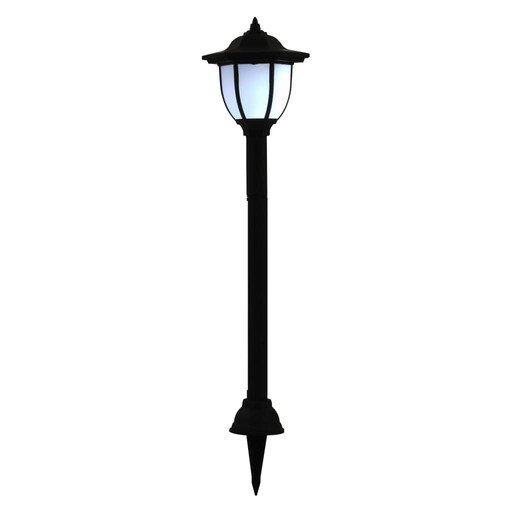
Why it suits this profile: A set of three solar lights is practical for a path, patio border or small garden. No mains connection is needed, and mounting materials are included.
The product information states that it has a rechargeable AA battery, automatic activation at dusk and an IP44 rating. However, place the lights somewhere with sufficient daylight.
Three lights per set, solar power, three 0.06 W LEDs per light and a black plastic housing.
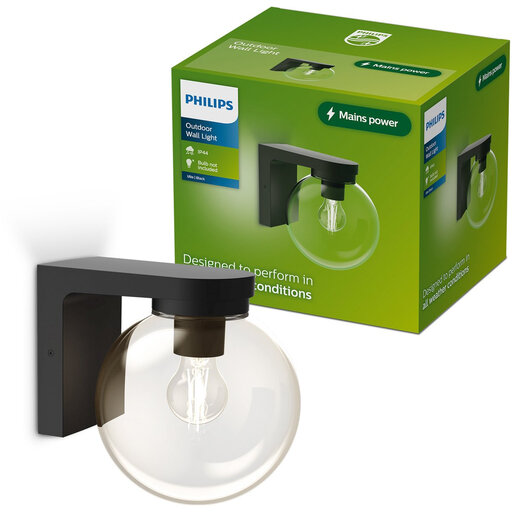
Why it suits this profile: This black outdoor light is suitable for an entrance, façade or covered patio where you want to choose your own E27 LED bulb.
The fitting is clearly specified as E27 and the light source is replaceable. This means you will not unintentionally buy a fitting with a fixed colour temperature.
Aluminium and glass, IP44, diffuse lighting and the freedom to choose a suitable E27 LED bulb.

Why it suits this profile: This solar outdoor light is designed for locations where a broad, powerful beam is needed, such as a driveway, rear of a property or large garden.
The product specifications state IP65, a motion sensor and an adjustable head. This makes the intended use more specific than the general claim that it is “weather-resistant”.
According to the product information, 4000 lumens, IP65, solar power and a sensor range of 8 metres for direct approach and 16 metres laterally.

Why it suits this profile: The combination of solar power, a motion sensor and two lighting modes is practical by a front door, shed or side path without existing wiring.
The sensor and automatic operation help prevent unnecessary illumination. Direct sunlight is still needed for a good charging cycle.
According to the product specifications, 1000 lumens, 3000 K, integrated LED, IP44 and two lighting modes.
We have put together a complete, up-to-date list of products that fully meet these strict selection criteria and the applicable European safety regulations.
For a sheltered façade, balcony or covered area, IP44 may be suitable. In a location more exposed to dust and water, IP65 may offer greater protection. Also check the installation instructions and avoid locations where water can collect.
A solar outdoor light does not use electricity from the mains. However, the purchase price, battery and expected service life all contribute to the total cost. Performance depends on sunlight, season, temperature and how often the light switches on.
The service life varies depending on the model and operating conditions. Some product descriptions, for example, state 25,000 or 50,000 hours of illumination. This is a stated product specification, not a guarantee for every installation. Keep the light clean, check the fixings and follow the safety instructions.
