
Vandaag of morgen in huis

Kwaliteit gegarandeerd

Welkomstaanbiedingen ontgrendelen: GRATIS bezorging | Tot 80% korting | Gratis 30 dagen JoyPlus-proefperiode
Download de app
Good outdoor lighting makes an entrance easier to see, creates a welcoming atmosphere on the patio and helps illuminate a garden path clearly. Yet many people choose an outdoor light based solely on its appearance or a high lumen rating. This can result in disappointing light output, materials that age quickly or a light that is unsuitable for the place where you want to install it.
So pay particular attention to these three common pitfalls:
Below, you can find out which specifications matter and which outdoor light suits different situations.
Start with the location and purpose. An outdoor light for a façade needs different features from garden-path lighting or atmospheric lighting for a balcony.
The IP classification indicates how well the housing protects against solid particles and moisture. For outdoor use, you will often see IP44 outdoor lighting. The first 4 indicates protection against solid objects from 1 millimetre in size; the second 4 indicates protection against splashing water from different directions.
An IP54 outdoor light also offers a higher level of protection against dust. The vidaXL LED Outdoor Lamp, for example, has IP54, a power rating of 9 W and a light output of 550 lumens. According to the product specifications, this makes it suitable for use along a garden path, provided it is installed according to the instructions.
IP44 and IP54 do not mean that you can clean a light by spraying it with a garden hose or place it underwater. For an exposed façade, balcony or patio, the installation position is also important. Preferably, do not place the light somewhere where it will be permanently exposed to powerful jets of water.
Wattage mainly tells you about energy consumption. For brightness, look at lumens. A light rated at 180 lumens is suitable for limited orientation or atmospheric lighting, while 500 to 800 lumens is better suited to an entrance or wider façade.
Colour temperature is expressed in Kelvin:
With integrated LED, you usually cannot replace the light source yourself. A fitting such as GU10 or E27 gives you more flexibility: you can choose the light output, colour and, if required, a smart bulb at a later date. Do pay attention to the maximum wattage.
A solar outdoor light does not need a permanent cable, but the solar panel must receive enough direct light during the day. Do not place this type of light under a solid canopy or on a façade that is almost always in the shade. Keep the panel free from dirt and leaves.
A fixed outdoor light works more consistently when there is little sunshine, but it often requires a power connection and installation by a qualified electrician. Also check whether fixings are included and whether they are suitable for your type of wall.

Why it suits this profile: This solar outdoor light is suitable for an entrance, balcony or small garden where no permanent wiring is available. The light has two lighting modes, a daylight sensor and a motion sensor.
The product specifications clearly state solar power, two settings and IP44. Placement in direct sunlight remains essential; IP44 means protection against splashing water, not protection against submersion.
Solar power without a mains cable, integrated LED and a stated light output of 400 lumens per light point.
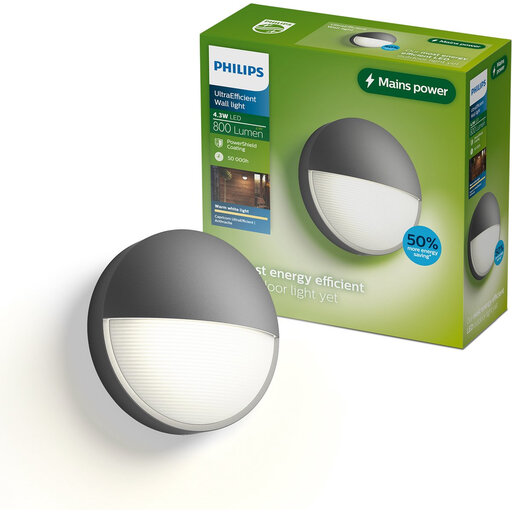
Why it suits this profile: This fixed outdoor wall light is ideal if you are looking for a consistent light source for a façade, balcony or entrance and can arrange professional installation.
The product information specifies the required permanent connection and professional installation. This helps you avoid buying a wall light that is unsuitable for a location without a power point.
Aluminium and plastic, integrated LED, warm white light at 2700 K, 800 lumens and IP44 according to the product details.

Why it suits this profile: This set is designed for garden enthusiasts who want to highlight garden paths, borders or plants flexibly and appreciate app control.
The set specifies the number of lights, the 800 cm cable length and IP44. Check the cable routes in advance to reduce the risk of tripping along paths.
Three integrated LED lights, adjustable colour temperature from 3000–6500 K, RGB, dimming function and control via Tuya Smart according to the product description.
A GU10 outdoor light is useful if you want to replace the light source later or adjust the light colour. The Philips Fylx is a black, round outdoor wall light with a GU10 fitting and IP44 classification. The light is supplied without a GU10 spotlight bulb. When buying, therefore, check not only the fitting but also the compatible LED bulb and maximum wattage.
For a black outdoor light on a modern façade, fixed models with integrated LED are also available. In this case, pay attention to the stated light output, colour temperature and whether the LED source can be replaced.
We have put together a complete, up-to-date list of products that fully meet these strict selection criteria and the applicable European safety regulations.
For atmospheric lighting on a patio, a lower lumen output may be sufficient. For an entrance, façade or shed, more light is often practical. Always compare the lumen output with the installation height and the purpose of the light. A motion sensor can also prevent a bright light from staying on all night.
IP44 is suitable for many sheltered outdoor locations, such as a covered entrance, balcony or façade. The classification protects against splashing water, but not against submersion or powerful jets of water. For a completely open and heavily exposed location, a higher IP classification may be more suitable. Always check the full product information.
A solar outdoor light uses energy stored in its integrated battery during the day. It does not need to be connected to the mains. However, its performance depends on sunlight, positioning, battery capacity and how often the motion sensor is activated. Clean the solar panel regularly and keep it free from shade.
