
Vandaag of morgen in huis

Kwaliteit gegarandeerd

Welkomstaanbiedingen ontgrendelen: GRATIS bezorging | Tot 80% korting | Gratis 30 dagen JoyPlus-proefperiode
Download de app
Good outdoor lighting can make all the difference by your entrance, driveway, in the garden, garage or on the balcony. But people often choose a light based on its appearance or a high lumen count. That can leave you with a lamp that’s too bright, not sufficiently protected from moisture or difficult to install.
As a Joybuy Product Recommendation Officer, I look at the key product specifications and compare them with the most common buying pitfalls. This helps you compare garden lighting based on how you’ll use it, how it’s installed and what you can verify from the product information.
A high lumen count doesn’t automatically make a lamp comfortable to use on a patio or by an entrance. A powerful light can be dazzling or make a small garden feel harshly lit. For ambient lighting, a warmer colour temperature, such as 2700K to 3000K, is often more pleasant. Bright white light may be more practical for a driveway or security spotlight.
Also consider how the light is distributed. An adjustable ground spotlight will illuminate a tree or wall differently from a wide wall light with a motion sensor.
An IP44 outdoor light is protected against splashing water, but isn’t designed to be submerged or exposed to powerful water jets. For example, place one under an overhang or on a sheltered wall. An IP65 outdoor light offers greater protection against dust and water jets, making it a better choice for a more exposed spot.
No IP rating means you can place a light fitting underwater. Always check the installation instructions too, as well as the position of cables, plugs and connections.
A mains-powered lamp needs a suitable outdoor socket or fixed connection. Some models with a GU10 fitting are sold without a light bulb. Solar outdoor lights don’t need mains power, but their panels do need to receive enough direct daylight.
So, before you buy, check:
The first digits in an IP code indicate protection against solid particles; the second digit refers to water. In practical terms:
Lumens indicate the amount of visible light. A compact wall light with a few hundred lumens may be enough for an entrance. A wide solar floodlight for a driveway will generally need a higher light output.
Colour temperature is measured in Kelvin:
An outdoor light with a sensor switches on only when it detects movement or dusk. Check the detection range, detection angle and adjustment options. A sensor pointed directly at a busy road may switch on unnecessarily often.
Solar outdoor lighting saves mains electricity, but performance depends on sunlight, the season, panel position and battery capacity. Philips’ own product information says some solar models can work for several nights after a full charge; in practice, they may last for less time during a Dutch winter.
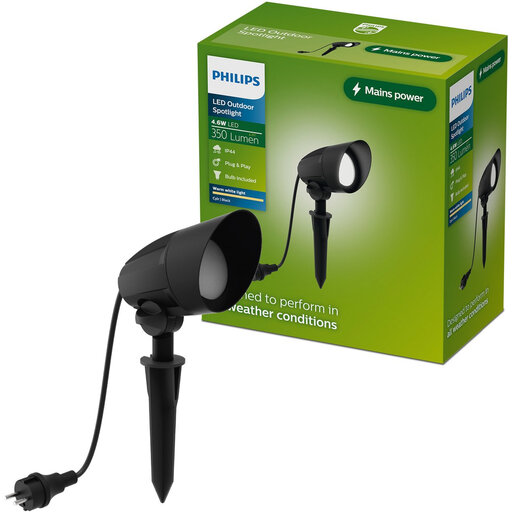
Why it suits this type of user: This ground spotlight is easy to push into the soil and comes with a 2700K GU10 LED bulb. It’s a good choice for lighting a garden path, shrub or small front garden without complicated installation.
The specifications list 350 lumens, 4,6 W, a 150 cm cable and IP44 protection. This makes it clear upfront that this is a directional, sheltered outdoor light, not a powerful floodlight.
Adjustable spotlight, warm 2700K colour and aluminium and glass casing. Use a suitable outdoor socket that’s protected against splashing water.
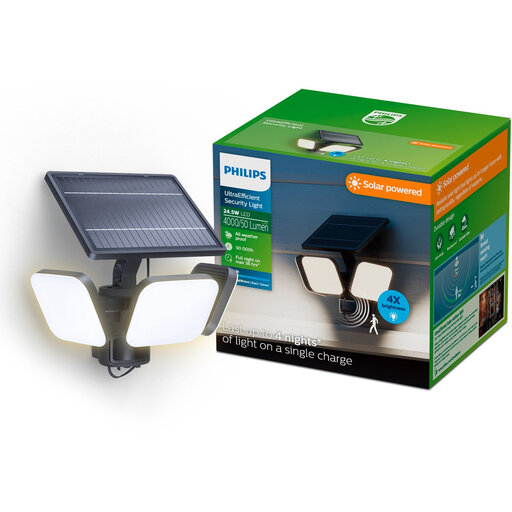
Why it suits this type of user: This solar wall light is designed for anyone who wants to illuminate a large area, such as a driveway or the side of a garage, without installing fixed wiring.
The product information lists IP65, 4000 lumens, an adjustable head and a PIR detection range of 8 metres when approached directly and 16 metres from the side. Make sure the panel is placed in direct sunlight.
High stated light output, IP65 protection and two lighting modes. According to Philips’ own information, the battery can provide light for up to four nights after a full charge.

Why it suits this type of user: The three adjustable light heads and wide coverage make this a good fit for a large garden, rear of a property, patio or garage where one small wall light wouldn’t spread light far enough.
The stated specifications include IP65, three lighting modes, a 180° detection angle and a range of 60 feet. Before installation, check that the stated light colour and dimensions suit your needs.
302 LEDs according to the product description, three light heads and installation without fixed wiring. Performance still depends on direct sunlight and battery charge.

Why it suits this type of user: This rechargeable wall light has magnetic mounting, making it handy for a balcony, shed or rented home where you don’t want to install fixed wiring.
The light runs on a rechargeable battery and has IP44 protection. This makes it flexible to use, but it isn’t suitable for submersion or direct water jets.
300 lumens, 3000K, motion sensor, USB-C charging and magnetic mounting. Check that the mounting plate is sturdy enough for your chosen wall.
We’ve put together a complete, up-to-date list of products that meet these strict selection criteria and comply with current European safety regulations.
Choose an adjustable outdoor ground spotlight, a wall light with a wide beam or an outdoor light with a motion sensor. Look for enough lumens, a detection angle that covers the driveway and, ideally, IP65 protection if the light will be completely exposed.
Lifespan varies by product, LED module, battery and conditions of use. Manufacturers often provide an estimated operating life. For example, according to the product information for some Philips outdoor lights, the stated lifespan is 15.000 to 50.000 hours. This is a product specification, not a guarantee of performance in every situation.
Solar outdoor lighting doesn’t use electricity from the mains while it’s operating. However, the light does rely on sunlight to charge its internal battery. In winter, in a shady spot or if the panel is dirty, its operating time may be reduced. Clean the panel regularly and position it somewhere as clear of trees, walls and other sources of shade as possible.
