
Vandaag of morgen in huis

Kwaliteit gegarandeerd

Welkomstaanbiedingen ontgrendelen: GRATIS bezorging | Tot 80% korting | Gratis 30 dagen JoyPlus-proefperiode
Download de app
Choosing a new light for your garden, exterior walls or driveway might seem straightforward. Yet many purchases disappoint. The light output is lower than expected, a solar panel doesn’t get enough sun, or a wall light turns out to be suitable only for a sheltered spot. Use this practical guide to compare outdoor lighting by its specifications rather than its marketing claims.
A black outdoor light or modern outdoor wall light might suit your exterior, but its design says little about brightness, installation or weather resistance. Always check:
A 300-lumen light is suitable for a balcony, patio or entrance. A larger driveway or long garden path will often need a higher light output.
Solar outdoor lighting works without a fixed power connection, but it still needs enough daylight. Don’t install a solar wall light under a canopy, close to a tall fence or on a north-facing wall without checking that the panel will receive direct sunlight. It may also stay lit for less time during the darker winter months.
According to Philips’ own information, the Philips Fyns has features including a dusk setting and a motion sensor. That doesn’t mean it will shine for just as long or as brightly in every location: the charging conditions still make a difference.
IP44 outdoor lighting is protected against solid objects larger than 1 millimetre and splashing water. This is generally suitable for a sheltered exterior wall, balcony or covered patio, but IP44 doesn’t mean a light is waterproof. Avoid submerging it or exposing it to direct jets of water.
IP65 outdoor lighting offers greater protection against dust and jets of water. This rating is a more suitable choice for a more exposed exterior wall, shed or driveway. Always check the installation instructions and the requirements for the power connection, too.
Lumens tell you how much light a lamp produces. Kelvin describes its colour temperature:
An LED outdoor light with an integrated light source is compact and often easy to use. With a light that has a GU10 or E27 fitting, you can choose the light source yourself. Check the maximum wattage and whether the light is supplied without an LED bulb.
Aluminium, plastic, glass and stainless steel are common materials for garden lighting. The material affects the weight, appearance and maintenance, but the IP rating is more important when deciding where to install the light.
Examples from the range:
A solar-powered outdoor light doesn’t need fixed wiring, but it does need a suitable spot for its solar panel. A light with a USB-rechargeable battery is more flexible to position, but needs charging from time to time.
Fixed 230V lights must be installed by a qualified electrician. This applies, for example, to some outdoor wall lights with a GU10 or E27 fitting. For a plug-in light, use a suitable outdoor socket and make sure cables won’t cause a trip hazard.

Why it suits this profile: This solar wall light is suitable for an entrance, balcony or patio without existing wiring. It runs on solar power and has two lighting modes, a motion sensor and a 400-lumen output.
The specifications clearly state the IP44 rating, light output and power source. This makes it easier to decide in advance whether a sheltered spot is suitable.
Solar-powered, integrated LED, 400 lumens and a motion sensor.

Why it suits this profile: For a large driveway, wide exterior wall or yard, the stated light output of 4000 lumens is a useful feature. The light has a motion sensor, an adjustable light head and an IP65 rating.
The higher IP rating helps you avoid choosing a splash-resistant model for a spot that is more exposed to rain and dust.
4000 lumens, IP65, solar power and an adjustable light head.
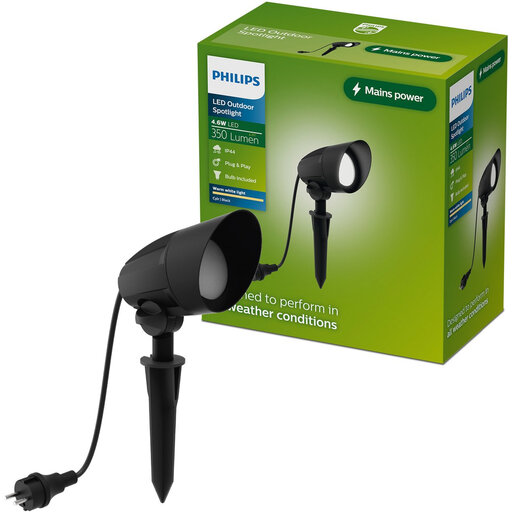
Why it suits this profile: This outdoor ground spotlight is designed to highlight a tree, shrub, path or lawn. It comes with a 350-lumen GU10 LED bulb and a 150 cm cable.
The light source, 2700 K colour temperature and IP44 rating are all stated. You’ll know it’s primarily a directional accent light for a suitable outdoor spot.
Directional positioning, included GU10 LED bulb and warm white light.
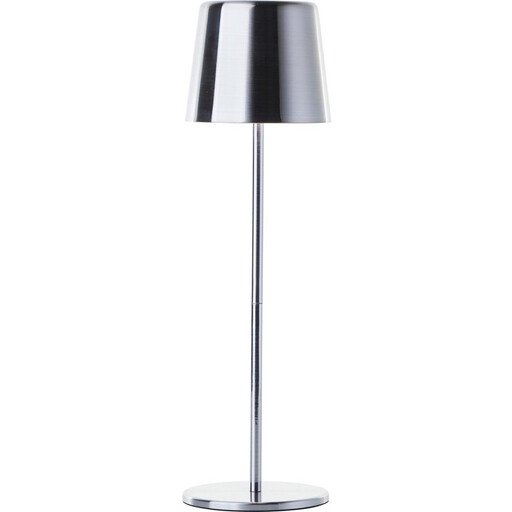
Why it suits this profile: This portable table lamp is handy for a table, balcony or covered patio. Its integrated 4W LED produces 300 lumens, and the colour temperature can be adjusted from 3000 to 6500 K.
The lamp doesn’t need to stay in one fixed position. However, the product information states IP44, so place it somewhere protected from direct jets of water.
Dimmable touch control, adjustable colour temperature and a USB-rechargeable battery.
We’ve put together a complete, up-to-date list of products that meet these strict selection criteria and comply with the applicable European safety regulations.
Choose a light output that suits the size of your driveway and check the IP rating. An outdoor light with a motion sensor can be useful if you don’t want it on all the time. For a large or exposed area, IP65 is generally more suitable than IP44, provided the mounting and connection are suitable too.
How long it stays on each night depends on battery capacity, the amount of sunlight, temperature and the lighting mode selected. Keep the solar panel clean and place it somewhere as free from shade as possible. A motion sensor or dimmed setting can help reduce energy use. The stated lifespan of an integrated LED, such as 15,000 or 25,000 hours, doesn’t automatically tell you how long the battery will last.
An LED outdoor light usually uses little energy compared with older light sources. Actual energy use depends on the wattage and how many hours the light is on. Solar garden lights don’t use electricity from the mains, but they still depend on sunlight and battery capacity. For fixed lighting, also check whether a sensor or timer can stop the light staying on unnecessarily.
