
Vandaag of morgen in huis

Kwaliteit gegarandeerd

Welkomstaanbiedingen ontgrendelen: GRATIS bezorging | Tot 80% korting | Gratis 30 dagen JoyPlus-proefperiode
Download de app
Buying an outdoor light seems simple, until you discover that not every light is suitable for a Dutch exterior wall, an open balcony or a sheltered veranda. A low price may be appealing, but the wrong protection rating, inconvenient power supply or unclear sensor settings can quickly make your purchase less practical.
As a Joybuy Product Recommendation Officer, I filter product information using verifiable criteria. This helps you avoid relying solely on advertising claims and choose outdoor lighting that suits the location, how you intend to use it and the maintenance you are prepared to carry out.
IP44 outdoor lighting is protected against splashing water and solid particles from 1 millimetre in size. This does not mean that the light can withstand a high-pressure jet, immersion or prolonged exposure to driving rain. An IP44 outdoor light is therefore often better suited to use beneath a canopy, awning or sheltered exterior wall.
For an open driveway or a location exposed to rain from several directions, IP65 may be more suitable. This rating provides protection against dust and water jets. However, always check the full product information and installation instructions.
Lumens indicate how much light a lamp produces according to its product specification. A 300-lumen LED outdoor light is useful by an entrance, balcony or small patio, but it is not automatically bright enough for a wide driveway. For ambient lighting, light distribution and colour temperature are particularly important.
A light rated at 2700 to 3000 K generally gives off warm white light. This works well for patio lighting and decorative outdoor lighting. Higher values produce whiter or cooler light, which can be useful by a garage or along a rear path. Also consider the direction of the light: a downward-facing outdoor wall light illuminates a different area from a lamp with a wide beam.
An outdoor light with a motion sensor is only practical when its detection area matches the route people take. If you position the sensor too high, behind an obstacle or directly opposite a busy road, the light may switch on too late or unnecessarily often.
A solar outdoor light also needs sufficient daylight. On a north-facing wall, beneath a balcony or behind tall trees, the solar panel may store less energy. A rechargeable outdoor light with a USB connection gives you more control in this situation, but it does need to be charged regularly.
Use the IP classification as your first filter:
For a fixed 230-volt connection, installation by a qualified electrician is advisable and may sometimes be required under installation regulations. A wireless light with a battery or USB charger is easier to install, but check how the mounting plate, magnet or screws support its weight.
A solar outdoor light works without mains electricity, but its performance depends on sunlight, the season and panel maintenance. A battery-powered model also works on darker days, but it needs to be charged or have its battery replaced. Therefore, check:
With integrated LED lighting, the light source is generally not designed to be replaced by the user. With a GU10 or E27 fitting, you can choose a suitable LED bulb yourself. This means you can adjust the colour and brightness later.
A sensor setting can be useful for an entrance or path. On a patio, you may want to dim the light or use a fixed low-light setting. An outdoor string light requires additional attention to cable length, connection points and the distance from standing water.
Look out for inconsistencies in product descriptions. For example, the UME solar lighting is listed as having a colour temperature of 7000 K, while the text describes it as warm white. Therefore, check the technical value itself: 7000 K normally indicates cooler, whiter light than 2700 to 3000 K.
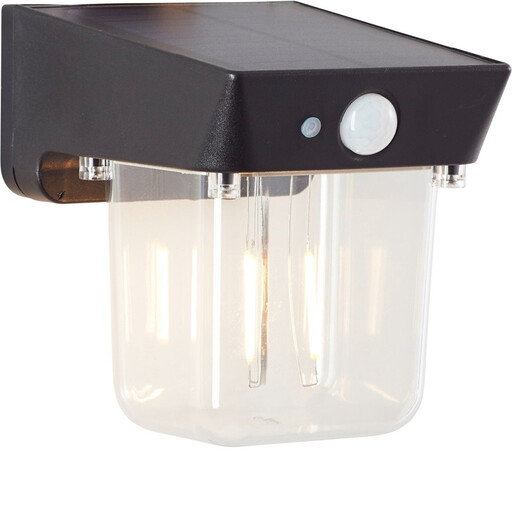
Why it suits this profile: This solar outdoor light works without fixed wiring and combines a motion sensor with 180 lumens and warm 2700 K light. This makes it suitable for an entrance, balcony or sheltered garden wall.
The product information states IP44, making it clear that this light offers protection against splashing water, not complete waterproofing. Install it in a sheltered position and keep the panel clean.
Integrated battery, solar power, sensor and dimmable function according to the product specification.

Why it suits this profile: If you are looking for a recognised brand, solar power and two light settings, this is a compact option for an exterior wall, patio or balcony.
The specification states IP44 and includes a daylight and motion sensor. Choose a location with direct sunlight and protection from strong water jets.
400 lumens per light point according to the product information, two light modes and an integrated LED.

Why it suits this profile: For a driveway, garage or spacious garden, the combination of three light heads, wide light coverage and a motion sensor is designed for functional lighting.
The IP65 classification is clearly higher than IP44. However, check the stated colour temperature of 7000 K if you are expecting warm light.
302 LEDs, three light settings, a 180° detection angle and a detection distance of 60 feet stated in the description.
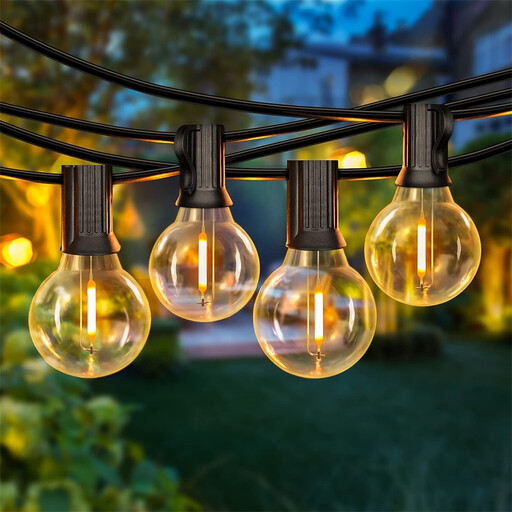
Why it suits this profile: This outdoor string light is designed for decoration, with a 30-metre length, 50+2 LEDs, dimming function and replaceable bulbs.
The plug-in power supply avoids reliance on a small battery. Keep connections away from standing water and follow the stated maximum connectable length.
Dimmable, with multiple light settings, a timer function and replaceable G40 bulbs according to the product description.
We have put together a complete, up-to-date list of products that fully meet these strict selection criteria and the applicable European safety regulations.
For a sheltered exterior wall, balcony or veranda, IP44 may be suitable. In a completely open location with greater exposure to rain and dust, an IP65 outdoor light may be a more logical starting point. Always check the installation instructions and do not install the light in conditions for which the manufacturer does not state that it is suitable.
Usage depends on the wattage, the number of hours the light is switched on and the setting selected. According to the product information, an integrated 4-watt LED light uses 4 kWh per 1000 hours. A motion sensor can reduce the number of hours the light is on. A solar outdoor light uses no mains electricity, but its battery depends on receiving sufficient sunlight.
Not always. Check the detection range, viewing direction and installation height. A sensor is often practical for a front door or path. For constant garden lighting or patio lighting, a fixed setting, dimming function or string light may be more pleasant. Also consider neighbours, passers-by and branches that could trigger the sensor.
