
Vandaag of morgen in huis

Kwaliteit gegarandeerd

Welkomstaanbiedingen ontgrendelen: GRATIS bezorging | Tot 80% korting | Gratis 30 dagen JoyPlus-proefperiode
Download de app
Good outdoor lighting needs to suit the location, purpose and British weather. A light for creating ambience on a covered balcony needs different features from an outdoor light for a driveway or exterior wall. Yet many products are promoted using terms such as “waterproof”, “extra bright” or “energy-efficient”, without explaining what that means in practice.
So, look out for these three common pitfalls:
The IP rating consists of two digits. The first indicates protection against solid particles, such as dust. The second relates to moisture and water.
A GU10 outdoor light uses a GU10 spotlight bulb, while an E27 outdoor light takes a larger screw-fitting bulb. Before you buy, check:
Warm white light around 2700K to 3000K is often a pleasant choice for a patio or entrance. For visibility and practical lighting, a higher brightness may be more useful. Look at the lumen figure rather than just the wattage: lumens indicate how much light the bulb produces according to the product specifications.
An outdoor wall light with a fixed connection is usually connected to 230 volts. Have this work carried out by a qualified installer. A plug-in garden spotlight is easier to install, but it needs a suitable outdoor socket.
A solar outdoor light works without fixed wiring, making it useful for a garden, shed or driveway without a power point. Position the solar panel somewhere that gets as much direct daylight as possible. Shade from a fence, tree or roof overhang can affect how long the light stays on.
For ambience, you could also choose outdoor string lights. Check where the plug will be positioned, how the connections are protected and whether the instructions say to keep the lights out of standing water.
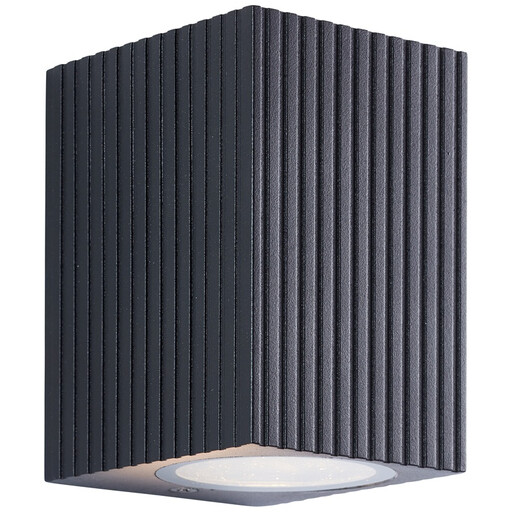
Why it suits this profile: This compact wall light is suitable for a sheltered exterior wall, balcony or entrance, and lets you choose your own GU10 LED bulb.
The specifications clearly state that the bulb is not included and that the light has an IP44 rating. This means you can choose a suitable GU10 bulb and installation location in advance.
Aluminium, glass and plastic; GU10 fitting up to a maximum of 10W; compact dimensions of approximately 10 × 6.9 × 7.8 cm.
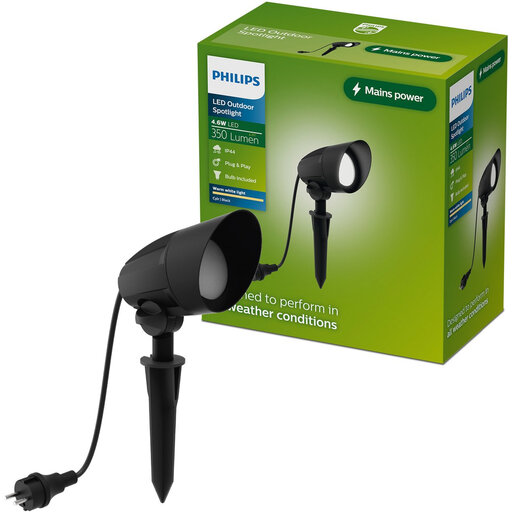
Why it suits this profile: This garden spotlight is designed to highlight a tree, flower bed, driveway or pathway without needing to be fixed to a wall.
The light comes with a GU10 LED bulb, so you don’t need to check separately whether the fitting and bulb are compatible.
350 lumens, 2700K, 4.6W and a 150 cm cable; adjustable ground installation and an IP44 rating.

Why it suits this profile: A practical choice for a driveway, garage, garden path or other location without a fixed power connection.
The stated IP65 rating and solar power supply make it clearer where this light can be used than a product with no listed protection rating or power source.
302 LEDs, stated output of 3000 lumens, three lighting modes, three adjustable heads and a 180-degree motion detection angle.
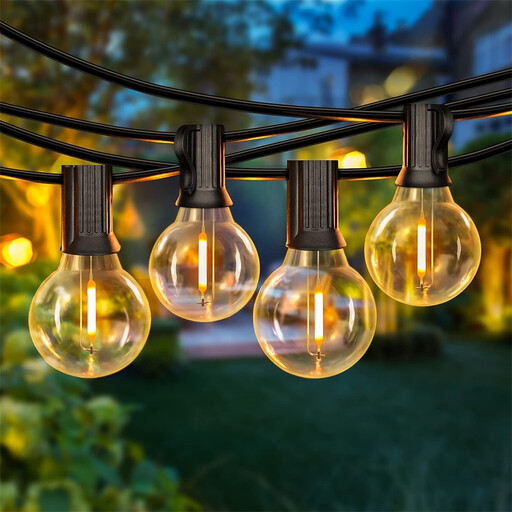
Why it suits this profile: These string lights are designed to decorate a patio, balcony, garden or party venue, where a warm glow matters more than focused lighting.
The length, power supply and maximum number of connectable sets are specified. The bulbs are also replaceable, but connections must be kept out of standing water.
30 metres long, 50+2 warm white LEDs, dimming function, timer, multiple lighting modes and plug-in power.
We’ve put together a complete, up-to-date list of products that meet these strict selection criteria and the applicable European safety regulations.
A garden spotlight, solar outdoor light or outdoor light with a motion sensor are practical options for a driveway. Check the IP rating, detection angle and brightness you need. A fixed connection must be installed by a qualified installer.
IP44 outdoor lighting is suitable for splashing water and sheltered locations, such as a covered entrance, balcony or veranda. For a fully exposed location with lots of rain or dust, a fitting with a higher protection rating, such as IP65, may be more suitable. Always check the installation instructions for the specific product.
LED outdoor lighting generally uses fewer watts than traditional light sources for a similar light output. Actual energy use depends on the wattage, how many hours the light is on and whether it stays on continuously or is activated by a sensor. Solar lighting doesn’t use mains electricity directly, but its performance depends on getting enough daylight and on the battery capacity.
