
Vandaag of morgen in huis

Kwaliteit gegarandeerd

Welkomstaanbiedingen ontgrendelen: GRATIS bezorging | Tot 80% korting | Gratis 30 dagen JoyPlus-proefperiode
Download de app
Good outdoor lighting needs to suit the location, purpose and power supply. A light for a balcony has different requirements from an outdoor light for a driveway or an in-ground spotlight for a wall. Yet many people base their choices mainly on appearance or a high lumen count.
The most common pitfalls:
The IP code indicates how well a product is protected against dust and moisture. IP44 outdoor lights are protected against solid objects larger than 1 millimetre and splashing water. They’re often suitable for sheltered walls, balconies, patios and covered entrances.
IP65 outdoor lighting offers greater protection against dust and water jets. This rating may be more suitable for a more exposed wall, garage, fence or driveway. However, IP65 doesn’t mean that a light can be submerged. Always follow the installation instructions and check that plugs and connections are suitable for outdoor use.
Light colour is measured in Kelvin:
Lumens indicate the amount of light. An outdoor decorative string light is mainly for creating atmosphere. Outdoor lighting with a motion sensor for a driveway will generally need a higher light output and a focused beam.
A solar-powered garden light avoids cables and is easy to install, but it needs direct sunlight. Mains power provides more consistent operation, but requires a suitable outdoor socket or professional installation. Have a fixed 230-volt outdoor wall light installed by a qualified electrician.
Pay attention to the dimensions too. A tall spike light can be practical along a path, while a compact light may fit better beside a narrow door. For wall mounting, check the surface, drilling distance and cable position before ordering.
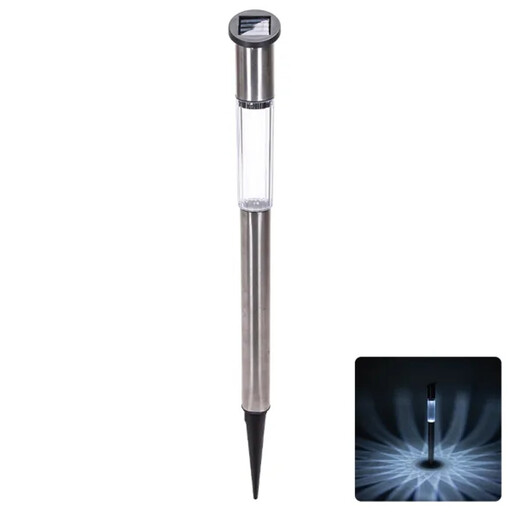
Why it suits this type of user: This spike light runs on solar power and is designed for paths, borders and small garden areas where you don’t want cables.
The product information clearly states that it has a polycrystalline solar panel, a charging time of 4–6 hours and an IP44 rating. So place the light somewhere sunny and sheltered.
Stainless steel housing, a 550 mm spike and a stated running time of 8–12 hours under the specified conditions.
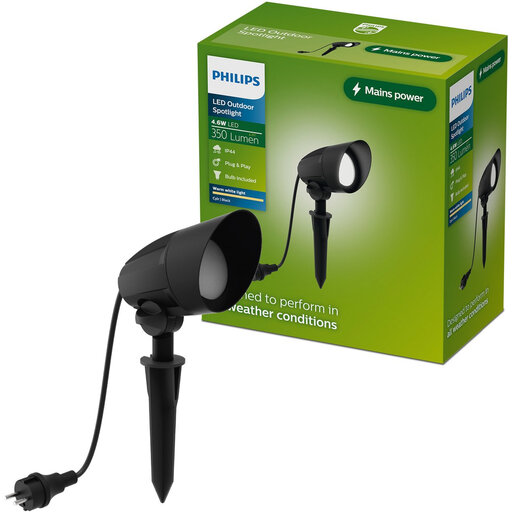
Why it suits this type of user: This outdoor in-ground spotlight has an adjustable design and comes with a GU10 LED bulb, making it suitable for a path, driveway or plants.
There’s no need to look for a light source separately. The specifications state 2700 K, 350 lumens, 4.6 W and IP44. It isn’t suitable for immersion or direct water jets.
Aluminium and glass construction, a 150 cm cable and a supplied GU10 bulb with a stated lifespan of 15,000 hours.

Why it suits this type of user: For a driveway, garage or large garden area, this solar outdoor light offers three lighting modes, three adjustable heads and motion detection.
According to the product description, this model has an IP65 rating, a 180° detection angle and a range of 60 feet. Before installation, check that the solar panel will receive direct sunlight.
The listed product specifications include 302 LEDs, 3000 lumens, three lighting modes and an integrated 1800 mAh battery.
Mount outdoor lights securely and make sure cables don’t create a trip hazard. Only use an outdoor socket or connection that’s suitable for the purpose. Fixed 230V lighting, such as a GU10 or E27 outdoor wall light, should be installed by a qualified electrician.
Clean solar panels and sensors regularly with a soft, slightly damp cloth. For outdoor string lights, check the plugs, connectors and maximum connection length. Don’t use an IP44 product where it will be exposed to direct high-pressure water jets.
We’ve put together a complete, up-to-date list of products that meet these strict selection criteria and the applicable European safety regulations.
It can be, as long as the panel receives enough direct daylight. In winter or during prolonged cloudy spells, the running time may be shorter. Place the panel somewhere unshaded and keep it clean.
It depends on the area and the light distribution. You need less light for general orientation than for broad, functional illumination. A model with a motion sensor can switch on the light only when it detects movement.
LED bulbs generally use little power. Calculate the energy consumption with: wattage × hours of use ÷ 1000 = kilowatt-hours. Solar lighting has no mains connection costs, but its performance still depends on sunlight and battery capacity.
