
Vandaag of morgen in huis

Kwaliteit gegarandeerd

Welkomstaanbiedingen ontgrendelen: GRATIS bezorging | Tot 80% korting | Gratis 30 dagen JoyPlus-proefperiode
Download de app
Choosing a new outdoor light seems straightforward, until you realise how much difference there is between a light for a sheltered veranda and a fitting exposed to rain, wind and dust. Marketing terms such as “waterproof”, “extra bright” and “energy-saving” don’t always tell the whole story.
The most common buying mistakes come down to three things:
With the right specifications, you can avoid disappointment and choose outdoor lighting that suits the location, how you’ll use it and the maintenance you’re happy to carry out.
The IP rating tells you how well a product is protected against solid particles and moisture. IP44 is a common rating for many garden and exterior wall applications. In practice, it means protection against splashing water from different directions, but not against immersion or powerful water jets.
An IP44 outdoor wall light could be a good fit for an entrance, balcony or covered patio wall. Don’t install it in a completely exposed spot where rainwater could sit on the connections for a long time.
According to its product classification, an IP65 solar light offers greater protection against dust and water jets. This makes it a more suitable option for a more exposed exterior wall, driveway or garden wall. Always check the installation instructions, though: a higher IP rating doesn’t automatically make every installation suitable for immersion.
Lumens tell you how much light a bulb produces. For decorative garden lighting, a lower lumen output is often enough. According to its product specifications, the Aigostar Solar Lawn Light has a power rating of 0.012 W, a colour temperature of 6500 K and a stated battery life of 8 to 12 hours. Its cool white light stands out along a path, but may feel harsh in a seating area.
Many households choose a warmer colour for a patio or entrance, such as 2700 K or 3000 K. An outdoor light with a motion sensor also doesn’t need to stay on at full brightness all evening. This can be practical for a driveway, shed or front door.
Also check whether a bulb is included. A GU10 or E27 fitting may be sold without one. You can then choose the colour temperature and energy consumption yourself, but you’ll need to buy the bulb separately.
Solar garden lights save you needing a mains connection, but they rely on sunlight. If possible, place the panel somewhere it will get several hours of direct daylight. Trees, tall fences and a north-facing wall can limit how much charge it gets.
Check the following:
Some solar product manufacturers say that performance can vary depending on the weather and the amount of available sunlight. Treat stated running times as product specifications based on certain conditions, rather than a fixed guarantee for every night.
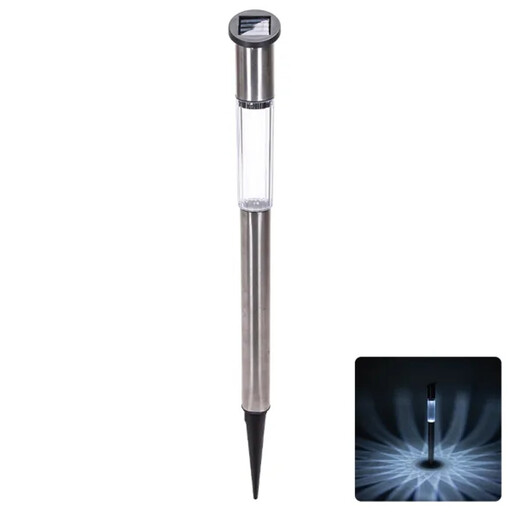
Why it suits this type of buyer: This solar-powered spike light is designed for paths, borders and small garden features, with no mains connection required.
The product specifications state an IP44 rating and a charging time of 4 to 6 hours. Place the light somewhere sunny but not completely exposed.
Stainless steel housing, spike mounting and a stated battery life of 8 to 12 hours.

Why it suits this type of buyer: This solar outdoor light is designed for an entrance, exterior wall or patio where automatic activation is useful.
The product listing mentions a built-in dusk and motion sensor, so the light doesn’t need to stay on all the time. Bear in mind that IP44 means it’s suitable for splashing water, not water jets.
1000 lumens, warm white light at 3000 K, two lighting modes and installation without fixed wiring, according to the product description.

Why it suits this type of buyer: With three adjustable light heads and motion detection, this light is designed for driveways, garages, large gardens and other spacious areas.
The product specifications state an IP65 rating, a 180° detection angle and three lighting modes. Make sure the panel has an unobstructed position in the sun, and check that the high brightness is suitable for the surroundings.
302 LEDs, a stated luminous flux of 3000 lumens and three adjustable heads for wide coverage.
We’ve put together a complete, up-to-date list of products that meet these strict selection criteria and the applicable European safety requirements.
An IP44 outdoor wall light could suit a sheltered front door or exterior wall. Choose one with a built-in motion sensor if you only need light when you arrive. For fixed models, always check the supply voltage and have the wiring installed in line with local regulations.
It depends on the battery, charging time, temperature, sunlight and operating mode. Manufacturers sometimes state a light source lifespan of, for example, 15,000 or 25,000 hours, but that doesn’t automatically tell you how long the battery will last. Clean the panel regularly and only replace the battery if the model is designed to allow this.
A light with a motion sensor is usually on for less time than one that stays on all evening. For a mains-powered model, consumption depends on the wattage and how long it’s switched on. Solar garden lights don’t use electricity from the mains, but their performance depends on getting enough sunlight and keeping the battery in good condition.
