
Vandaag of morgen in huis

Kwaliteit gegarandeerd

Welkomstaanbiedingen ontgrendelen: GRATIS bezorging | Tot 80% korting | Gratis 30 dagen JoyPlus-proefperiode
Download de app
Buying an outdoor lamp sounds simple, until you discover that not every outdoor light is suitable for the same location. A solar wall light by the front door has to cope with rain and shade. A light along the garden path should provide even illumination above all else. On a driveway, an outdoor lamp with a motion sensor is often more practical than one that stays on all night.
The main pitfalls are usually not related to appearance, but to the specifications.
An IP44 outdoor lamp is protected against splashing water and solid objects measuring 1 millimetre or more. This does not mean that the lamp can withstand a direct jet of water or prolonged immersion. IP44 is therefore mainly suitable for sheltered façades, balconies, covered areas and patios.
An IP65 outdoor lamp offers greater protection against dust and water jets. This makes this type more suitable for an open garden, driveway or location where rain falls directly on the lamp. However, always check the full product description: the IP rating does not tell you everything about installation, cables or the mounting surface.
More light does not automatically mean more comfortable lighting. A 3000-lumen lamp may be suitable for illuminating a wide driveway, but it could be too bright next to a seating area. For outdoor mood lighting, lower brightness, a warmer colour temperature and dimming functionality are often more relevant.
As well as lumens, consider:
A solar-powered lamp does not work independently of its surroundings. Shade from a fence, tree or covered area reduces the amount of energy the panel can store. In winter, the days are shorter and sunlight is often weaker, which can reduce the operating time.
Therefore, position solar outdoor lighting so that the panel receives as much direct sunlight as possible during the day. Also check the specified charging time, operating time and battery capacity. A solar wall light is easy to install, but not every wall has a suitable sunny position.
Use IP44 for sheltered outdoor areas where splashing water is the main concern. Examples include a covered balcony, an entrance beneath a canopy or a patio next to the façade.
Choose IP65 for an exposed position where the lamp will be affected by rain, dust and changing weather conditions. When installing a lamp on a façade or fence, the fixings and cable entry must also be suitable for outdoor use.
Also check whether the LED light source can be replaced. With integrated LED models, the light source is usually not replaced separately.
A motion sensor can save energy by switching the lamp on only when movement is detected. Check the detection range, detection angle and available lighting modes. A wide angle is useful on a driveway, but it can also detect movement outside the area you want to monitor.
When installing the lamp, consider its height and direction. Do not position a sensor directly towards a busy public pavement if you want to avoid unnecessary activation.

Why it suits this profile: This solar wall light works without permanent wiring and features an integrated LED, motion sensor and two lighting modes. That makes it a straightforward choice for a first purchase for an entrance, balcony or sheltered façade.
The IP44 rating is clearly stated. This means the lamp is intended for splashing water, not immersion or direct water jets.
400 lumens per light point, warm white 2700K light, two modes and installation without a mains connection.
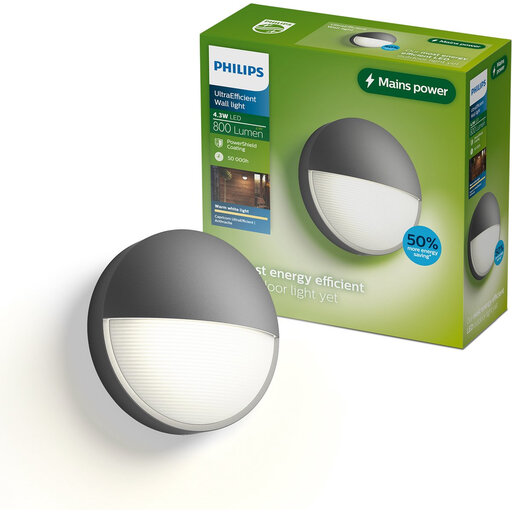
Why it suits this profile: A fixed wall light with an aluminium housing and integrated LED is ideal for anyone looking for a permanent lighting solution for a façade, entrance or balcony.
The specifications state IP44 and professional installation. This makes it clear from the outset that this is not a wireless solar solution and still needs shelter from direct water jets.
800 lumens, warm white 2700K light, an aluminium housing and a stated lifespan of up to 50,000 operating hours according to the product description.

Why it suits this profile: For a driveway, garage or large garden where a wide beam and motion detection are required, this model offers several adjustment options.
The product details state IP65, a detection distance of 60 feet, a detection angle of 180° and three lighting modes. However, check that this distance suits your installation location.
302 LEDs, a stated light output of 3000 lumens, three adjustable heads and a solar panel with an 1800mAh lithium-ion battery according to the product specifications.

Why it suits this profile: This is a practical choice for garden enthusiasts who want to control path lighting and mood lighting via an app.
The set is rated IP44 and uses a plug-in cable. This makes its limitations clear: install the lamps in a sheltered location and keep the cable out of walkways.
Three integrated LED lamps, adjustable colour temperature from 3000–6500K, RGB, dimming function and control via Tuya Smart according to the product information.
We have put together a complete, up-to-date list of products that fully meet these strict selection criteria and the applicable European safety regulations.
Start by temporarily placing a solar outdoor lamp in the intended location. Over the course of a sunny day, check whether the panel receives enough light. Then mount the lamp securely and make sure that branches, leaves or dirt do not cover the sensor or panel.
With fixed LED outdoor lamps, the power must be switched off before carrying out maintenance. According to the product information, hardwired lighting should be connected by a qualified electrician. Clean the fittings with a soft, dry or slightly damp cloth, depending on the instructions. Do not use abrasive products.
Stability is important for garden path lighting. Check that ground spikes are firmly secured and do not run cables across walkways. A waterproof outdoor lamp is not automatically resistant to every type of incorrect use, so always follow the safety information for the specific model.
Yes, but the operating time may vary. Shorter days, cloudy weather, shade and the low winter sun provide less energy for charging. Position the panel as openly as possible and keep its surface clean. When buying, check the specified charging time and operating time.
IP44 is suitable for splashing water and sheltered outdoor locations, such as a covered patio, balcony or entrance. For a fully exposed location with direct rain or water jets, a higher protection rating, such as IP65, may be more appropriate. Also check the installation and cable instructions.
A motion sensor can reduce the number of hours the lamp is lit because it does not stay on continuously. Actual consumption depends on the brightness, activation duration, battery and number of activations. With solar lighting, the energy comes from the panel; with mains-powered lighting, consumption is determined by the wattage and usage time.
