
Vandaag of morgen in huis

Kwaliteit gegarandeerd

Welkomstaanbiedingen ontgrendelen: GRATIS bezorging | Tot 80% korting | Gratis 30 dagen JoyPlus-proefperiode
Download de app
Suitable outdoor lighting makes an entrance more visible, creates a welcoming atmosphere on the patio and helps illuminate dark corners in the garden. However, the range of products is not always easy to compare. An attractive product photo reveals little about the correct installation method, the required light source or the level of protection against rain.
The following pitfalls are common:
The IP code consists of two digits. The first digit refers to protection against solid particles, while the second refers to water. IP44 means protection against objects larger than 1 millimetre and splashing water from different directions.
This makes an IP44 outdoor lamp suitable for, for example:
For a completely exposed location with lots of rain or splashing water, a product with a higher IP rating may be more suitable. Always check the installation instructions: IP protection only applies when the seals, lampshade and light source have been fitted correctly.
An E27 outdoor lamp uses a large screw fitting. You can choose the colour temperature, brightness and, in some cases, whether it can be dimmed. A GU10 outdoor lamp uses a compact spotlight fitting and is useful when you want to direct light at a wall, plant or path.
With integrated LED outdoor lighting, the light source and fitting form a single unit. Pay particular attention to:
Warm white light of around 2700 to 3000 K is usually well suited to patio and balcony lighting. For practical lighting by a gate or driveway, a higher brightness may be more useful.
An outdoor wall light with a fixed connection requires a suitable wall, safe wiring and correct sealing. A solar outdoor lamp can be installed without a mains connection, but the solar panel must receive direct or sufficient daylight.
Ground spotlights and spike lights are practical options for garden lighting. For models with a cable, check where the cord runs so that it does not create a trip hazard. A table lamp or freestanding outdoor lamp is more flexible to move, but must be placed on a stable, level surface.
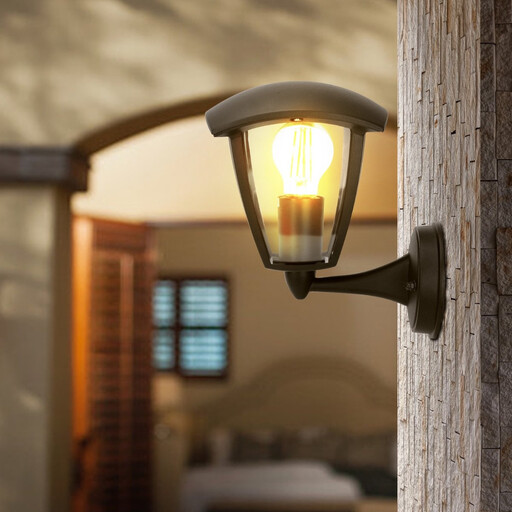
Why it suits this profile: This black outdoor wall light has an E27 fitting and is supplied without a light source. That means you can choose a suitable LED bulb for a balcony, walkway or sheltered entrance.
The product information clearly states that the light source is not included. The IP44 rating is suitable for splashing water, but not for direct water jets.
E27 fitting, maximum 60 W according to the product specification, and dimensions of approximately 21.5 × 17 × 23.5 cm.
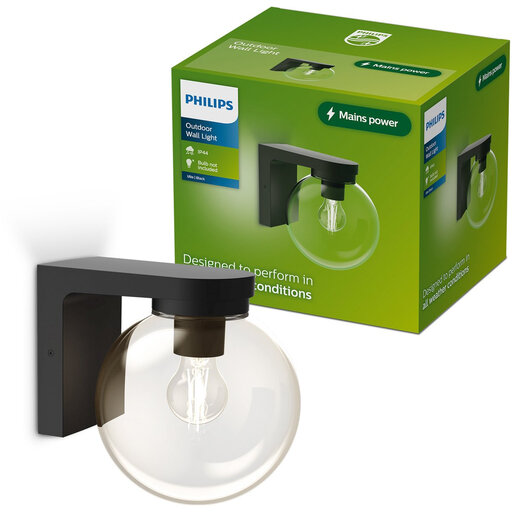
Why it suits this profile: The aluminium and glass fitting complements a modern façade and allows you to choose your own E27 LED bulb for atmospheric or functional lighting.
According to the product information, the light source is removable and not included. This prevents you from accidentally ending up with an unwanted colour temperature or brightness.
IP44, one E27 light point, diffuse light distribution and dimensions of approximately 20 × 25.2 × 22.7 cm.

Why it suits this profile: This solar outdoor lamp is designed for a driveway, gate or another location where you want light without a fixed power connection. The motion sensor switches the lamp on when needed.
The product information explicitly states an IP44 rating and solar power. However, place the panel somewhere with sufficient direct daylight.
Integrated LED, 1000 lumens, 3000 K, two lighting modes and a built-in motion sensor.
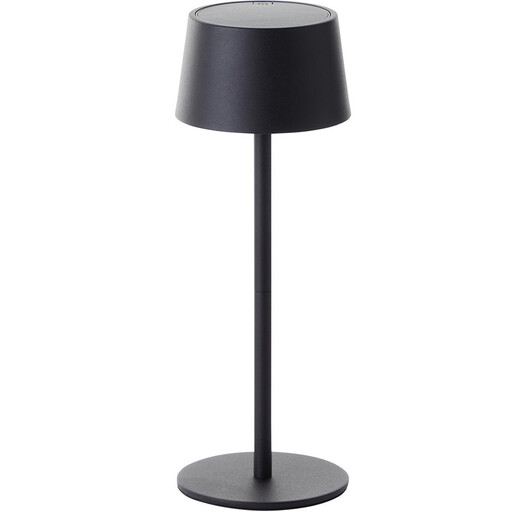
Why it suits this profile: This freestanding lamp is ideal for tenants or anyone who wants to move their lighting regularly between a table, balcony and patio.
As well as charging via solar power, it can also be charged via USB. This means you are not entirely dependent on the battery’s solar charge when there is little sunshine.
170 lumens, warm white light at 3000 K, three dimming levels and IP44 splash protection.
We have compiled a complete, up-to-date list of products that fully meet these strict selection criteria and the applicable European safety regulations.
Yes, IP44 is generally suitable for sheltered outdoor locations and protection against splashing water. It does not mean that the lamp is completely waterproof. Therefore, do not place an IP44 outdoor lamp somewhere where water jets, prolonged pooling or immersion may occur.
The operating time per night depends on sunlight, battery capacity, light setting and sensor settings. In winter or after several cloudy days, a solar outdoor lamp may stay lit for less time. Keep the solar panel clean and choose a location with as much direct daylight as possible.
LED bulbs generally use little power in relation to their light output. When comparing products, look at watts, lumens and the number of hours the lamp will be lit. An outdoor lamp with a motion sensor can reduce electricity consumption because it does not stay on continuously. Solar lighting does not require a fixed mains connection, but the battery must still be charged sufficiently.
