
Vandaag of morgen in huis

Kwaliteit gegarandeerd

Welkomstaanbiedingen ontgrendelen: GRATIS bezorging | Tot 80% korting | Gratis 30 dagen JoyPlus-proefperiode
Download de app
Choosing a new outdoor light may seem straightforward, until you realise how many differences there are. A light may look suitable in the product photo, but in practice provide too little light, be difficult to install or fail to withstand the location where you want to use it.
Three common pitfalls are:
That is why it is sensible to first determine where the lighting will go, how much light you need and how the light will be powered.
For a driveway, front door or dark passageway, functional lighting is usually more important than decoration. An outdoor light with a sensor can switch on automatically when it detects movement. This is practical when you arrive home with shopping or do not want to operate a switch manually.
On a balcony, veranda or patio, the focus is often on creating atmosphere. A portable light, an outdoor string light or compact patio lighting may be a better fit than a fixed wall light. Do pay attention to the stated protection rating and only use a product in the way specified by the manufacturer.
Outdoor wall lights are popular for façades and entrances. Models with a GU10 or E27 fitting give you more freedom to choose your own LED bulb and colour temperature. An integrated LED light is often compact, but with some models the light source cannot be replaced.
The IP code consists of two digits. The first digit relates to solid particles, while the second refers to moisture. In practice, IP44 outdoor lighting means that the light is protected against solid objects measuring 1 millimetre or more and against splashing water from different directions.
IP44 is often suitable for a sheltered façade, balcony or patio. For a completely exposed location with heavy rainfall, a higher rating such as IP65 may be more suitable. Always check the installation instructions. According to the product information, an IP44 light must not be immersed and is not intended for direct water jets.
The number of lumens indicates how much light a lamp produces. A compact mood light generally needs fewer lumens than lighting for a driveway or large garden path. Also consider the colour temperature:
A light with several modes can be useful when you want to switch between functional and decorative lighting. For example, the Atmosphera Zack lamp is listed as offering white light, a flame effect and multicolour as three modes.
Solar outdoor lighting works without a fixed connection, but needs direct sunlight to charge the battery. Do not position the panel beneath a roof edge or behind vegetation. Clean the panel and sensor regularly.
A rechargeable light with a USB connection is easy to move, but needs to be recharged periodically. Also check how the light is secured. Magnetic mounting is convenient, but the surface must be flat, clean and strong enough to support it.
A fixed outdoor wall light with a voltage of 220-240 volts will often need to be connected to the mains. Have this type of installation carried out by a qualified installer in accordance with local regulations. Switch off the power before carrying out maintenance.
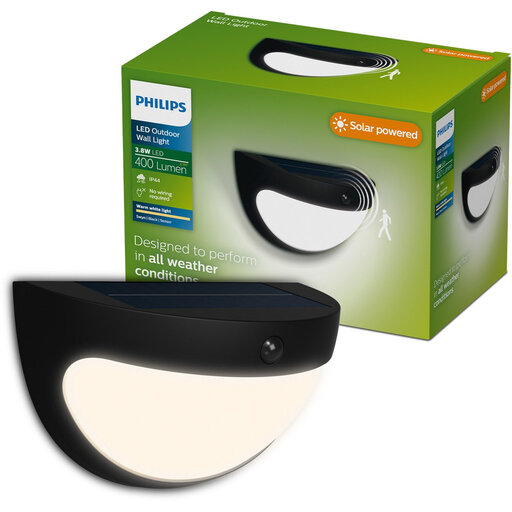
Why it suits this profile: This solar outdoor light requires no fixed wiring and features a daylight and motion sensor. That makes it practical for an entrance, shed or small garden.
The specifications list two light modes, a motion sensor and IP44 protection. However, make sure the chosen mounting location receives enough direct sunlight.
Solar power, 400 lumens per light point, warm white light at 2700K and installation without a mains connection.
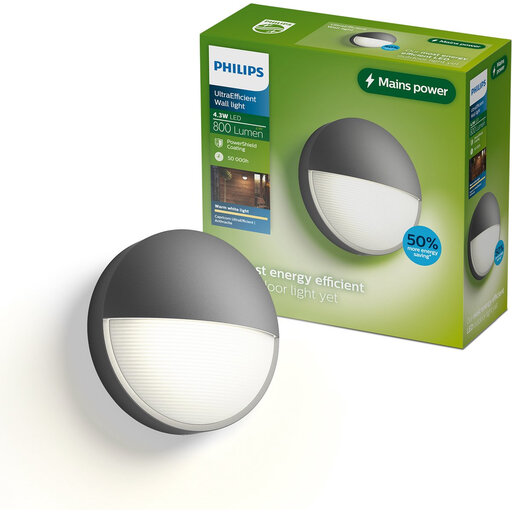
Why it suits this profile: For anyone looking for fixed LED outdoor lighting with an aluminium housing, a modern design and a clearly stated light output for a façade or balcony.
The product information lists IP44 and professional installation. This makes it clear that it is not a freestanding light to be placed just anywhere.
Integrated LED, 800 lumens, 2700K warm white light and an aluminium and plastic construction.

Why it suits this profile: This model is designed for larger areas such as driveways, grounds, garages or spacious patios where broad illumination and several adjustable modes are desired.
The stated IP65 rating is higher than IP44, although the installation location still needs direct sunlight to charge the solar battery.
Three adjustable lamp heads, a light output of 3000 lumens according to the product information, motion detection and three light modes.
We have put together a complete, up-to-date list of products that fully meet these strict selection criteria and the applicable European safety regulations.
An outdoor string light requires extra attention when it comes to the connection. Check that the model is intended for outdoor use, keep connections away from standing water and unplug the light before cleaning the cable. For festive lighting, cable length, replaceable bulbs and a timer function are also important considerations.
IP44 provides protection against splashing water and is often used for sheltered façades, balconies and patios. The rating does not mean that the light is waterproof. Do not place the product under water and avoid direct water jets.
The service life varies depending on the model, operating conditions and power supply. With an integrated LED, the light source cannot always be replaced. With a light featuring a GU10 or E27 fitting, you can replace the bulb type later, provided it remains within the stated specifications.
Solar garden lighting uses a built-in battery that charges via the solar panel during the day. Under normal use, no fixed mains connection is required. Operating time depends, among other things, on sunlight, the season, battery capacity and the selected light mode.
