
Vandaag of morgen in huis

Kwaliteit gegarandeerd

Welkomstaanbiedingen ontgrendelen: GRATIS bezorging | Tot 80% korting | Gratis 30 dagen JoyPlus-proefperiode
Download de app
Lighting a garden, patio, driveway or balcony may seem straightforward. Yet many buyers run into the same problems: a light produces less illumination than expected, the battery is flat after a cloudy day, or the housing is unsuitable for the place where you want to install it. With the right checks beforehand, you can avoid making the wrong purchase.
A light with a high lumen output is not automatically suitable for every application. For a pathway, you generally need even, relatively low-level lighting. For a driveway or back door, a more powerful light with a motion sensor may be more practical. Also consider the colour temperature:
Therefore, always check the lumen output, colour temperature and light distribution. A solar path light with 10 lumens is intended for marking a route and creating ambience, not for lighting a large patio.
An IP rating consists of two digits. The first digit refers to solid particles, while the second refers to water. IP44 means protection against splashing water; the light is not designed to be submerged or exposed to powerful, direct jets of water. IP65 provides greater protection against dust and water jets, but this light should not be placed underwater either.
So, look at the actual IP rating rather than relying solely on terms such as “waterproof” or “weatherproof”. IP44 may be sufficient for a sheltered wall. For an exposed border, lawn or driveway, waterproof outdoor lighting with IP65 is a more logical choice, provided it is positioned and installed correctly.
Solar-powered garden lights charge during the day. Shade from a fence, tree or canopy reduces the available charging time. The stated operating time is usually based on favourable conditions. In winter, during cloudy weather or when the solar panel is dirty, the light may stay on for less time.
Therefore, place a solar outdoor light where it will receive as much direct daylight as possible. Also check whether the on/off switch needs to be set to “on” before the first charge. With many models, the light then switches on automatically via a dusk sensor.
Use the light output as a practical guide:
These are guidelines, not fixed rules. The height, mounting angle and colour of the surroundings all affect the result. With decorative solar garden lighting, the number of lights and their spacing can sometimes be more important than using one powerful light source.
Choose the IP rating according to the location. A light installed beneath an eave will be exposed to less rain than a ground light in an open garden. Also check the quality of the fixing. A sturdy ground stake prevents solar path lights from leaning or becoming a trip hazard.
For wall lights, it is important that the wall, wall plugs and screws are suitable for the surface. A 230-volt outdoor light must be connected by a qualified installer in accordance with the product information.
Solar garden lighting has an integrated rechargeable battery. Its capacity and charging time partly determine how long the light stays on in the evening. USB-rechargeable models are more flexible in shady locations, but they do need to be charged manually.
Clean solar panels and light windows regularly with a soft, slightly damp cloth. Do not use abrasive products, and never open an integrated battery yourself. For lights with replaceable bulbs, check the fitting, such as E27 or GU10, and confirm the maximum wattage.
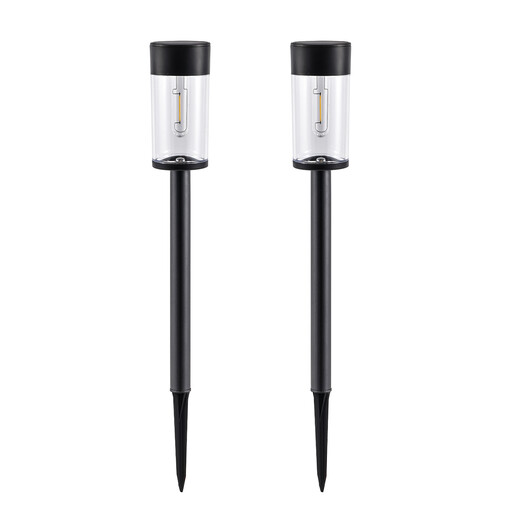
Why it suits this profile: This set is designed as a simple introduction to solar path lighting along a garden path, lawn edge or driveway. It is installed using ground stakes, with no wiring required.
The product description clearly states 10 lumens per light, a colour temperature of 3000K and IP65. This makes it easier to assess whether it is suitable before you buy.
A set of two, automatic on/off operation, 3000K warm white light and a stated IP65 rating.

Why it suits this profile: Suitable for a wall, entrance or patio where you want a higher light output and automatic detection without running a power cable.
The specifications list 1000 lumens, 3000K, a motion sensor and IP44. This shows that the model is primarily intended for splash protection and functional lighting.
1000 lumens, two lighting modes, integrated LED and installation without connection to the mains.

Why it suits this profile: For a driveway, garage, back garden or spacious patio where a wide beam and motion detection matter more than subtle decoration.
The product information specifies 3000 lumens, three lighting modes, a 180-degree detection angle and IP65. This makes the light easier to compare for larger areas.
Three adjustable light heads, 3000 lumens, motion detection and IP65 according to the product specifications.
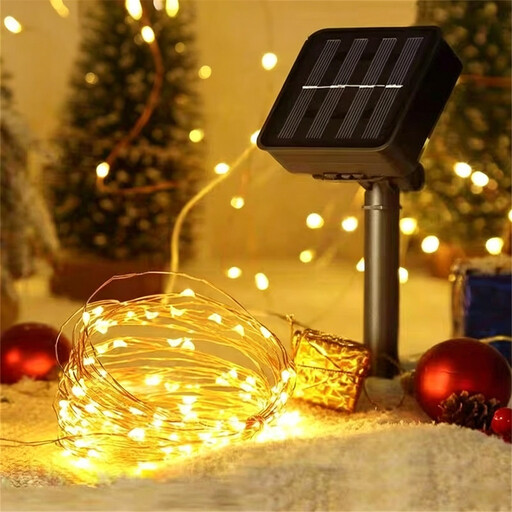
Why it suits this profile: A practical choice for decorative lighting around a patio, balcony, tree or pergola, without needing a wall light or ground spotlight.
The set specifies a length of 49 feet per string, 75 LEDs per string and eight lighting modes. This makes it easier to plan the coverage and effect in advance.
Two strings, each with 75 LEDs, eight modes and automatic solar-powered operation according to the product description.
We have compiled a complete, up-to-date list of products that fully meet these strict selection criteria and the applicable European safety regulations.
Yes, but performance can vary due to shorter days, cloudy weather and shade. Choose a sunny location, keep the panel clean and expect a shorter operating time when there is little daylight. For consistent lighting, a USB- or mains-powered model may be more practical.
For marking a route and creating a soft line of light, a low lumen output is often sufficient, such as around 10 lumens per path light. If you want to see obstacles more clearly, combine several lights with an even spacing between them. A powerful outdoor light with a motion sensor is better suited to a driveway, entrance or garage.
IP44 means that the light is protected against solid particles measuring 1 millimetre or more and against splashing water. A solar wall light with this rating is suitable for normal outdoor use, but not for submersion, direct water jets or locations where rainwater collects.
