
Vandaag of morgen in huis

Kwaliteit gegarandeerd

Welkomstaanbiedingen ontgrendelen: GRATIS bezorging | Tot 80% korting | Gratis 30 dagen JoyPlus-proefperiode
Download de app
An outdoor light may promise a lot on paper, but what really matters is whether it suits the spot where you plan to install it. For example, a solar outdoor light on a shady wall will not charge as well. An IP44 outdoor light is suitable for splashes, but not for a spot that is regularly exposed to powerful jets of water. And smart garden lighting may offer more settings, but it needs a power supply, app control and sometimes an account.
In this guide, you’ll find out what to consider when choosing outdoor lighting for your garden, patio, exterior walls, driveway, garage or entrance.
A high lumen figure does not automatically mean a light will work well in every location. Lumens indicate the total light output, but do not tell you exactly how wide or focused the beam will be. A powerful floodlight can be useful for a driveway or garage. For a narrow garden path, a lower output may be enough.
Also consider:
An IP rating consists of two digits. The first indicates protection against solid objects, while the second relates to moisture and water. An IP44 outdoor light is protected against solid objects and splashes. This rating makes it suitable for many sheltered exterior walls, patios and garden paths.
An IP65 outdoor light offers greater protection against dust and jets of water. This is useful for a more exposed wall, driveway or garage area. Always check the installation instructions, though: the light’s IP rating does not mean every connection is automatically waterproof.
A solar-powered outdoor light needs enough daylight to charge its battery. Trees, eaves, tall fences and a north-facing wall can all limit its output. In winter, the days are shorter and sunlight is often less intense.
A solar wall light is handy if you don’t want to run a cable, but position the solar panel in as open a spot as possible. Clean it regularly with a soft cloth and check that the battery is suitable for the way you plan to use the light.
Choose solar outdoor lighting for straightforward installation without fixed wiring. It works well by an entrance, garden shed, patio or remote part of the garden. Mains power is more reliable for steady, long-lasting illumination. A rechargeable outdoor light with a USB connection offers flexibility, but needs to be charged periodically.
An outdoor light with a motion sensor switches on when it detects movement. Check the detection distance and angle, as these determine whether someone coming from the driveway or along the garden path will actually be detected. An outdoor light with a dusk sensor responds to ambient light and can switch on automatically as it gets dark.
Also check which modes are available. Some lights only run at full brightness for a limited time, while others combine low-level background lighting with brighter illumination when they detect movement.
For an entrance or exterior wall, warm light of around 2700 to 3000 K is often more relaxing. Neutral or cool light can make functional lighting for a garage or driveway clearer. Smart garden lighting may offer adjustable CCT colour temperatures, RGB colours, dimming and control via an app or voice assistant.
Check whether smart lighting requires wifi, Bluetooth, a bridge or an account. Cable routing also matters outdoors: cables must not create a trip hazard.
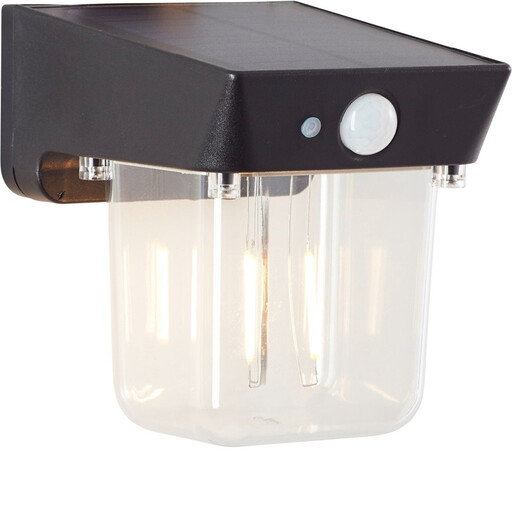
Why it suits this need: This compact solar wall light works without fixed wiring and combines a motion sensor with warm white light. It’s a good fit for a small entrance, balcony or sheltered garden wall.
The product information clearly states that it is solar-powered, with an output of 2 W, 180 lm and an IP44 rating. Be sure to install it in a sheltered spot with enough daylight.
Solar power, motion sensor, dimming function, 2700 K colour temperature and a compact size of 11.5 × 10 × 11 cm.

Why it suits this need: For a wide driveway, garage or large garden area, this powerful solar outdoor light offers a high stated light output and IP65 protection.
The product details list the 4000 lm light output, IP65 rating, dusk sensor and detection range separately. This makes it easier to match the light to a large, open area.
Stated output of 4000 lm, 5000 K, IP65 rating, adjustable lamp head and solar power with two lighting modes.

Why it suits this need: This solar floodlight is designed for larger areas such as a driveway, garage, back garden or poolside, where broad coverage is important.
The three adjustable heads and stated 270° coverage give a clearer idea of how the light will be spread than a lumen figure alone. The IP65 rating is suitable for a more exposed installation spot.
302 LEDs, stated output of 3000 lm, IP65 rating, three lighting modes, a 180° detection angle and installation without a mains cable.

Why it suits this need: This set is designed for garden paths, borders and decorative accents. According to the product information, dimming, CCT and RGB settings are available through Tuya Smart.
The product description specifies IP44 and explains that the light is splash-resistant, but not suitable for submersion or direct jets of water. This makes it easier to choose the right spot.
Three ground lights, 660 lm, adjustable from 3000 to 6500 K, RGB, dimming function, Bluetooth and an 8-metre cable.
We’ve put together a complete, up-to-date list of products that meet these strict selection criteria and comply with current European safety regulations.
Before placing your order, check the following:
For a sheltered spot, IP44 may be enough, for example under a canopy or on a wall with little direct exposure to rain. For a more exposed location, IP65 is a more suitable choice. Always check the connection, cable gland and installation instructions too.
It depends on its location, the available daylight and the battery capacity. In dark or overcast weather, the light may not stay on for as long. Position the panel where it will receive as much light as possible and keep it clean. If you need a light to stay on for long periods every evening, mains power may be more practical.
Solar outdoor lighting does not use mains electricity while it is on, but it does need a battery and solar panel. Mains-powered LED outdoor lighting generally has a low stated wattage. Calculate the cost using this formula: power in watts ÷ 1000 × hours of use × electricity tariff. With sensor-controlled lighting, the actual hours of use are often lower than for lights that stay on continuously.
