
Vandaag of morgen in huis

Kwaliteit gegarandeerd

Welkomstaanbiedingen ontgrendelen: GRATIS bezorging | Tot 80% korting | Gratis 30 dagen JoyPlus-proefperiode
Download de app
Good outdoor lighting needs to do more than look attractive. The lamp must suit its location, provide enough light and withstand the British weather. Even so, many people choose an outdoor lamp based solely on its design or a high lumen rating. This can result in a lamp that is too bright for a balcony, quickly runs out of charge in winter or is not adequately protected against rain.
So pay particular attention to these three common pitfalls:
Light output is measured in lumens (lm). For atmospheric patio lighting, a lower number is often sufficient. An outdoor wall light with around 180 to 400 lumens may be suitable for an entrance, balcony or covered patio. A driveway, garage or larger garden may require more light.
Colour temperature is measured in kelvin (K):
Also consider the light distribution. A lamp with several adjustable heads illuminates a larger area, while a compact outdoor wall light mainly illuminates its immediate surroundings.
The IP code consists of two digits. The first digit indicates protection against solid particles, while the second refers to water.
So do not look only for the term “weather-resistant outdoor lamp”. Check the specific IP rating and installation requirements.
A solar outdoor lamp works without a fixed power connection. However, the solar panel needs direct daylight. Do not place it beneath a canopy, dense tree or balcony slab if you expect a regular charging cycle.
LED outdoor lighting generally uses little energy and often has an integrated light source. On some models, the LED cannot be replaced. An outdoor lamp with a GU10 or E27 fitting, on the other hand, allows you to choose a suitable bulb yourself or replace it later.
Also check whether:
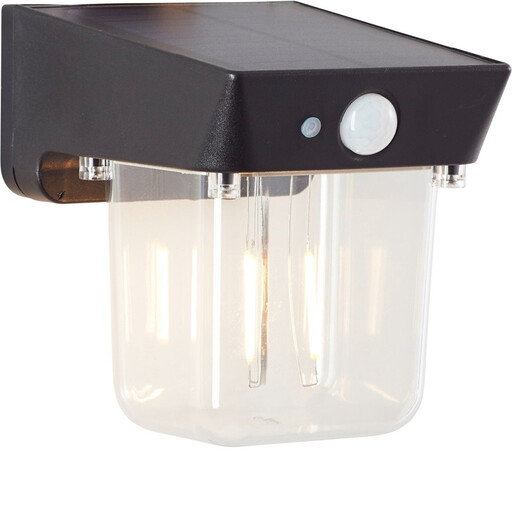
Why it suits this customer profile: This compact solar outdoor lamp is designed for an entrance, balcony, patio or sheltered façade where no cable is available. The integrated LED provides 180 lumens at 2700K and the lamp has a motion sensor.
The specifications make it clear that this lamp has a modest light output. So do not expect wide-area lighting; it is designed to provide practical illumination close to the wall. IP44 is mainly suitable for a sheltered location.
Solar power, motion sensor, dimmable function and a compact height of 11.5 cm.
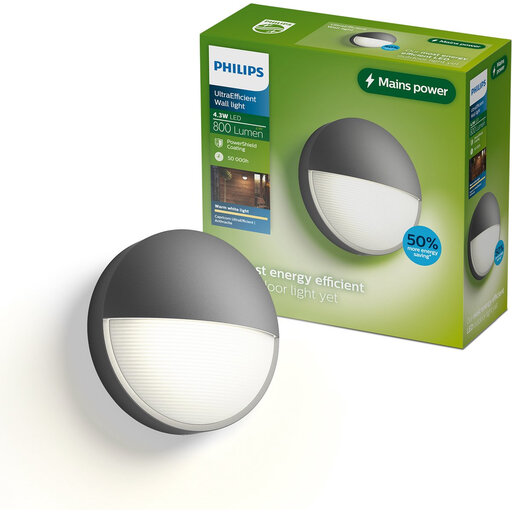
Why it suits this customer profile: This fixed outdoor wall light is designed for anyone looking for a sleek design, a permanent mains connection and clearly defined light output. The integrated LED delivers 800 lumens at 2700K.
The lamp does not rely on sunlight, but it does require connection to the mains by a qualified electrician. IP44 means protection against splashing water, not unlimited exposure to water jets.
Aluminium housing, integrated LED, 800 lumens and warm white light at 2700K.

Why it suits this customer profile: The three adjustable light heads, 270-degree coverage and sensor with a stated range of 60 feet are designed for larger areas such as a driveway, garage, garden or poolside.
The IP65 rating is more specific than simply saying “waterproof”. However, check that the installation site receives enough sunlight; the stated 3,000 lumens may be unnecessarily bright for a small balcony.
302 LEDs, 3,000 lumens, three lighting modes, solar power and three adjustable heads.
Position a solar outdoor lamp so that the panel receives direct light during the day. Clean the panel and sensor regularly with a soft, damp cloth. With a lamp that has a motion sensor, it helps to align the detection direction with a path or door, so the lamp is not triggered unnecessarily by passing branches or traffic.
For fixed outdoor wall lighting, the wall must be suitable for mounting the lamp. Models running on 230 volts, such as certain E27 and GU10 lamps, must be installed in accordance with local regulations. A lamp supplied without a light source also requires a separate check of the fitting, wattage and colour temperature.
Wireless table lamps and magnetic wall lights are practical choices for a balcony or patio. With IP44 models, however, check that they are positioned in a sheltered spot and are not exposed to direct water jets.
We have put together a complete, up-to-date list of products that fully meet these strict selection criteria and the applicable European safety regulations.
For atmospheric lighting on a patio or balcony, around 180 to 400 lumens may be suitable. A driveway, garage or large garden will require more light. Also consider the beam angle: a wide beam illuminates a larger area without making a single spot excessively bright.
IP44 is suitable for many sheltered outdoor locations, such as a covered entrance, balcony or patio. The code protects against splashing water, but not against immersion or powerful water jets. For a completely exposed location, a higher IP rating may be the more sensible choice.
A solar outdoor lamp does not use electricity from the mains during normal operation. The solar panel charges the integrated battery. Actual operating time depends on sunlight, the season, the panel position, battery capacity and the selected lighting mode.
