
Vandaag of morgen in huis

Kwaliteit gegarandeerd

Welkomstaanbiedingen ontgrendelen: GRATIS bezorging | Tot 80% korting | Gratis 30 dagen JoyPlus-proefperiode
Download de app
Good outdoor lighting needs to do more than look attractive. An outdoor lamp should suit the location, the type of light you want and how you plan to use it. Yet many people choose a model based solely on its design or a claim such as “weatherproof”. This can result in insufficient light, batteries that run out quickly or a lamp that turns out to be unsuitable for the installation location.
Pay particular attention to these three common pitfalls:
Start with the location and purpose. Functional light is more important than ambience alone for an entrance or driveway. An outdoor lamp with a sensor can be useful here, as it only switches on when movement is detected. A softer light colour and a freestanding lamp are more suitable for a patio or balcony.
Common options include:
The IP rating indicates the extent to which a light fitting is protected against dust and moisture. IP44 outdoor lighting is protected against solid objects larger than 1 millimetre and splashing water from different directions. This makes IP44 suitable for many sheltered outdoor locations, such as a façade, balcony or covered area.
However, IP44 does not mean that the lamp is waterproof. Do not place an IP44 outdoor lamp where it could remain underwater for extended periods or be directly hit by a pressure washer. Also check that cables, plugs and connection points are suitable for outdoor use.
Lumens indicate how much light a lamp produces. By comparison, the vidaXL LED outdoor lamp specifies 550 lumens at 9 watts, while the Philips Splay garden post specifies 800 lumens. These are verifiable product specifications, but the right choice depends on the intended use.
Colour temperature is expressed in Kelvin:
According to Philips’ own product information, the Splay and Capricorn models produce light at 2700 K. The Philips Fyns specifies 3000 K. So do not look only at an outdoor lamp’s appearance; also consider its light colour and distribution.
A fixed 230-volt outdoor wall lamp generally requires professional installation. This applies, for example, to models with a GU10 or E27 fitting. Check whether the light source is included. The Philips Fylx is supplied without a GU10 bulb, allowing you to choose the light colour and brightness yourself.
A solar outdoor lamp is easier to install, but the solar panel must be able to receive direct daylight. Shade from a fence, tree or covered area can affect the operating time. With a battery-powered model, it is important to check the battery type, charging method and stated operating time.
Also consider integrated LED. It requires little maintenance, but cannot be replaced on some models. A separate GU10 or E27 bulb offers greater flexibility if you later want to use a different light colour or brightness.
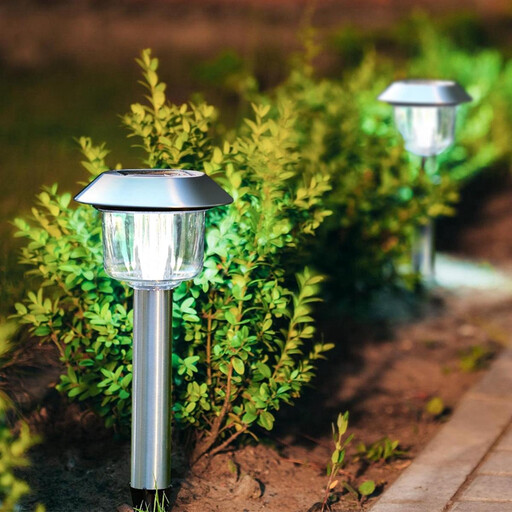
Why it suits this profile: This compact solar outdoor lamp works without fixed wiring and is designed for use in a garden or on a patio. It is 36.6 cm high and has a stainless steel and plastic housing.
There is no need to arrange a power point or an installer. However, place the lamp somewhere with enough daylight, as this has a direct impact on how it works.
Solar-powered, 36.6 cm high and supplied as one lamp with batteries included.

Why it suits this profile: This garden post light is 96 cm high, has an aluminium housing and specifies 800 lumens at 2700 K. This makes it suitable for paths, borders and patios.
The light output and colour temperature are clearly stated. However, the IP44 rating means it should be positioned away from direct water and correctly earthed.
800 lumens, warm white light at 2700 K and an aluminium design with integrated LED.

Why it suits this profile: This solar outdoor wall lamp specifies 1000 lumens, 3000 K and a motion sensor. It is designed for entrances, façades or dark passageways without fixed wiring.
The sensor and two light modes are listed in the product specifications. For reliable operation, the panel must receive direct sunlight and be kept free from dirt.
1000 lumens, motion sensor, two modes and installation without connecting to the mains electricity supply.
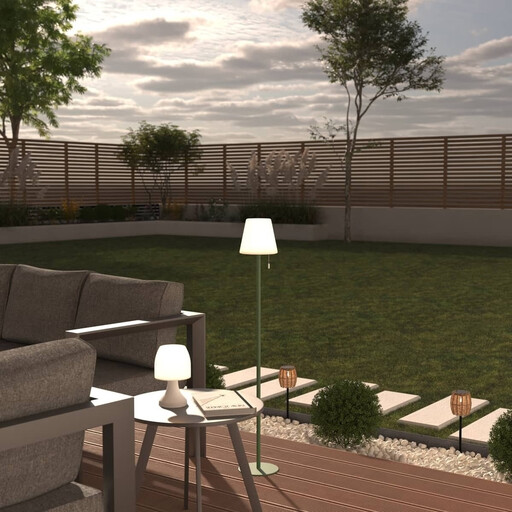
Why it suits this profile: This freestanding cordless outdoor lamp is 108 cm high, runs on batteries and offers multicolour, flame-effect and white light. This makes it easy to move around on a balcony or patio.
You are not dependent on a socket. The stated operating time is up to ten hours, so remember to allow time for charging or replacing the batteries.
Three light modes, IP44 and a portable design with a steel base and plastic shade.
We have put together a complete, up-to-date list of products that fully meet these strict selection criteria and the applicable European safety regulations.
For a sheltered façade, balcony or patio, IP44 may be suitable, provided the lamp is not immersed or exposed to powerful water jets. A higher level of protection may be preferable for a fully open or heavily exposed location. Always follow the manufacturer’s installation instructions.
A solar outdoor lamp does not use electricity from the mains. This means running costs while it is lit are limited, but its performance depends on sunlight, battery capacity and maintaining the panel. In a shady garden, a fixed LED outdoor lamp may be more practical.
Mount the lamp securely on a suitable surface and point the sensor towards the area where movement is expected. Avoid branches, busy roads or places where the sensor could be triggered continually. For a fixed 230V connection, the installation must be carried out by a qualified electrician in accordance with local regulations.
