
Vandaag of morgen in huis

Kwaliteit gegarandeerd

Welkomstaanbiedingen ontgrendelen: GRATIS bezorging | Tot 80% korting | Gratis 30 dagen JoyPlus-proefperiode
Download de app
Choosing new outdoor lighting seems straightforward until you look at the details. A light may look attractive but still be unsuitable for an exposed façade, dark driveway or balcony without direct sunlight. Features such as “weather-resistant”, “energy-efficient” and “long-lasting” are not always explained clearly either.
As a Joybuy Product Recommendation Officer, I filter the most important product specifications from the range. This helps you quickly see which outdoor light, garden light or outdoor wall light suits your situation, and which marketing claims are worth checking.
An IP44 outdoor light is protected against solid objects larger than 1 millimetre and against splashing water from different directions. This does not mean that the light can be submerged or withstand a powerful jet of water. Do not place an IP44 light where rainwater collects or where you clean the façade directly with a pressure washer.
For completely open and heavily exposed locations, a higher IP rating may be more practical. Always check the installation instructions for the specific model.
A solar outdoor light needs sufficient daylight during the day to charge its battery. Beneath a covered area, on a north-facing wall or between tall fences, its output may be lower. In winter and on cloudy days, the operating time may also vary.
A solar-powered outdoor light is particularly useful when you do not want to install a power cable. However, choose the installation location based on the amount of direct sunlight it receives, not just its appearance.
Some lights have an integrated LED light source. With other models, you only buy the fitting and need to add an E27 or GU10 bulb yourself. So check:
A warm colour temperature of around 2700K to 3000K is usually suitable for atmospheric lighting. For functional lighting around a shed, entrance or driveway, a higher light output may be more important.
First, consider the combination of IP rating and location. An outdoor wall light beneath an overhang is exposed to less rain than an outdoor ground spotlight in an open lawn. An IP44 rating is suitable for splashing water, but not for immersion.
Also consider the surface. A ground spotlight must stand securely in the ground and should not create a trip hazard. A wall light should be installed using fixings suitable for brick, concrete or wood. For a permanent 230-volt connection, installation by a qualified electrician is advisable and may sometimes be required according to the product instructions.
Lumens indicate how much light a lamp emits. Wattage mainly indicates electrical consumption and is not directly related to brightness. An LED light can produce sufficient lumens while using relatively few watts.
Examples from the range:
An outdoor light with a motion sensor is practical for a driveway or back door. For a patio where you spend a longer time, constant soft light or dimmability is often more comfortable.
Fixed LED outdoor lighting provides a consistent light output but requires cabling. Solar lighting is more flexible to install but depends on sunlight and battery charge. A light with USB charging offers an additional option when there is little sunlight.
Clean solar panels and fittings regularly with a soft, dry cloth. For fixed lighting, check that cables, connections and seals remain intact. Switch off the power before carrying out maintenance or installation.
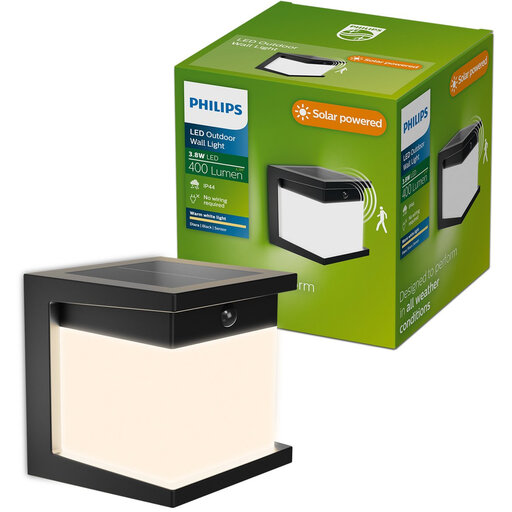
Why it suits this profile: According to the product specifications, this compact solar outdoor light works without permanent wiring and has two light modes, a motion sensor and 400 lumens.
The specifications clearly state that it has an integrated LED, IP44 rating and requires direct sunlight. This makes it easier to determine in advance whether the installation location is suitable.
No mains connection required; warm white light at 2700K; dimensions of approximately 12 × 11 × 12 cm.

Why it suits this profile: This garden post light is designed for paths, patios and borders, combining an aluminium housing with integrated LED lighting.
The product information explicitly states the installation location, IP44 protection and earthing requirement. This helps prevent you from buying a decorative post light without the appropriate electrical preparation.
800 lumens; 2700K warm white light; height of 96 cm; integrated LED.
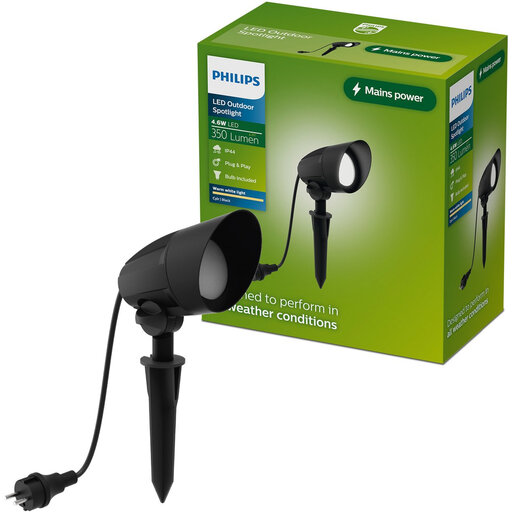
Why it suits this profile: This ground spotlight can be rotated, comes with a GU10 LED bulb and is suitable for illuminating trees, shrubs, a driveway or garden features.
The light specifies a 150 cm cable, connection to 230 volts and IP44 limitation. This means you can allow for a suitable outdoor socket and protection from direct water in advance.
350 lumens; 2700K; rotatable light head; GU10 bulb included.
We have compiled a complete, up-to-date list of products that fully meet these strict selection criteria and the applicable European safety regulations.
For a balcony, a solar wall light, compact garden light or wireless LED outdoor light are practical options. Check that the solar panel receives direct light and that the lamp does not obstruct the space. For a fixed outdoor wall light, secure installation is important. IP44 protection is suitable against splashing water, but do not place the light where rainwater collects.
Consumption depends on the wattage and the number of hours the light is used. A 5-watt light that is switched on for four hours every day uses approximately 7.3 kWh per year. The actual cost depends on your energy tariff. A solar outdoor light does not use mains electricity while operating, but its battery and light output depend on charging conditions.
Lifespan varies depending on the light source, housing, usage and exposure to moisture. With integrated LED models, the product information sometimes states an expected lifespan. With replaceable E27 or GU10 bulbs, you can replace the light source separately. Also check the seals, mounting and connections regularly. According to the product information, the statutory guarantee for the products mentioned is at least two years; additional rights may apply under national legislation.
