
Vandaag of morgen in huis

Kwaliteit gegarandeerd

Welkomstaanbiedingen ontgrendelen: GRATIS bezorging | Tot 80% korting | Gratis 30 dagen JoyPlus-proefperiode
Download de app
Good outdoor lighting for the garden needs to do more than simply look attractive. A light by the front door should provide enough illumination to find the keyhole, while lighting on a patio should mainly create atmosphere. On a balcony or along a garden path, size, installation and power supply also play an important role.
The following three pitfalls are common:
Misinterpreting a high IP rating
IP44 outdoor lighting is protected against splashing water and solid objects of a certain size. This does not mean that the light is waterproof or suitable for a location regularly exposed to a powerful jet of water.
Overestimating a sensor or solar panel
An outdoor light with a sensor does not always switch on at exactly the desired distance or for the desired length of time. With a solar outdoor light, performance also depends on the amount of daylight, positioning and the season. Always check which functions and technical specifications are actually stated.
Forgetting the fitting and installation costs
An LED outdoor light with an integrated light source is ready to use straight away, but the light source may not always be replaceable. With an outdoor wall light featuring an E27 or GU10 fitting, you still need to purchase a suitable bulb. Wired models generally need to be connected by a qualified electrician.
IP44 means in practice that the light fitting is protected against splashing water from different directions. This makes the classification suitable for many façades, entrances, balconies and sheltered patios. However, do not install an IP44 light in a location exposed to direct jets of water or prolonged extreme weather.
Also pay attention to the installation position. A wall light beneath an overhang is exposed to less rain than a fitting on a completely open façade. Check too that the wall is sturdy enough and that the supplied or required fixings are suitable for brick, concrete or another surface.
An E27 fitting accommodates various standard bulbs. This means you can choose warm white light or a dimmable LED bulb, for example. A GU10 fitting is designed for a spotlight and generally provides more focused light downwards.
An integrated LED has the advantage that you do not need to buy a separate bulb. However, check the light output in lumens, power consumption in watts and colour temperature in kelvin. Warm white light around 2700 K often suits an entrance or patio. For example, Philips Capricorn specifies 800 lumens, 4.3 watts and 2700 K. According to the product information, the LED light source is not replaceable.
A motion sensor can be useful by a front door, shed or garden path. Check whether the sensor is part of the light fitting and whether the light runs on mains electricity or an integrated battery. The Brilliant Todd has an E27 fitting, a motion sensor and a maximum load of 60 watts. The light source is not included.
The Brilliant Parson combines an integrated LED with a solar panel, battery and motion sensor. The stated light output is 180 lumens, the light colour is 2700 K and power consumption is 2 watts. Install a solar outdoor light in a location where the panel can receive sufficient daylight. Shade from a wall, tree or shelter can affect its operating time.
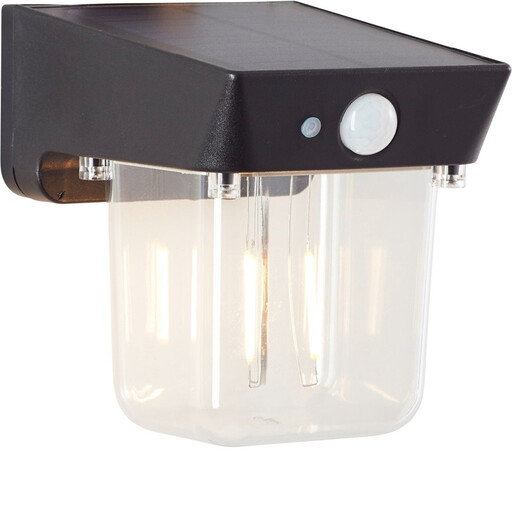
Why it suits this profile: This black outdoor light runs on solar power and does not require a fixed mains connection. That can be useful for tenants, on a balcony or in a location where running cables is difficult.
The product information clearly states the integrated battery, 180 lumens and IP44 classification. This makes the key limitations and features clear in advance.
Integrated LED, solar panel, motion sensor, 2700 K warm white light and a compact size of 11.5 × 10 × 11 cm.
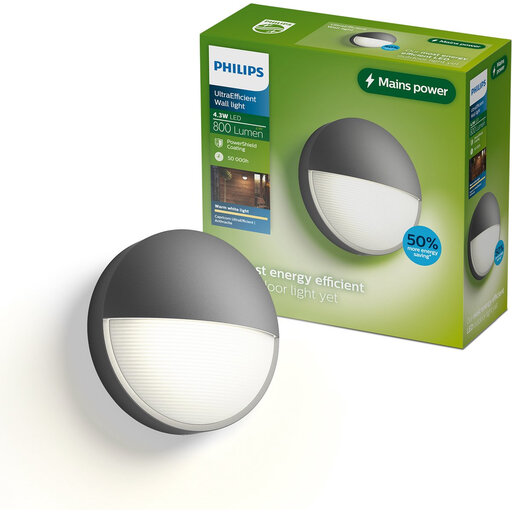
Why it suits this profile: For a fixed entrance, façade or patio, this aluminium light fitting offers an integrated LED solution with a clearly stated light output and warm colour temperature.
The specifications state both IP44 and 800 lumens at 2700 K. You therefore do not have to rely solely on the appearance or brand name.
Aluminium housing, integrated LED, 800 lumens, 4.3 watts and warm white light at 2700 K.
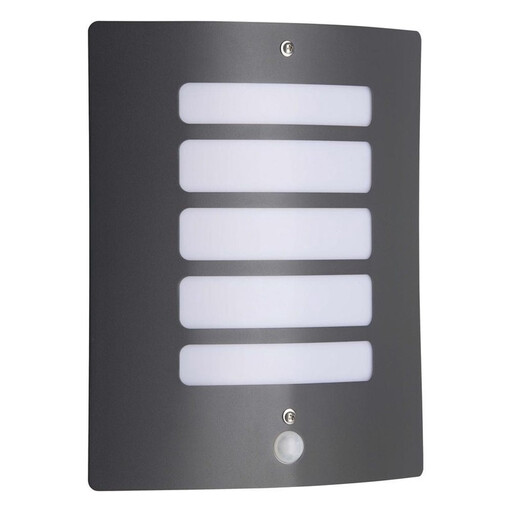
Why it suits this profile: This outdoor wall light is designed for an entrance, façade or side path where automatic activation is more important than an integrated light source.
The E27 fitting makes the light source replaceable. The sensor function is listed separately, and the maximum load of 60 watts avoids any uncertainty about compatible bulbs.
Motion sensor, E27 fitting, anthracite colour, IP44 and downward light distribution.
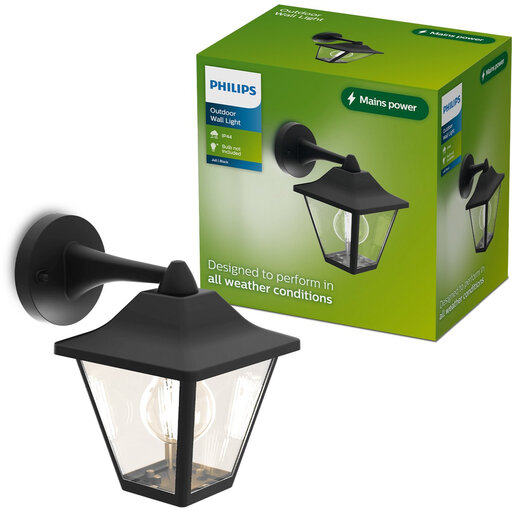
Why it suits this profile: The lantern shape complements homes with a traditional façade, veranda or entrance. The E27 fitting allows you to choose your own LED bulb and light colour.
The light is supplied without a light source. This is clear from the outset, so you can choose a suitable E27 LED bulb instead of using an incompatible light source.
Black aluminium housing, E27 fitting, IP44 and dimensions of 15 × 21.7 × 22.2 cm.
We have put together a complete, up-to-date list of products that fully meet these strict selection criteria and the applicable European safety regulations.
Fixed outdoor lighting running at 230 volts must be connected by a qualified electrician. Switch off the electricity at the consumer unit before carrying out any work on wiring or maintenance. Use fixings suitable for the wall and prevent cable connections from being exposed to water for prolonged periods.
Clean an outdoor light with a soft, dry cloth. Do not use abrasive products. With a solar outdoor light, it is also advisable to keep the panel clear of leaves and dirt. For each model, check whether the light source is replaceable and whether the fitting is suitable for an exposed or sheltered location.
IP44 is suitable for many sheltered façades, entrances, balconies and patios. The classification protects against splashing water, but not against direct jets of water or immersion. You should therefore also consider the exact installation location.
An LED outdoor light generally uses fewer watts than traditional light sources for a similar light output. Compare the stated wattage and number of operating hours. A light with a sensor can limit the number of hours it is switched on, while a solar outdoor light does not need direct mains electricity while in use.
An outdoor light with a sensor is practical when you only need illumination when movement is detected. For fixed, atmospheric lighting, you can choose a wall light with an E27 or GU10 fitting. Pay attention to the light distribution, IP44 classification, installation method and whether a light source is included.
