
Vandaag of morgen in huis

Kwaliteit gegarandeerd

Welkomstaanbiedingen ontgrendelen: GRATIS bezorging | Tot 80% korting | Gratis 30 dagen JoyPlus-proefperiode
Download de app
The right outdoor lighting makes your entrance easier to see, creates a welcoming atmosphere on your patio and helps you find your way to the shed or driveway. But a good-looking product photo isn’t enough to make the right choice. Many disappointing purchases happen because shoppers focus only on design, lumens or a low price.
The main pitfalls:
IP44 is a common protection rating for many covered entrances, balconies and sheltered exterior walls. The first 4 indicates protection against solid objects larger than 1 millimetre. The second 4 means protection against splashing water from different directions.
This makes an IP44 outdoor light suitable for many typical outdoor uses, but not necessarily for a spot where it will be sprayed directly with water. Install an outdoor wall light according to the manufacturer’s instructions, and make sure water doesn’t collect around the bulb holder or seal.
Consider the material too. Metal and aluminium can give a sturdy feel, while plastic is often lighter. A black outdoor light suits many exterior walls, but dust, limescale marks and grime can show up more quickly on a dark finish.
A fitting with an E27 bulb holder takes a standard replaceable bulb. You can then choose warm white light, a brighter bulb or a dimmable LED bulb. Always check the fitting’s maximum wattage. The Brilliant Newport and Brilliant Todd, for example, each take one E27 bulb of up to 60 watts and are supplied without a light source.
A GU10 bulb holder is often designed for a compact spotlight. This lets you direct the light more precisely at a door, part of an exterior wall or a path. According to the product information, the Philips Fylx is supplied without a GU10 spotlight bulb. When buying, check the bulb holder, light colour, brightness and whether it’s compatible with a dimmer.
With integrated LED outdoor lighting, the light source is already built into the fitting. That saves you having to choose a separate bulb, but the LED module isn’t replaceable on some models. Also check the lumen output: 180 lumens is mainly suitable for accent or entrance lighting, while 1000 lumens gives a much brighter light for security purposes.
A wired outdoor light needs a fixed connection and, if you’re unsure, should be installed by a qualified electrician. This applies to various outdoor wall lights from Brilliant and Philips. Switch off the power at the consumer unit before any electrical work is carried out.
A solar outdoor light is easier to install because it doesn’t need a cable to the mains. Make sure you position the solar panel somewhere that gets as much direct daylight as possible. In a shady Dutch garden, the battery may not charge as fully. According to Philips’ own product information, the Fyns and Swyn have a motion sensor and different light modes. Actual run time will still depend on conditions such as sunlight and temperature.
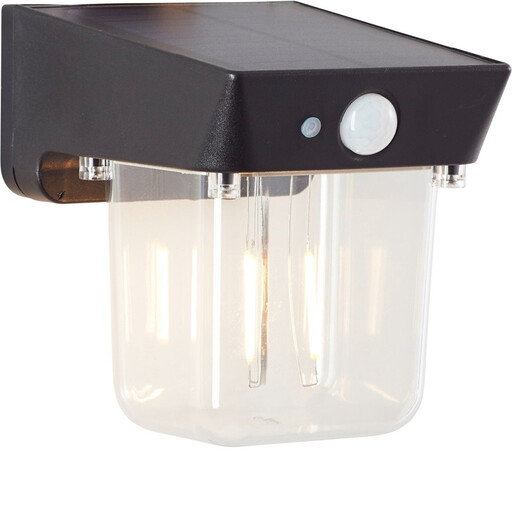
Why it suits this type of shopper: This compact solar wall light doesn’t need a fixed power connection and combines integrated LED lighting with a motion sensor. It’s a practical choice for a balcony, shed or entrance where wiring would be difficult.
The specifications clearly state that it’s solar-powered, has a motion sensor and an IP44 rating, and comes with an integrated light source. So there’s no need to order a separate E27 or GU10 bulb.
180 lumens, warm 2700 K light, an integrated battery and a compact height of 11.5 cm.
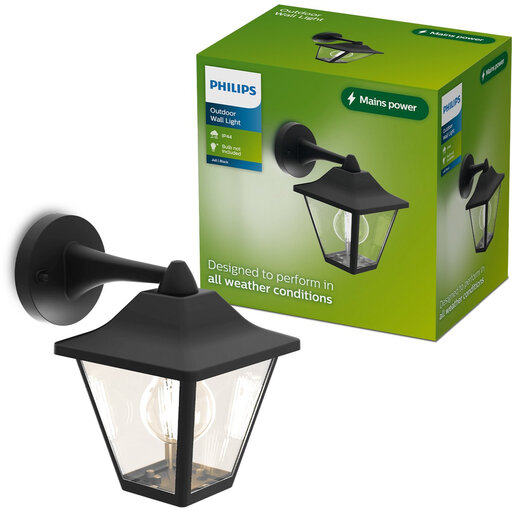
Why it suits this type of shopper: Its classic design works well by an entrance, veranda or exterior wall where appearance and a replaceable light source are important.
The E27 bulb holder is specified, and the light is supplied without a bulb. This means you can choose a suitable LED bulb in advance rather than ending up with an unsuitable one included in the box.
IP44 rating, black aluminium housing, E27 bulb holder and dimensions of approximately 15 × 21.7 × 22.2 cm.

Why it suits this type of shopper: By a driveway, back path or dark exterior wall, a brighter light can be more useful than simple mood lighting.
The product details list 1000 lumens, an IP44 rating, a dusk sensor and a motion sensor. For an effective charging cycle, it still needs to be positioned in direct sunlight.
1000 lumens, 3000 K, integrated LED, two light modes and a 3-metre cable for flexible installation.
IP44 is suitable for many sheltered or normally exposed locations. The light is splash-resistant, but isn’t designed to withstand direct jets of water or immersion. Always follow the installation instructions and check that the seal is fitted correctly.
A solar outdoor light runs on energy stored in its built-in battery, which charges from the solar panel during the day. It doesn’t need to be connected to the mains. Its output depends on sunlight, the season, temperature and shade. Also check whether the battery is replaceable: on several models, the light source or battery isn’t designed to be replaced by the user.
This varies by model and sensor range. Mount the light so the sensor can detect the direction people will approach from, and avoid pointing it directly at a busy road or moving branches. For a wired outdoor light, have the electrical connection installed in accordance with local regulations. A sensor light is best for practical exterior lighting; a fixed, dimmable light may be more comfortable on a patio.
We’ve put together a complete, up-to-date list of products that meet these strict selection criteria and comply with current European safety regulations.
