
Vandaag of morgen in huis

Kwaliteit gegarandeerd

Welkomstaanbiedingen ontgrendelen: GRATIS bezorging | Tot 80% korting | Gratis 30 dagen JoyPlus-proefperiode
Download de app
Good outdoor lighting should suit the location, purpose and way you intend to use the lamp. A lamp for atmospheric garden lighting needs different features from an outdoor light with a motion sensor by the front door. Yet many models look very similar at first glance.
The most common purchasing mistakes stem from three misconceptions:
Before choosing a product, consider what you want the lamp to do.
Also consider the colour temperature. 2700K looks warm and soft. 3000K also produces warm white light, but may appear slightly brighter. Higher colour temperatures, such as 5000K, are cooler and more functional.
The IP code consists of two digits. The first refers to protection against solid particles, while the second indicates protection against water.
An IP rating does not automatically make a lamp suitable for every situation. Do not place an IP44 outdoor light somewhere where water constantly collects on it. Always follow the installation instructions.
Wattage mainly indicates energy consumption. To determine the amount of light, look at lumens.
More lumens are not always more practical. Also consider the direction of the beam, the mounting height and the distance between multiple lamps.
Solar outdoor lighting does not require a fixed mains connection. However, the lamp must receive enough direct sunlight. Clean the solar panel regularly and bear in mind that operating times vary throughout the year.
With LED outdoor lighting with an integrated LED, you do not need to replace a bulb. However, check whether the light source can be replaced. With some models, the entire fitting must be replaced when the LED reaches the end of its life.
A fitting with an E27 or GU10 socket offers greater flexibility. You can choose the colour temperature and brightness yourself, then replace the light source later. Always check whether a bulb is included. According to the product information, the Philips Juli and various Philips Fylx models are supplied without a light source.
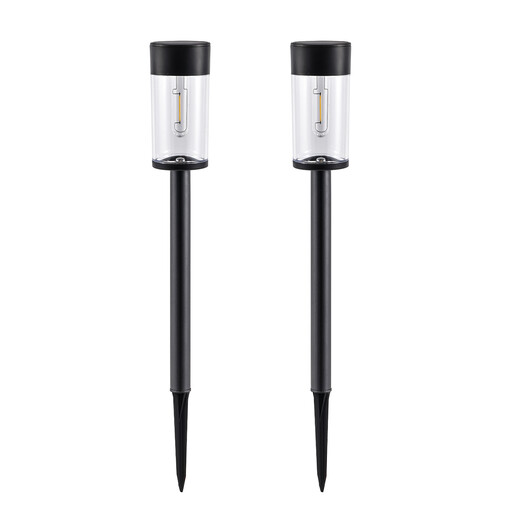
Why it suits this profile: This set is designed for anyone who wants to mark a path, flower bed or driveway without cables. The lights are installed using ground stakes.
The product information states that it has an integrated light sensor, automatic switching on and off, and an IP65 rating. However, make sure you place the panels in a sunny location.
Two lamps per set, 3000K warm white light, automatic operation and a stated operating time of 8 to 12 hours under suitable charging conditions.
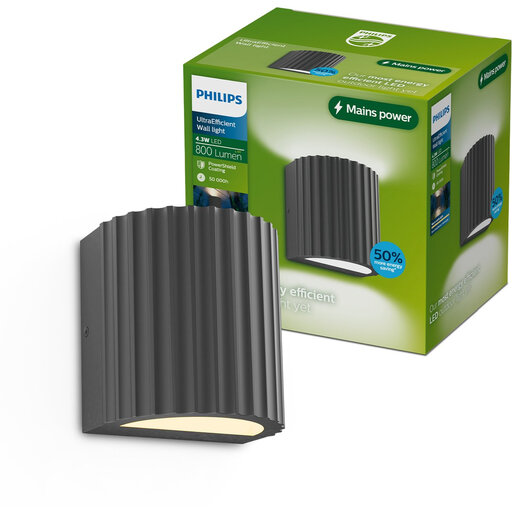
Why it suits this profile: This fixed outdoor light is ideal for an exterior wall, patio or balcony where a sleek look and directed lighting are important.
The specifications state that it requires a 230V connection and has an integrated LED. This means you know in advance that fixed installation is required and that you do not need to buy a separate socket.
800 lumens, 2700K warm white light, two-way light distribution and an aluminium housing, according to the product description.

Why it suits this profile: An option for a large driveway, the side of a garage or a wide exterior wall where plenty of light and motion detection are desired without fixed wiring.
The product information states that it has an IP65 rating, an adjustable head and motion detection. Check beforehand that the location receives enough direct sunlight.
According to the product specifications, 4000 lumens, a sensor range of up to 8 metres when approached directly and up to 16 metres when approached from the side.
We have put together a complete, up-to-date list of products that fully meet these strict selection criteria and the applicable European safety regulations.
Do not place a solar wall light or solar-powered garden light beneath an overhang if this prevents the panel from receiving enough light. For a fixed outdoor light, the connection must be installed by a suitably qualified installer when the fitting is connected to the mains.
Also bear the following points in mind:
It can be, but performance depends on the amount of direct sunlight, the positioning and the condition of the solar panel. During dark or overcast periods, the operating time may be shorter. Choose a location without shade and clean the panel regularly.
An IP44 outdoor light is protected against splashing water and is often suitable for a sheltered exterior wall or balcony. IP65 also provides dust-tight protection and protection against water jets. Neither rating means that the lamp can be used underwater.
For decorative path lighting, a low light output is often sufficient, for example around 10 lumens per lamp. An entrance, driveway or outdoor light with a motion sensor will generally require more light. Do not look at lumens alone; also consider the distance between the lamps and the direction of the light beam.
